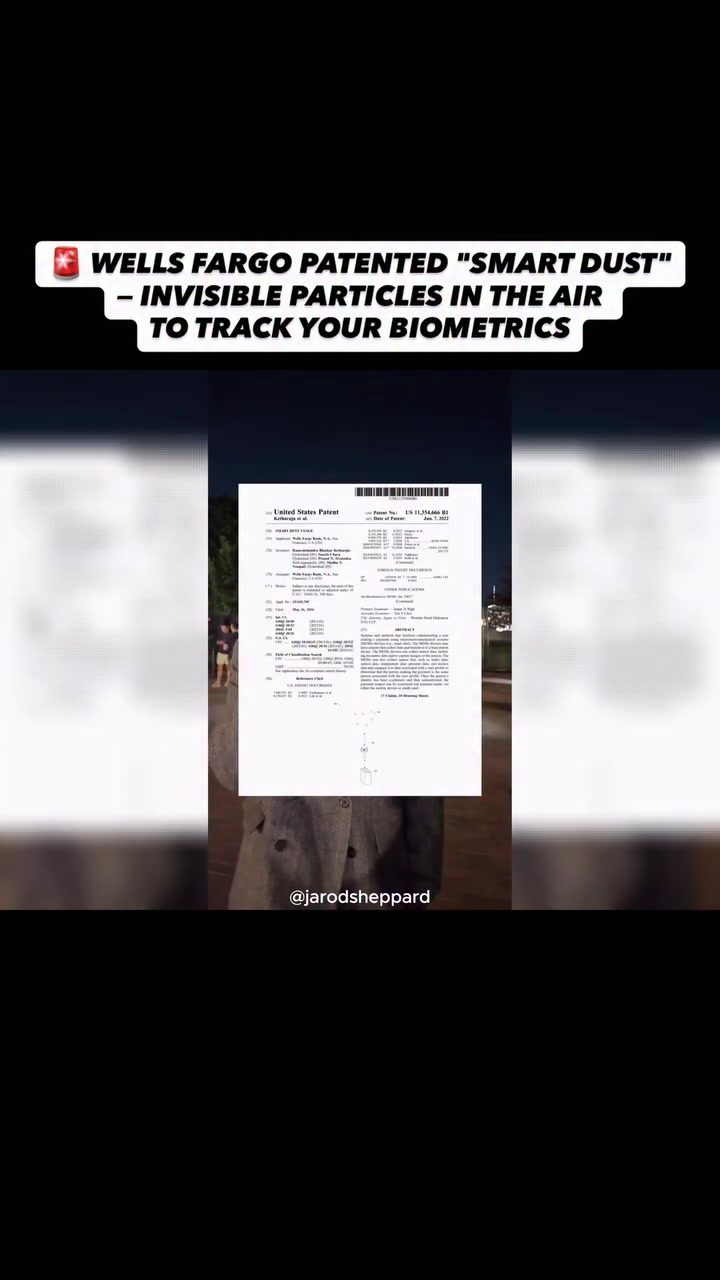
Wells Fargo’s Smart Dust Patent
Wells Fargo has developed a groundbreaking technology known as Smart Dust, a system of invisible sensory particles designed to track biometric data. This patent involves deploying tiny particles in the air that can record various biometric readings, including heart rate, temperature, audio, and facial features. These readings are then used to authenticate payments without the need for traditional passwords. The implications of this technology are vast, raising questions about privacy, security, and the future of biometric authentication.
Context
In today's digital age, the need for secure and efficient authentication methods is more critical than ever. Traditional passwords can be hacked, forgotten, or stolen, leading to significant security risks. Biometric authentication offers a more secure alternative by using unique physical characteristics to verify identity. Smart Dust takes this concept a step further by leveraging invisible particles to continuously monitor and authenticate users.
The origins of Smart Dust trace back to research funded by the Defense Advanced Research Projects Agency (DARPA) in the late 1990s. Initially, the goal was to develop tiny wireless sensors for military applications, specifically to infiltrate enemy personnel and systems. This technology was not originally intended for banking, demonstrating the versatility and broad potential of such innovations.
Main discussion
The Technology Behind Smart Dust
The core of the Smart Dust technology lies in its ability to deploy invisible sensory particles that can track biometric data. These particles are so small that they are undetectable to the human eye, making them ideal for covert surveillance and monitoring.
The technology works by recording a variety of biometric data points, including:
- Heart rate: Monitors the user's heart rate to ensure authenticity.
- Temperature: Measures body temperature to detect any anomalies.
- Audio: Captures audio signals to verify the user's voice and environment.
- Facial features: Analyzes facial features for identification purposes.
The collected data is then used to verify payments and other transactions, eliminating the need for traditional passwords. This not only enhances security but also provides a seamless user experience.
The Broader Implications
The potential implications of Smart Dust extend far beyond banking. The technology could be used in various industries, including healthcare, security, and even personal devices. Imagine a world where your body itself becomes your authentication token, allowing you to access your devices, homes, and vehicles with a simple touch. This level of integration and convenience could revolutionize how we interact with technology.
Ingestible Chips and Future Applications
The discussion around Smart Dust also touches on the concept of ingestible chips, which take biometric authentication to an entirely new level. These chips, developed by companies like Proteus, contain a small sensor and a switch that powers up when ingested. The acids in the stomach act as an electrolyte, creating an 18-bit ECG-like signal that turns the user's entire body into an authentication token.
This technology has already been cleared by the FDA and CE stamped, making it available for medical applications. The potential for this technology in everyday life is immense. Imagine being able to authenticate yourself simply by touching your phone, computer, or car door. This level of integration could provide unparalleled security and convenience, making traditional authentication methods obsolete.
Privacy and Ethical Considerations
While the benefits of Smart Dust and ingestible chips are clear, there are also significant privacy and ethical considerations to be addressed. The continuous monitoring of biometric data raises concerns about privacy and potential misuse. Who has access to this data? How is it stored and protected? These are critical questions that need to be addressed as the technology advances.
Additionally, the potential for misuse by malicious actors is a real concern. The ability to track and authenticate users without their knowledge raises significant ethical questions. It is essential to develop strict regulations and safeguards to ensure that this technology is used responsibly and ethically.
Practical Tips
For those interested in the potential of Smart Dust and ingestible chips, there are several practical steps to consider:
- Stay Informed: Keep up-to-date with the latest developments in biometric authentication and related technologies. Understanding the capabilities and limitations of these technologies is crucial for making informed decisions.
- Evaluate Security Measures: Ensure that any biometric authentication systems you use have robust security measures in place. This includes encryption, secure data storage, and strict access controls.
- Advocate for Regulation: Engage with policymakers and industry leaders to advocate for regulations that protect privacy and ensure ethical use of biometric data. Your voice can help shape the future of this technology.
Important Takeaways
- Smart Dust and ingestible chips represent a significant advancement in biometric authentication, offering enhanced security and convenience.
- The technology has broad applications across various industries, including banking, healthcare, and personal devices.
- Privacy and ethical considerations are crucial as the technology advances, requiring robust regulations and safeguards.
- Staying informed and advocating for responsible use can help ensure that these technologies are used for the benefit of society.
Conclusion
Wells Fargo's Smart Dust patent represents a groundbreaking development in biometric authentication, with the potential to revolutionize how we secure and access our digital and physical environments. The technology's origins in military research highlight its versatility and broad potential. However, it is essential to address the privacy and ethical considerations that come with such advancements. By staying informed, evaluating security measures, and advocating for regulation, we can ensure that this technology is used responsibly and ethically, paving the way for a more secure and convenient future.
Questions readers ask
What is Wells Fargo's Smart Dust and how does it work?
Smart Dust is a cutting-edge technology created by Wells Fargo consisting of microscopic, invisible sensory particles. These particles are designed to float in the air and record various biometric data, such as heart rate, temperature, and facial features. The collected data is then utilized to authenticate payments securely, eliminating the need for traditional passwords.
How does Smart Dust enhance security compared to traditional passwords?
Smart Dust enhances security by using unique biometric data that is difficult to replicate or steal, unlike traditional passwords. By tracking vital information like heart rate and facial features, the technology ensures that only authorized individuals can authenticate payments, significantly reducing the risk of fraud and identity theft.
What types of biometric data can Smart Dust track?
Wells Fargo's Smart Dust can track a variety of biometric data, including heart rate, body temperature, audio signals, and facial features. This comprehensive data collection allows for robust and accurate authentication, making it a reliable method for securing payments and access to sensitive information.
Is Smart Dust technology similar to DARPA's Smart Dust?
Wells Fargo’s Smart Dust shares the concept of using microscopic sensors but has a more targeted approach. While DARPA’s Smart Dust was focused on environmental sensing, Wells Fargo's technology is designed specifically for biometric data tracking to enhance authentication processes. Both technologies utilize tiny, invisible particles for data collection.
How does Smart Dust ensure privacy while tracking biometric data?
Privacy is a significant concern with any biometric tracking technology. Wells Fargo's Smart Dust is designed to minimize privacy risks by using invisible particles and encrypting the data collected. The technology ensures that personal information remains secure and is only used for authentication purposes, reducing the chances of data breaches or misuse.
What are the potential applications of Smart Dust beyond payment authentication?
Beyond payment authentication, Smart Dust has the potential to be applied in various fields such as healthcare monitoring, where it can track vital signs of patients, and home security, where it can authenticate users without the need for keys or passwords. The technology’s versatility makes it a promising solution for enhancing security and convenience in multiple areas of daily life.
What are the implications of Smart Dust on the future of authentication methods?
The development of Smart Dust signifies a shift towards more secure and convenient authentication methods. By leveraging biometric data, this technology can make traditional passwords obsolete, reducing the risks associated with forgotten or stolen passwords. This advancement paves the way for a future where authentication is seamless, secure, and based on unique biological characteristics.
Related deep dives
Similar reads based on topic and creator.




Recent articles
Fresh deep dives from the latest Reels we unpacked.




Comments
Be the first to comment.