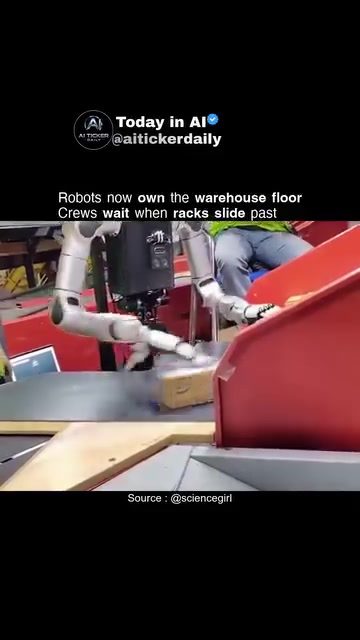
Warehouse automation is transforming the logistics industry, increasing efficiency and reducing manual labor. This shift is most evident in the integration of mobile robots, shuttles, and automated racking systems that move independently while human workers supervise exceptions.
Context / Why this matters
The evolution of warehouse operations is driven by the need for faster, more accurate, and cost-effective logistics. Traditional methods, which rely heavily on manual labor, are being replaced by automated systems that can handle a wide range of tasks with greater precision and speed. The widespread adoption of mobile robots, shuttles, and automated racking systems is a testament to this transformation.
Main discussion
The Role of Mobile Robots and Shuttles
Mobile robots and shuttles are at the forefront of this automation wave. These devices can navigate warehouse floors, pick up items, and move them to their designated locations with minimal human intervention. This not only speeds up the process but also reduces the risk of errors and injuries associated with manual handling.
The integration of these robots is a significant step toward a fully automated warehouse. Unlike traditional methods, where workers push carts along rows of shelves, these robots are software-scheduled, meaning they move based on pre-programmed routes and tasks. This level of automation ensures that goods are moved efficiently, minimizing downtime and maximizing productivity.
Automated Racking Systems
Automated racking systems complement the use of mobile robots and shuttles. These systems consist of dense racks that move on their own, enabling better use of warehouse space and quicker access to stored items. The automated nature of these systems allows for dynamic storage solutions, where items can be rearranged based on demand and inventory levels.
The combination of automated racking systems and mobile robots creates a seamless workflow. Robots can quickly locate items on moving racks, pick them up, and transport them to the appropriate area. This level of coordination is crucial for maintaining a high level of efficiency in a modern warehouse.
The Human Factor
While automation is central to this transformation, the role of human workers remains essential. Human supervisors oversee the exceptions and handle tasks that require decision-making and problem-solving. This balance between automation and human oversight ensures that the warehouse operates smoothly, even in the face of unexpected challenges.
The transition to a more automated warehouse also creates new opportunities for workers. Rather than performing repetitive tasks, human workers can focus on more strategic roles, such as quality control, maintenance, and optimization of automated systems. This shift not only improves job satisfaction but also enhances the overall efficiency of the warehouse.
The Transition to Automated Warehouses
The shift from manual to automated warehouses is not a sudden change but a gradual transition. Many warehouses are already implementing automated systems in phases, gradually integrating more advanced technologies as they become available. This approach allows for a smoother transition, enabling companies to adapt to new technologies without disruptive changes to their operations.
The transition to automation also involves significant investments in technology and training. Companies must invest in advanced robotic systems, automation software, and training programs for their employees. However, the long-term benefits, in terms of increased efficiency, reduced costs, and improved accuracy, often outweigh the initial investments.
The Future of Warehouse Automation
The future of warehouse automation holds even more promise. As technology continues to evolve, we can expect to see more sophisticated automated systems that offer even greater levels of efficiency and accuracy. This includes advancements in artificial intelligence, machine learning, and robotics, which will enable warehouses to operate with minimal human intervention.
However, the future of warehouse automation is not just about technology. It also involves a cultural shift within the logistics industry. Companies must embrace a mindset of continuous improvement, where they are always looking for new ways to enhance their operations and stay ahead of the competition.
Practical tips
-
Assess Your Current Setup: Evaluate your current warehouse operations and identify areas where automation can provide the most significant benefits. Look for repetitive tasks that can be easily automated, such as picking and packing.
-
Start Small: Begin with small-scale automation projects, such as implementing a few automated racking systems or mobile robots. This allows you to test the waters and make adjustments as needed before committing to a full-scale automation overhaul.
-
Invest in Training: Ensure that your employees are well-trained in using and maintaining the new automated systems. This not only improves the effectiveness of the automation but also helps employees feel more comfortable with the changes.
-
Monitor and Optimize: Continuously monitor the performance of your automated systems and make necessary adjustments. Use data and analytics to optimize your operations and identify areas for improvement.
-
Stay Updated: Keep up with the latest advancements in warehouse automation technology. Attend industry conferences, read trade journals, and engage with experts to stay informed about the latest innovations and best practices.
Important takeaways
Warehouse automation is rapidly becoming the norm in the logistics industry. Mobile robots, shuttles, and automated racking systems are transforming traditional warehouses into highly efficient, automated environments. While this transition involves significant investments and changes, the long-term benefits in terms of increased efficiency, reduced costs, and improved accuracy are substantial.
The success of warehouse automation relies on a balance between technology and human oversight. While automation handles repetitive tasks, human workers play a crucial role in supervision, decision-making, and problem-solving. This balance ensures that warehouses operate smoothly and effectively, even in the face of unexpected challenges.
Conclusion
The future of warehouse operations lies in automation. By embracing mobile robots, shuttles, and automated racking systems, companies can achieve unprecedented levels of efficiency and accuracy. As technology continues to evolve, the possibilities for warehouse automation are limitless. The key is to stay informed, adapt to changes, and continually optimize operations to stay ahead in the competitive logistics industry.
Questions readers ask
What are the primary benefits of using robotic arms in warehouses?
Robotic arms in warehouses increase efficiency by handling items quickly and precisely. They reduce human error, optimize warehouse space, and enable dense storage solutions. Additionally, they can operate continuously, minimizing downtime and enhancing overall productivity.
How do mobile shuttles enhance logistics in warehouse settings?
Mobile shuttles in logistics improve the flow of goods by navigating warehouses independently, retrieving, and storing items efficiently. They work alongside automated racking systems to optimize space and reduce the need for manual intervention, thus streamlining operations and cutting costs.
What is the role of automated racking systems in warehouse automation?
Automated racking systems play a crucial role in warehouse automation by moving goods in a well-organized manner. These systems work in tandem with mobile shuttles to maximize storage density, ensuring that every inch of warehouse space is efficiently used. They also facilitate quicker access to inventory, enhancing overall operational efficiency.
How does warehouse automation technology improve item handling?
Automated warehouse systems, including robotic arms and mobile shuttles, handle items with high precision and speed, reducing the risk of damage and misplacement. These systems can manage a variety of items, from small packages to large pallets, ensuring smooth and efficient operations throughout the warehouse.
What are the key advantages of using mobile shuttles in logistics?
Mobile shuttles in logistics offer several advantages, including reduced labor costs, increased speed, and improved accuracy in item handling. They work in conjunction with other automated systems to enhance warehouse space optimization, ensuring that inventory is stored and retrieved efficiently.
How do robotic arms contribute to warehouse space optimization?
Robotic arms contribute to warehouse space optimization by enabling dense storage solutions and navigating narrow aisles effectively. They can retrieve and store items in high-density racks, maximizing the use of vertical space, and improving overall storage efficiency, which is especially useful in warehouses with limited floor space.
What is the impact of robotic warehouse navigation on logistics operations?
Robotic warehouse navigation significantly impacts logistics operations by allowing autonomous movement of goods. Robotic arms and mobile shuttles can navigate complex warehouse layouts, reducing the need for manual intervention and minimizing errors. This results in faster, more accurate, and cost-effective logistics operations.
Related deep dives
Similar reads based on topic and creator.




Recent articles
Fresh deep dives from the latest Reels we unpacked.




Comments
Be the first to comment.