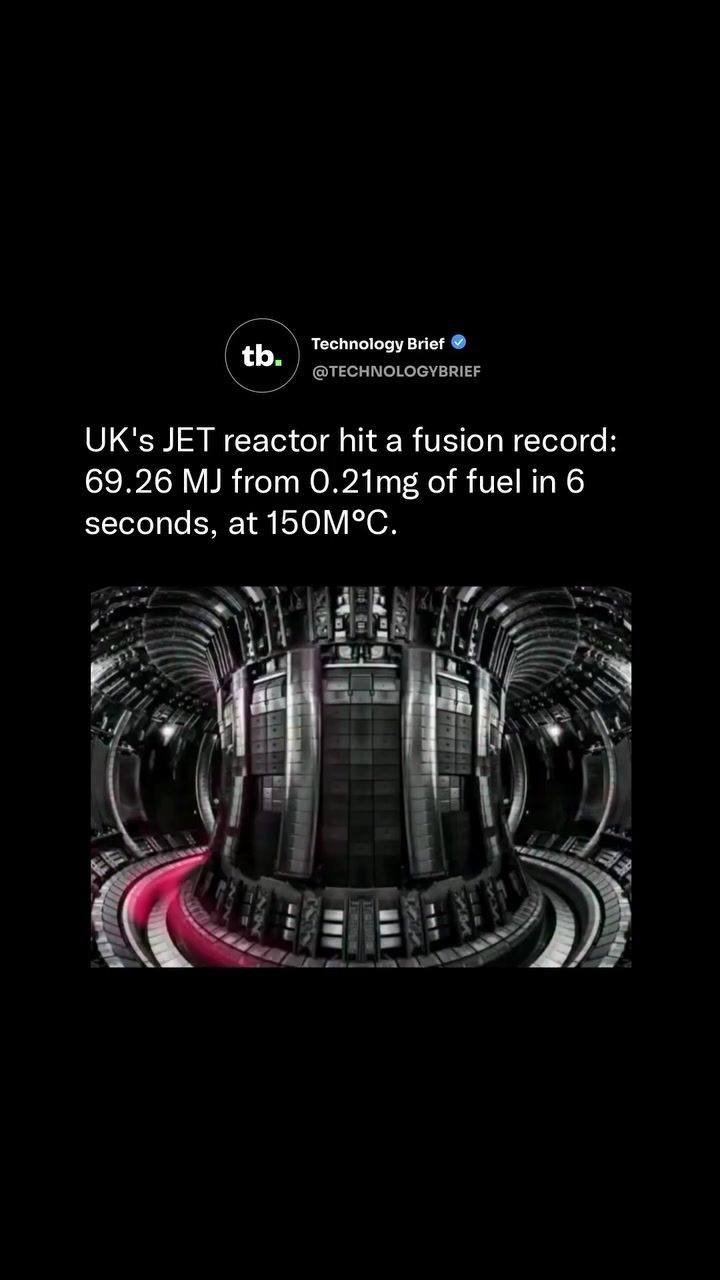
The UK’s Joint European Torus (JET) Reactor: A Milestone in Fusion Energy
The UK’s Joint European Torus (JET) reactor has achieved a significant milestone in the field of fusion energy. In its final experiment before shutting down in December 2023, JET set a new world record for controlled fusion energy. This groundbreaking achievement involved generating an impressive 69.26 megajoules of energy using a mere 0.21 milligrams of deuterium-tritium fuel—two forms of hydrogen—in a burst lasting approximately 5.2 seconds.
Why This Matters
The JET reactor's accomplishment is a pivotal step toward harnessing fusion as a clean, nearly limitless power source. Fusion energy has long been seen as the holy grail of power generation due to its potential to provide vast amounts of energy with minimal environmental impact. Unlike fossil fuels, fusion does not produce greenhouse gases or radioactive waste, making it a highly attractive option for sustainable energy.
Main Discussion
The Technology Behind the Record
The JET reactor's success relies on a complex interplay of physics and engineering. The reactor, shaped like a donut, uses powerful magnetic fields to confine a hot plasma—a cloud of superheated gas. In this experiment, scientists heated the plasma to an astonishing 150 million degrees Celsius, approximately 10 times hotter than the Sun's core. This extreme temperature is necessary because, on Earth, there is no massive gravitational pressure to force atoms together, unlike inside a star.
The Experiment and Its Impact
The experiment not only broke the reactor's previous record of 59 megajoules, set in 2022, but also demonstrated the feasibility of controlled fusion energy. The energy generated during this experiment could theoretically power around 12,000 homes. To put this into perspective, the same amount of energy would require roughly 2 kilograms of coal to produce. Moreover, this achievement highlights the potential of fusion energy to revolutionize the way we power our world.
Historical Context
JET has been operational since 1983 and has played a crucial role in advancing fusion research. Over its 40 years of operation, JET has provided invaluable data that scientists now use to design ITER, a far larger fusion reactor being built in France. ITER aims to build on JET's accomplishments and produce more energy than it consumes, a critical milestone for practical fusion power.
The Donut-Shaped Reactor
JET’s unique donut shape, also known as a tokamak, is essential for confining the plasma. This design uses magnetic fields to create a stable, toroidal (doughnut-shaped) path for the plasma to travel. The magnetic confinement prevents the plasma from touching the reactor walls, which would otherwise cool it down and interrupt the fusion process. This configuration allows for the sustained high temperatures needed for fusion reactions.
The Role of Plasma
Plasma, often referred to as the fourth state of matter, is a highly ionized gas containing free electrons and ions. In the context of fusion reactors, the plasma serves as the medium for nuclear fusion reactions. The high temperatures and pressures within the plasma force atomic nuclei to fuse, releasing a tremendous amount of energy. Controlling this plasma is one of the greatest challenges in fusion research.
Practical Tips
For those interested in fusion energy, it’s essential to understand the basic principles and challenges involved. Here are some practical tips for staying informed and engaged with this exciting field:
Stay Informed
Stay updated with the latest developments in fusion research by following reputable sources. Publications like Technology Brief provide insights into the latest achievements and challenges in the field.
Join the Community
Engage with online communities and forums dedicated to fusion energy. These platforms offer opportunities to connect with experts, ask questions, and stay informed about new breakthroughs.
Support Research
Consider supporting organizations that conduct fusion research. Your contributions can help accelerate the development of fusion technology and bring us closer to a future powered by clean, limitless energy.
Important Takeaways
The JET reactor's record-breaking experiment underscores the potential of fusion energy to revolutionize power generation. Key takeaways from this achievement include:
- Efficiency: The experiment generated an impressive 69.26 megajoules of energy from a tiny amount of fuel, demonstrating the high efficiency of fusion reactions.
- Sustainability: Fusion energy offers a clean and nearly limitless power source, free from the environmental impact of fossil fuels.
- Future Prospects: The data collected from JET's experiments are being used to design ITER, which aims to produce more energy than it consumes, representing a significant step toward practical fusion power.
Conclusion
The UK’s Joint European Torus (JET) reactor has made a monumental stride in the quest for fusion energy. By setting a new world record for controlled fusion energy, JET has demonstrated the potential of fusion to become a sustainable and powerful energy source. As research continues and new reactors like ITER come online, the future of energy looks increasingly bright.
Questions readers ask
What is the significance of the 69.26 megajoules of fusion energy generated by the JET reactor?
The 69.26 megajoules of fusion energy generated by the JET reactor is a world record for controlled fusion energy. This achievement highlights the potential of fusion power as a sustainable and clean energy source, marking a significant step forward in fusion technology.
What fuel was used in the JET reactor's record-breaking experiment?
The JET reactor used a combination of deuterium and tritium, which are both forms of hydrogen, to achieve its record-breaking energy output. Only 0.21 milligrams of this fuel mix was required for the experiment, demonstrating the efficiency of fusion reactions.
How long did the JET reactor's final experiment last?
The final experiment conducted by the JET reactor lasted for approximately 5.2 seconds. During this brief period, the reactor was able to generate a remarkable amount of energy, underscoring the power of fusion reactions.
Why is the JET reactor's achievement considered a milestone in fusion energy?
The JET reactor's achievement is considered a milestone because it demonstrates the feasibility of generating significant amounts of energy through controlled fusion reactions. This breakthrough brings us closer to utilizing fusion as a practical and environmentally friendly power source.
What are the benefits of fusion energy as highlighted by the JET reactor's success?
The success of the JET reactor underscores several benefits of fusion energy, including its potential to provide nearly limitless power, its minimal environmental impact, and its reliance on abundant fuel sources like hydrogen. These factors make fusion an attractive option for future energy needs.
What does the shutdown of the JET reactor in December 2023 signify for fusion research?
The shutdown of the JET reactor marks the end of its operational phase but not the end of fusion research. The data and insights gained from its experiments will inform future projects, such as the International Thermonuclear Experimental Reactor (ITER), which aims to build on JET's achievements and further advance fusion technology.
Related deep dives
Similar reads based on topic and creator.




Recent articles
Fresh deep dives from the latest Reels we unpacked.




Comments
Be the first to comment.