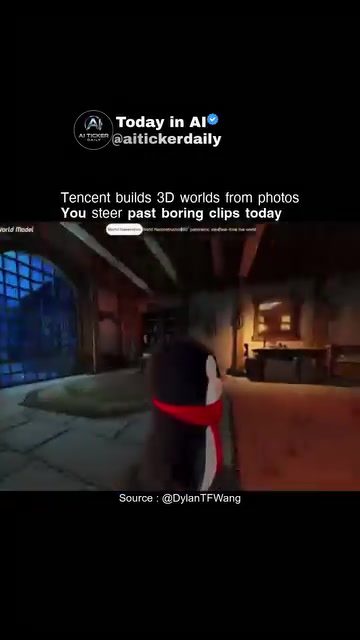
AI-Driven 3D World Generation from Photos
AI-driven 3D world generation is revolutionizing the way we interact with digital environments. Companies like Tencent are leveraging advanced AI models to create immersive, navigable 3D worlds from simple photographs. This technology goes beyond just improving video quality; it enables users to engage with and customize their surroundings, setting the stage for a new era of interactive digital experiences.
Why This Matters
The rise of navigable 3D worlds marks a significant shift from passive media consumption. While traditional video content is watched in a static, linear manner, 3D worlds offer a dynamic, interactive experience. Users can steer their journey through these environments, explore different perspectives, and even modify the world to suit their preferences. This level of interactivity is not just a novelty; it opens up new possibilities for entertainment, education, and professional applications.
Main Discussion
The Technology Behind 3D World Generation
At the heart of this innovation is AI Ticker's use of AI models to translate 2D photographs into detailed 3D environments. The process involves sophisticated algorithms that analyze the content of a photo and reconstruct it in three dimensions. This technology allows for a high degree of visual fidelity, capturing intricate details such as textures, lighting, and spatial relationships.
Customization and Interactivity
One of the standout features of AI-generated 3D worlds is the ability to customize and interact with the environment. Users can steer their perspective through the world, choosing where to look and what to explore. This level of control is achieved through advanced AI algorithms that enable real-time adjustments and user inputs. For instance, users can navigate through a cozy interior with a fireplace and bookshelves, adjusting the lighting or rearranging furniture to their liking.
Applications and Use Cases
The potential applications of AI-generated 3D worlds are vast. In entertainment, these worlds can be used to create immersive gaming experiences, interactive storytelling, and virtual reality environments. In education, they can provide students with engaging, hands-on learning experiences. Professionally, architects and designers can use these tools to create detailed, walk-through models of their projects.
Practical Tips
- Start with High-Quality Photos: The quality of the 3D world generated is directly related to the quality of the input photos. Use high-resolution images with clear details to ensure the best results.
- Experimentation: Don't be afraid to experiment with different photos and settings. The ability to steer and customize the environment allows for a high degree of creativity and exploration.
- Explore the Environment: Take advantage of the 360-degree view and interactive features. Move around, change perspectives, and adjust elements to get a full sense of the environment.
- Utilize Community Resources: Engage with communities and forums focused on AI-generated 3D worlds. Share your creations, ask questions, and learn from others' experiences.
Important Takeaways
- Interactivity is Key: The ability to steer and customize 3D worlds sets this technology apart from traditional media. It offers a more engaging and personalized experience.
- High-Quality Inputs Matter: The fidelity of the 3D world depends on the quality of the input photos. High-resolution images with clear details yield the best results.
- Versatile Applications: AI-generated 3D worlds have applications across various fields, from entertainment and education to professional design and architecture.
- Community Engagement: Engage with communities focused on this technology to enhance your understanding and creativity.
Conclusion
AI-driven 3D world generation from photographs is more than just a technological achievement; it represents a new frontier in digital interaction. By leveraging advanced AI models, companies like Tencent are creating immersive, navigable 3D environments that offer unparalleled levels of interactivity and customization. As this technology continues to evolve, the possibilities for its application are virtually limitless. Whether you're exploring a cozy interior, designing a new building, or creating an interactive learning environment, AI-generated 3D worlds offer a new way to engage with the digital realm.
Questions readers ask
How does Tencent's AI technology convert photos into 3D worlds?
Tencent's AI uses advanced models to analyze and interpret the depth, texture, and context of photos. It then generates a 3D environment, allowing users to navigate and interact with the digital space as if they were physically present.
What makes Tencent's 3D worlds different from traditional video content?
Unlike traditional videos, Tencent's 3D worlds are immersive and interactive. Users can explore these environments from multiple angles, move through them freely, and even customize elements, providing a dynamic and engaging experience.
Can users modify the 3D worlds created from their photos?
Yes, one of the key features of Tencent's 3D technology is its customizability. Users can alter various aspects of the generated 3D world, allowing for a personalized and unique interactive experience.
What are the potential uses of AI-driven 3D world generation from photos?
This technology can be applied in various fields, including gaming, virtual tourism, real estate, and remote work. It enables users to create and explore realistic, interactive 3D environments from simple photographs, enhancing user engagement and satisfaction.
How does navigating a 3D world differ from watching a video?
Navigating a 3D world allows users to control their perspective and movement, unlike the linear, passive experience of watching a video. This interactive approach encourages user engagement and immersion, making it a more dynamic form of digital interaction.
What kind of photos work best for creating 3D worlds with Tencent's AI?
High-quality photos with clear details and depth information tend to work best. The more distinct features and textures a photo has, the more accurate and immersive the resulting 3D world will be.
Is any special equipment required to navigate these 3D worlds?
No, special equipment is generally not required. Most 3D worlds can be navigated using standard input devices like a keyboard, mouse, or touchscreen. However, using VR headsets can enhance the immersive experience.
Related deep dives
Similar reads based on topic and creator.




Recent articles
Fresh deep dives from the latest Reels we unpacked.




Comments
Be the first to comment.