Super-Kamiokande: The Giant Neutrino Hunter
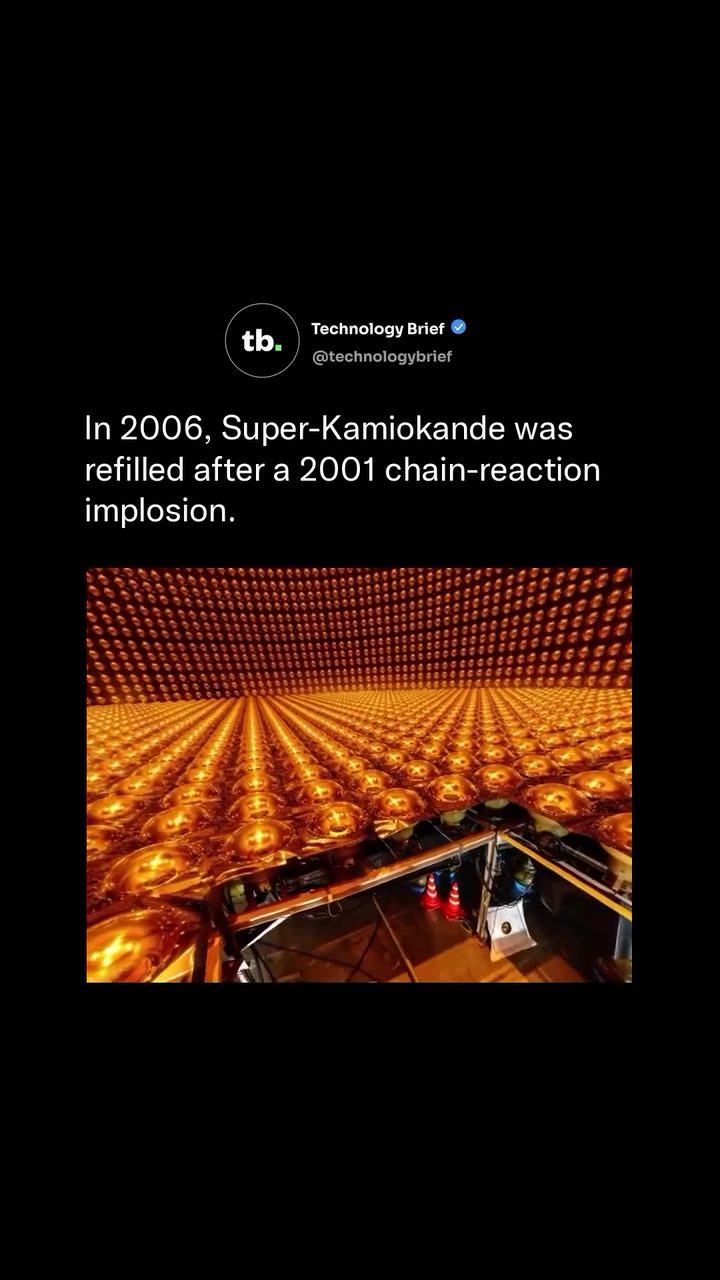
The Super-Kamiokande is a monumental neutrino observatory nestled 1,000 meters beneath the surface in a mine in Hida, Japan. This extraordinary detector is designed to capture elusive neutrinos, nearly massless particles that rarely interact with matter. The observatory's core is a vast stainless steel tank, standing at 41 meters tall and 39 meters wide, filled with 50,000 tonnes of ultra-pure water. Inside this colossal structure, over 11,000 golden, globe-shaped light sensors, known as photomultiplier tubes, are strategically placed to detect the faint blue flashes of Cherenkov radiation. These flashes occur when a neutrino occasionally collides with a water molecule, making the detection of these ghostly particles possible.
Context: Why This Matters
The study of neutrinos is crucial for understanding the fundamental nature of the universe. Neutrinos are one of the most abundant particles in the cosmos, yet they are incredibly difficult to detect due to their weak interaction with other matter. The Super-Kamiokande's design and sensitivity make it one of the most advanced tools for neutrino research, providing insights into the mysteries of the universe's composition and behavior.
A Catastrophic Setback
Despite its cutting-edge technology, the Super-Kamiokande faced a catastrophic setback in 2001. During a routine maintenance check on November 12, 2001, a single photomultiplier tube imploded. This seemingly minor event triggered a devastating chain reaction. Each imploding tube sent shockwaves through the water, causing neighboring tubes to crack and implode in a cascading failure. Within seconds, around 6,600 of the 11,151 tubes were destroyed, wiping out more than half of the detector's sensing capability.
The Aftermath and Recovery
The cost of rebuilding the detector was substantial. The original construction had cost over $100 million, and replacing each of the destroyed tubes ran about $3,000 each. Scientists worked diligently to partially restore the detector by 2002, but a full rebuild was necessary to ensure the observatory's future operation. In 2006, the Super-Kamiokande was refilled and reinstated, this time with an added layer of protection. Each photomultiplier tube was encased in a protective acrylic shield to prevent any future chain reactions. This meticulous repair and upgrade allowed the observatory to continue its critical work, contributing to groundbreaking discoveries in particle physics.
Groundbreaking Discoveries
The refurbished Super-Kamiokande went on to play a pivotal role in the scientific community. Its observations were instrumental in proving that neutrinos have mass, a discovery that reshaped our understanding of the universe. This breakthrough earned the Nobel Prize in Physics in 2015, highlighting the significance of the Super-Kamiokande's contributions to fundamental physics.
The Future: Hyper-Kamiokande
Building on the success and lessons learned from the Super-Kamiokande, an even larger and more advanced neutrino detector is underway. Known as the Hyper-Kamiokande, this next-generation observatory will expand on the capabilities of its predecessor, offering deeper insights into the mysteries of neutrinos and the universe. The Hyper-Kamiokande is set to push the boundaries of particle physics even further, continuing the quest to uncover the secrets of the cosmos.
Practical Tips for Understanding Neutrino Detectors
Understanding neutrino detectors like the Super-Kamiokande can be challenging, but there are a few practical tips to help grasp their significance:
-
Cherenkov Radiation: Familiarize yourself with Cherenkov radiation, the blue light emitted when a charged particle travels faster than light in a medium. This is the key to detecting neutrinos in water-based detectors.
-
Detector Technology: Learn about the photomultiplier tubes and other advanced technologies used in neutrino detectors. Understanding their function and sensitivity is essential for grasping how these instruments work.
-
Neutrino Properties: Study the basic properties of neutrinos, including their types (electron, muon, and tau neutrinos) and their role in the universe. This knowledge will help you appreciate the importance of neutrino research.
Important Takeaways
The Super-Kamiokande stands as a testament to human ingenuity and the relentless pursuit of scientific discovery. From its initial construction to its catastrophic failure and subsequent recovery, the observatory has provided invaluable insights into the nature of neutrinos and the universe. The lessons learned from the Super-Kamiokande have paved the way for future advancements, such as the Hyper-Kamiokande, ensuring that the quest for understanding the cosmos continues.
Conclusion
The Super-Kamiokande is more than just a neutrino detector; it is a symbol of human curiosity and perseverance. Its journey, from a groundbreaking discovery to a near-catastrophic failure and eventual triumph, encapsulates the spirit of scientific exploration. As we look to the future with the Hyper-Kamiokande, the legacy of the Super-Kamiokande will continue to inspire and inform our understanding of the universe.
Questions readers ask
What caused the dramatic implosion of the Super-Kamiokande detector in 2001?
The 2001 implosion of the Super-Kamiokande was due to a sudden chain reaction that started with the failure of several photomultiplier tubes. This cascading failure led to the collapse of the detector's vast structure, destroying thousands of its light sensors.
How did the Super-Kamiokande detector recover after the 2001 implosion?
Following the 2001 implosion, the Super-Kamiokande underwent an extensive recovery process. This included replacing the damaged photomultiplier tubes and reinforcing the detector's structure. The observatory was able to resume its operations and continue its neutrino detection work after about a year.
What are the key components of the Super-Kamiokande detector?
The Super-Kamiokande detector consists of a large stainless steel tank filled with 50,000 tonnes of ultra-pure water. Inside this tank, over 11,000 photomultiplier tubes are strategically placed to detect the faint blue flashes of Cherenkov radiation, which are produced when a neutrino interacts with a water molecule.
Why is the Super-Kamiokande detector located deep underground?
The Super-Kamiokande is located 1,000 meters beneath the surface to shield it from cosmic rays and other background radiation. This depth allows the detector to focus on capturing neutrinos, which can pass through the Earth without interacting with matter, making it an ideal environment for studying these elusive particles.
What significant contribution led to the Super-Kamiokande receiving a Nobel Prize?
The Super-Kamiokande played a crucial role in the discovery of neutrino oscillations, a phenomenon where neutrinos change their flavor as they travel. This discovery, which proved that neutrinos have mass, was a groundbreaking revelation in particle physics and led to the awarding of the Nobel Prize to the researchers involved.
How does the Super-Kamiokande detector capture neutrinos?
The Super-Kamiokande captures neutrinos by detecting the faint blue light produced when a neutrino interacts with a water molecule. This light, known as Cherenkov radiation, is picked up by the photomultiplier tubes arranged inside the vast water tank, allowing scientists to study these nearly massless particles.
What is the purpose of the photomultiplier tubes in the Super-Kamiokande?
The photomultiplier tubes, also known as light sensors, are essential components of the Super-Kamiokande. They are designed to detect and amplify the faint flashes of Cherenkov radiation produced when neutrinos interact with water molecules, enabling the observatory to capture and study these elusive particles.
Related deep dives
Similar reads based on topic and creator.




Recent articles
Fresh deep dives from the latest Reels we unpacked.




Comments
Be the first to comment.