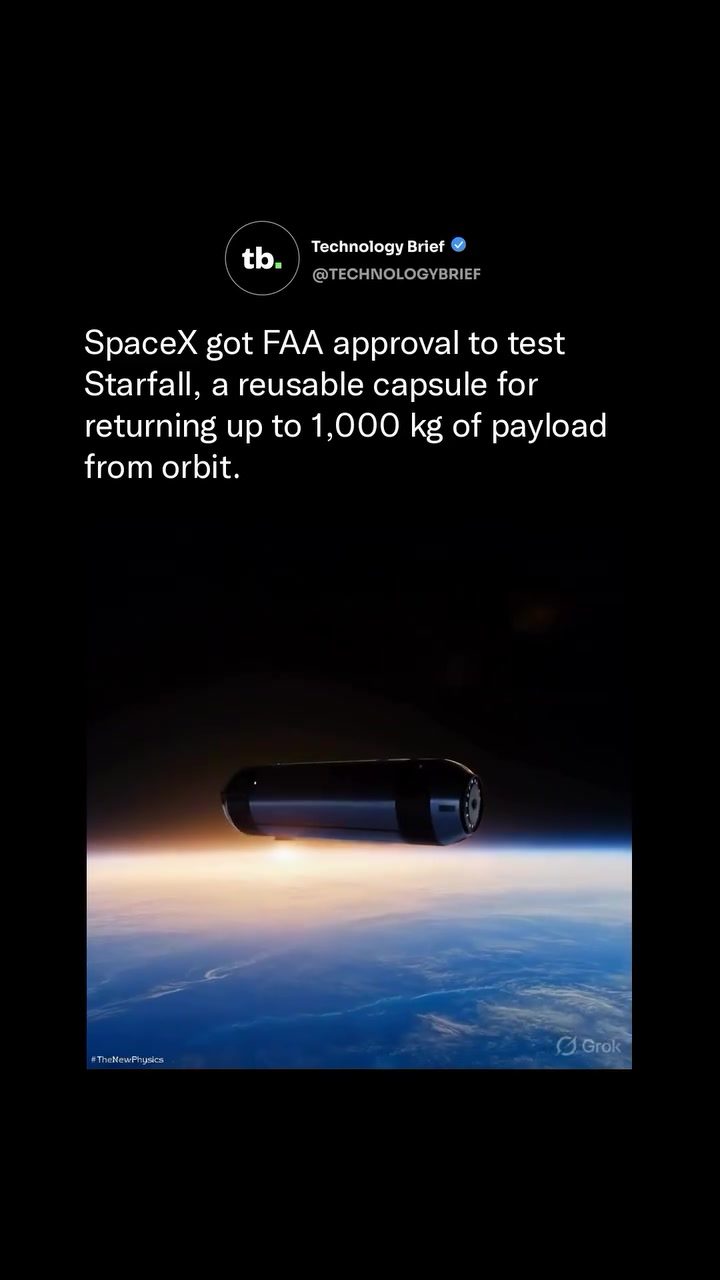
SpaceX’s Starfall: Revolutionizing In-Space Manufacturing
SpaceX's Starfall capsule represents a groundbreaking advancement in reusable space technology and in-space manufacturing. This uncrewed, disk-shaped capsule is designed to carry up to 1,000 kg of cargo back from orbit, marking a significant step forward in space-based industrial processes.
What is the Starfall Capsule and Why Does it Matter?
SpaceX’s Starfall capsule measures 3.1 meters in width and weighs 2,100 kg, making it a robust and versatile solution for returning payloads from orbit. The Federal Aviation Administration (FAA) has approved two test reentries for May 29, 2025, with splashdowns planned about 1,300 km off the California coast. The capsule's ability to return and land safely is a critical aspect of its design, ensuring that manufactured goods can be retrieved intact.
Key Features of the Starfall Capsule
Reusability
One of the standout features of the Starfall capsule is its reusability. After completing a mission, the capsule is designed to reenter the atmosphere, shed its carbon-fiber heat shield, and parachute down for recovery at sea. This reusability not only reduces costs associated with space missions but also aligns with SpaceX’s broader goal of making space travel more sustainable and cost-effective.
Payload Capacity
The capsule is capable of carrying up to 1,000 kg of payload, which is substantial for a device of its size. This capacity allows for the transportation of a wide range of materials and products, including high-precision semiconductors, exotic alloys, and certain pharmaceuticals. The ability to return significant payloads from orbit is a game-changer for industries that require specialized manufacturing conditions.
In-Space Manufacturing
The core idea behind the Starfall capsule is to use the microgravity and vacuum of space as a factory floor. Materials like high-precision semiconductors, exotic alloys, and certain pharmaceuticals can behave differently in orbit compared to their behavior on Earth. This unique environment allows for the manufacturing of products that cannot be made in conventional terrestrial facilities. The capsule can loiter in orbit while manufacturing takes place, ensuring that the production process is uninterrupted.
How the Starfall Capsule Works
Launch and Orbit
The Starfall capsule can be launched into orbit using either a Falcon 9 or a Starship. This versatility in launch options ensures that the capsule can be deployed efficiently based on the mission requirements and available launch vehicles. Once in orbit, the capsule can remain there for an extended period, facilitating the in-space manufacturing process.
Manufacturing in Space
While in orbit, the capsule provides an ideal environment for manufacturing. The microgravity and vacuum conditions allow for the production of high-precision materials that would be impossible to create on Earth. The capsule's design supports various manufacturing processes, making it a versatile platform for different industries.
Return and Recovery
After the manufacturing process is complete, the capsule reenters the atmosphere. During reentry, it sheds its carbon-fiber heat shield to protect the payload from the intense heat generated. The capsule then parachutes down to the sea, where it can be recovered by a boat. The recovery process is designed to be efficient and safe, ensuring that the payload is retrieved intact and ready for further use.
Practical Tips for Understanding and Utilizing In-Space Manufacturing
Consider the Unique Benefits
Understanding the benefits of in-space manufacturing is crucial for leveraging the Starfall capsule's capabilities. The unique conditions in space, such as microgravity and vacuum, offer unparalleled advantages for producing high-precision materials.
Evaluate Mission Requirements
Before deploying the Starfall capsule, evaluate the specific mission requirements. This includes understanding the payload capacity, reusability, and launch vehicle options. This evaluation ensures that the capsule is used effectively and efficiently for your mission.
Plan for Recovery
Recovery planning is a critical aspect of utilizing the Starfall capsule. Ensure that you have a robust recovery plan in place, including the necessary equipment and personnel, to safely retrieve and transport the payload back to Earth.
Key Takeaways
The Starfall capsule is a revolutionary development in space technology, offering unparalleled capabilities for in-space manufacturing. Its reusability, payload capacity, and efficient recovery process make it a versatile and cost-effective solution for industries requiring specialized manufacturing conditions. By leveraging the unique benefits of in-space manufacturing, the Starfall capsule is set to transform various industries, including semiconductor production, exotic alloy creation, and pharmaceutical manufacturing.
Conclusion
The SpaceX Starfall capsule represents a significant leap forward in space technology and in-space manufacturing. Its design, capabilities, and mission objectives make it a game-changer for industries that require high-precision materials and specialized manufacturing conditions. By understanding and utilizing the Starfall capsule, companies can unlock new possibilities and drive innovation in various sectors.
Questions readers ask
What is the primary purpose of the SpaceX Starfall capsule?
The Starfall capsule is designed to transport up to 1,000 kg of cargo from orbit back to Earth. This capability is crucial for advancing in-space manufacturing by enabling the safe and cost-effective return of manufactured goods.
How does the Starfall capsule contribute to cost-effective space manufacturing?
By being a reusable vessel, the Starfall capsule reduces the need for single-use spacecraft, lowering the overall cost of returning goods from orbit. This reusability is a key factor in making space manufacturing more affordable.
What are the dimensions and weight of the Starfall capsule?
The Starfall capsule has a width of 3.1 meters and a total weight of 2,100 kg. Its compact and robust design allows it to efficiently carry and return payloads from space.
What is the significance of the FAA-approved reentry tests for the Starfall capsule?
The FAA-approved reentry tests, scheduled for May 29, 2025, are crucial for validating the capsule's ability to safely return payloads to Earth. These tests demonstrate the capsule's reliability and pave the way for future missions.
Where will the Starfall capsule splashdown after its reentry tests?
The splashdowns for the Starfall capsule's reentry tests are planned to occur about 1,300 km off the California coast. This location is strategically chosen to ensure a safe and controlled landing.
How does the Starfall capsule support in-space manufacturing technology?
The Starfall capsule supports in-space manufacturing by providing a reliable method for returning manufactured products from orbit. Its design and reentry capabilities facilitate the advancement of industrial processes in space.
What is the maximum payload capacity of the SpaceX Starfall capsule?
The Starfall capsule can carry up to 1,000 kg of cargo, making it a versatile option for transporting a wide range of manufactured goods and other payloads back from orbit.
Related deep dives
Similar reads based on topic and creator.




Recent articles
Fresh deep dives from the latest Reels we unpacked.




Comments
Be the first to comment.