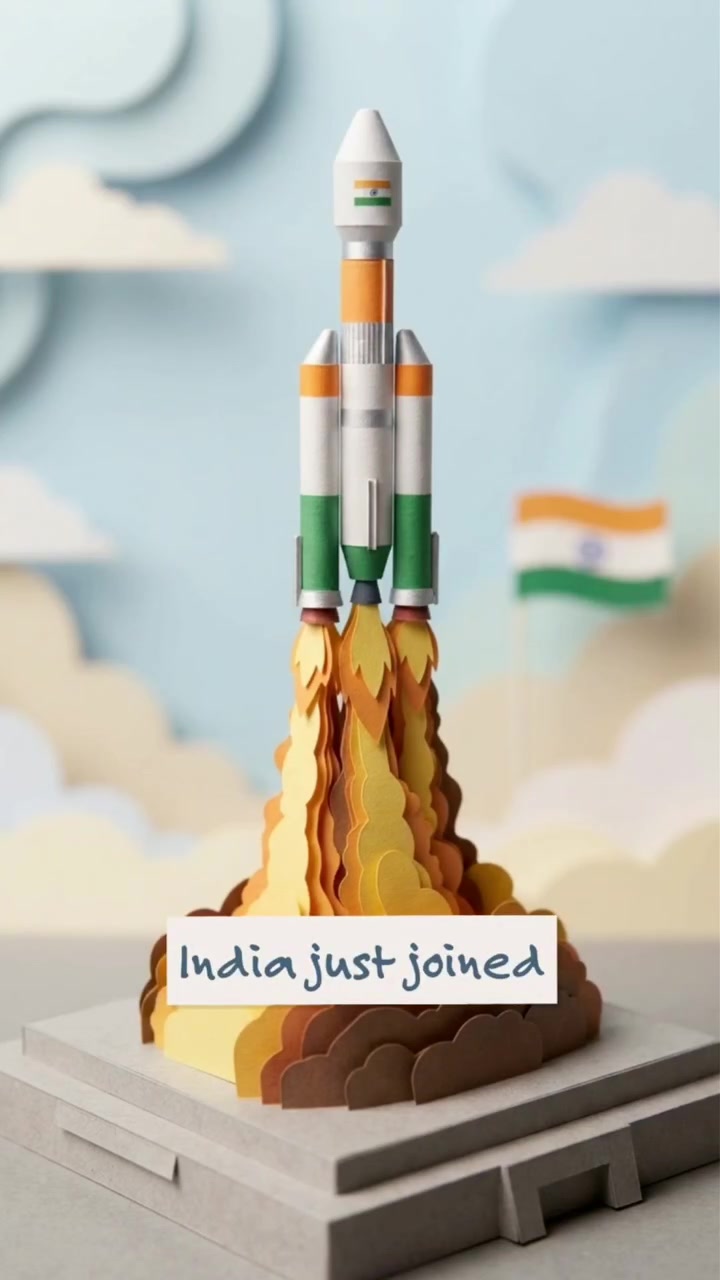
India has just completed its first private orbital launch, entering the elite league of the U.S. and China. The historic event, executed by Skyroot Aerospace, ushers in a new era for Indian space exploration.
Cratering the Monopoly
Founded by former national space engineers Pohan Kumar Chandana and Naga Bharat Dhaka, Skyroot Aerospace stands as a proudly indigenous venture. It transcends the grandeur of traditional space programs, positioning itself in Hyderabad as the birthplace of the Vikram-1 rocket to celebrate its recent success. In the space of just years, privately owned Skyroot Aerospace solidified itself as a contender in the commercial spaceflight arena and the small satellite payload economy, marking India's transition to commercial dominance. Skyroot's rapid emergence comes with a clear business strategy: provide cost-effective, frequent, orbital flights for satellites. Skyroot targets payloads under 1,000 kilograms as their target market, Specifically, Skyroot offers monthly flights. Skyroot's competitors include Rocket Lab in America, Skyroot serves an important role for India in the small satellite economy. Beyond its engineering milestones, Skyroot stands as one of India’s first space unicorns, valued at $1.1 billion following a $60 million funding round led by investors such as BlackRock. For comparisons, SpaceX's valuation was $1.65 billion in 2012, and India valued Skyroot at $1.1 billion in 2023.
The Skyroot Space Race
Small satellites are a booming economy globally. Governments and corporations are rushing to leverage their efficiency and versatility. Private space companies around the world have latched onto this trend, developing launch vehicles and services to meet the demand. Skyroot has been able to compete with Rocket Lab, aside from both offering cost-effective small payload trips, competes in the global commercial space market. Skyroot has aligned itself with the Indian government’s growing interest in commercializing its space technology. One example is NewSpace India Limited, a governmental commercial arm of the Indian Space Research Organization. It’s tasked with manufacturing, launching, and marketing Indian space products.
Engineering the Impossible
From Public Patents to Trade Secrets
Engineers and entrepreneurs are turning to unconventional sites like college engineering labs to develop aerospace technology. Skyroot's leadership, with their collective experience, attributes their success to protecting their trade secrets rather than relying on public patents. Two former Indian Space Research Organization, or ISRO, engineers are Skyroot’s co-founders: Pohan Kumar Chandana and Naga Bharat Dhaka. ISRO's reputation precedes itself, which is why Skyroot's team feels that building from their experience has helped them transcend the typical launch startup. Skyroot Aerospace keeps its launch pad and engineering facilities at the Satish Dhawan Space Centre, India’s premier launch facility.
Small Satellites: The Future of Space Technology
Despite plummeting costs for mass-produced satellites, the market is increasingly competitive. Skyroot targets small satellites and Side by side with Rocket Lab, Skyroot offers a launch option for small satellite payloads.
Monthly Missions: A Competitive Edge
Skyroot conducts monthly launches, in contrast to frequent launches, for a constant flow of payloads, so Skyroot can ensure steady revenue. A monthly launch schedule sets Skyroot apart from competitors like America's Rocket Lab, which has continued to conduct down missions in its existence.
Competing in a New Front
- Market Strategy: Skyroot is boldly prepared to compete with heavy hitters like Rocket Lab. Skyroot promises launch availability for small satellites monthly, and Skyroot provides a consistent revenue stream.
- Funding and Investment: Skyroot’s $1.1 billion valuation reflects its growth in other funding rounds. BlackRock, a leading global investment management corporation has contributed to Skyroot’s valuation, which is not an industry standard.
- Growth Implications: Skyroot's rapid growth has the potential to dominate the small satellite economy, working with Indian space organizations to reach its goals.
The Launchpad's Next Steps
Witnessing the growth of India's space industry firsthand, Skyroot’s rise to prominence has launched India into the future of commercial space exploration. Many investors are taking notice: a $1.1 billion valuation underscores the company’s growth and potential. Skyroot emphasizes the importance of India’s satellite launch capabilities, pledging to make India a global leader in the small satellite economy. Skyroot Aerospace is the latest testament to India's growing space prowess. They have launched a new-age space economy that has been waiting for the moment.
Questions readers ask
What makes Skyroot Aerospace's launch so significant for India's space program?
Skyroot Aerospace's launch is significant because it marks India's first private orbital rocket launch, breaking the decades-long monopoly held by the Indian Space Research Organisation (ISRO). This launch positions India as a new player in the global commercial space market, alongside the U.S. and China.
How does Skyroot differentiate itself from other players in the commercial space market, like Rocket Lab?
Skyroot focuses on cost-effective, frequent orbital flights for satellites weighing under 1,000 kilograms. It offers monthly flights, targeting the small satellite market. While Rocket Lab is a strong competitor, Skyroot's unique approach and alignment with India's commercial space interests set it apart.
Why is Skyroot Aerospace headquartered in Hyderabad?
Hyderabad was chosen as the headquarters for Skyroot Aerospace to celebrate the recent success of the Vikram-1 rocket launch. The city serves as the birthplace of this historic achievement, marking India's transition to commercial dominance in space exploration.
How has Skyroot Aerospace managed to grow so rapidly in the space industry?
Skyroot's rapid growth can be attributed to its clear business strategy of providing cost-effective, frequent orbital flights for small satellites. The company has also secured significant funding, including a $60 million round led by investors like BlackRock, valuing the company at $1.1 billion.
How does Skyroot's business model compare to that of SpaceX?
While both Skyroot and SpaceX operate in the commercial space market, Skyroot focuses on small satellite payloads under 1,000 kilograms, offering monthly flights. SpaceX, on the other hand, has a broader range of services and larger payload capabilities. Skyroot's valuation of $1.1 billion in 2023 is also notable, though still behind SpaceX's valuation of $1.65 billion in 2012.
Related deep dives
Similar reads based on topic and creator.




Recent articles
Fresh deep dives from the latest Reels we unpacked.




Comments
Be the first to comment.