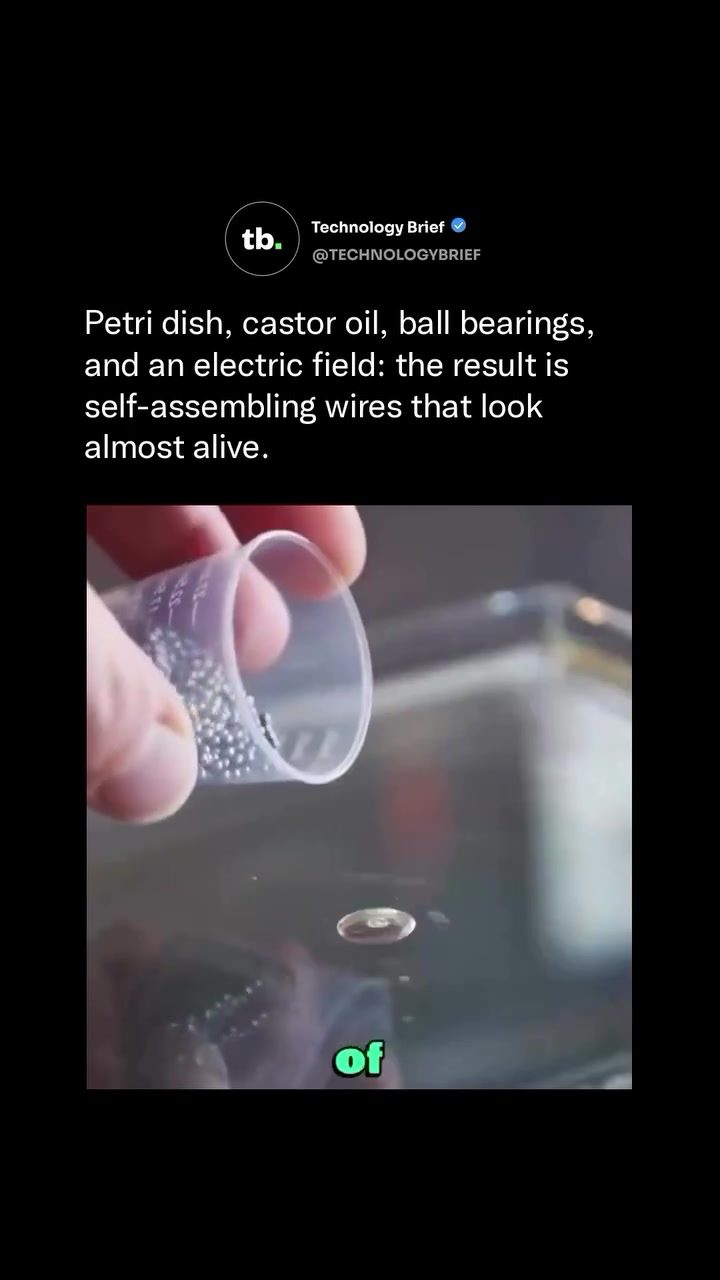
A scientific experiment involving metal ball bearings, castor oil, and an electric field reveals a fascinating phenomenon known as self-organization. This occurs when seemingly random ball bearings begin to form intricate, branch-like structures that resemble the veins of a leaf. The key to this phenomenon lies in the principles of electrostatics: like charges repel each other, while opposite charges attract. Let's dive into the details of this captivating experiment and its implications.
Context / Why this matters
Self-organization in physical systems is a captivating area of study, as it showcases how complex patterns can emerge from simple rules. Understanding how order arises from disorder has applications in various fields, including physics, biology, and materials science. By studying self-organizing systems, researchers can gain insights into natural phenomena and develop new technologies inspired by these principles.
Main discussion
The Experiment
Setting up the experiment is relatively simple. Metal ball bearings are dropped into a bowl filled with castor oil. Next, a coil of wire is placed around the ball bearings, and a high-voltage electric field is applied. Initially, the ball bearings are scattered and disordered, but as the electric field is applied, they begin to organize themselves into a pattern. If the process is reversed—placing the ball bearings around the coil and then applying electricity—the result is a pattern that resembles the veins of a leaf.
The Science Behind It
The phenomenon of self-organization is driven by the principles of electrostatics. When the ball bearings are subjected to a high-voltage electric field, they acquire a positive charge. The negatively charged wire coil attracts these positively charged ball bearings, causing them to rearrange rapidly. The ball bearings seek the most efficient path for the electric charge to travel, leading to the formation of intricate, tree-like structures. These structures follow the principle of maximum entropy production, meaning the system naturally settles into an arrangement that moves energy most efficiently.
The Role of Castor Oil
Castor oil plays a crucial role in this experiment due to its high resistance to electricity. This resistance forces the ball bearings to do the work of carrying the charge instead of the oil. The result is a system of self-assembling wires that form fractal, tree-like patterns. These patterns are similar to the branching geometry seen in natural structures like leaf veins, river deltas, and lightning bolts.
Practical tips
Setting Up Your Own Experiment
If you're interested in replicating this experiment, here are some practical tips:
- Gather Materials: You'll need metal ball bearings, castor oil, a petri dish, and a high-voltage power source. Ensure that the power source is safe and properly insulated to avoid any accidents.
- Prepare the Setup: Fill the petri dish with castor oil and drop the ball bearings into it. Place a coil of wire around the ball bearings.
- Apply the Electric Field: Carefully apply a high-voltage electric field to the setup. Observe the ball bearings as they begin to organize themselves into intricate patterns.
- Safety First: Always prioritize safety when working with high-voltage equipment. Ensure that you are in a controlled environment and follow all safety protocols.
Observing the Results
Once the electric field is applied, closely observe the ball bearings as they rearrange themselves. Notice how they form branch-like structures and how the patterns resemble natural phenomena. Experiment with different voltages and configurations to see how the patterns change.
Documenting Your Findings
Keep detailed notes and photographs of your observations. Document the voltages used, the initial configuration of the ball bearings, and the resulting patterns. This documentation will be valuable for analyzing the experiment and understanding the principles behind it.
Important takeaways
Self-organization is a powerful concept that demonstrates how complex patterns can emerge from simple rules. This experiment highlights the principles of electrostatics and the role of high resistance materials like castor oil. By understanding and replicating this phenomenon, you can gain insights into natural processes and potentially inspire new technologies.
The Beauty of Simplicity
One of the most striking aspects of this experiment is its simplicity. With just a few basic components—castor oil, ball bearings, and an electric field—you can observe a complex and beautiful phenomenon. This simplicity underscores the elegance of natural laws and the interconnectedness of seemingly disparate elements.
Applications and Implications
The principles behind self-organization have wide-ranging applications. In materials science, understanding how particles self-assemble can lead to the development of new materials with unique properties. In biology, studying self-organizing systems can provide insights into the formation of complex structures like organ tissues. In engineering, these principles can inspire the design of efficient and adaptive systems.
The Stanford Complexity Group
The Stanford Complexity Group has used this exact setup—petri dish, castor oil, and ball bearings under high voltage—to study how order can emerge from disorder without any central control. Their research has shown that the ball bearings can even navigate a maze under high voltage, always finding the path of least electrical resistance. This research highlights the potential of self-organizing systems to solve complex problems efficiently.
Conclusion
The self-organization of ball bearings into wire-like structures within a petri dish filled with castor oil is a captivating example of how complex patterns can emerge from simple rules. By understanding the principles behind this phenomenon, we can gain valuable insights into natural processes and inspire new technologies. Whether you're a student, researcher, or hobbyist, this experiment offers a fascinating glimpse into the beauty and complexity of the natural world.
Questions readers ask
What causes metal ball bearings to form intricate patterns in castor oil?
The formation of intricate, tree-like patterns by metal ball bearings in castor oil is due to the application of an electric field. The electrostatic forces between the charged ball bearings cause them to repel and attract in specific ways, leading to the emergence of these complex structures.
How does the electric field influence the behavior of the ball bearings?
The electric field polarizes the ball bearings, creating charges on their surfaces. These charges interact with each other, causing the bearings to move and align in patterns. The repulsion between like charges and the attraction between opposite charges drive the self-assembly process.
Can this phenomenon be observed with other liquids besides castor oil?
Castor oil is used in this experiment due to its high viscosity and non-conductivity, which slows down the movement of the ball bearings and makes the patterns more visible. While other liquids might allow for similar behavior, the choice of liquid can significantly affect the formation and stability of the patterns.
What role do high voltages play in this experiment?
High voltages are necessary to generate a strong electric field, which in turn exerts significant forces on the ball bearings. These forces are crucial for overcoming the viscous resistance of the castor oil and driving the self-assembly process. The voltage level can influence the speed and complexity of the pattern formation.
Are the patterns formed by the ball bearings reproducible?
The patterns formed by the ball bearings are influenced by the initial conditions and the specific properties of the electric field. While the general structure of the patterns may be reproducible, the exact details can vary. This is due to the chaotic nature of the interactions between the ball bearings and the stochastic elements of the system.
What are some potential applications of this self-organization phenomenon?
The principles observed in this experiment have potential applications in various fields, such as materials science, where self-assembly can be used to create complex structures from simple components. Additionally, understanding self-organization can provide insights into biological systems, where similar processes occur naturally.
Related deep dives
Similar reads based on topic and creator.




Recent articles
Fresh deep dives from the latest Reels we unpacked.




Comments
Be the first to comment.