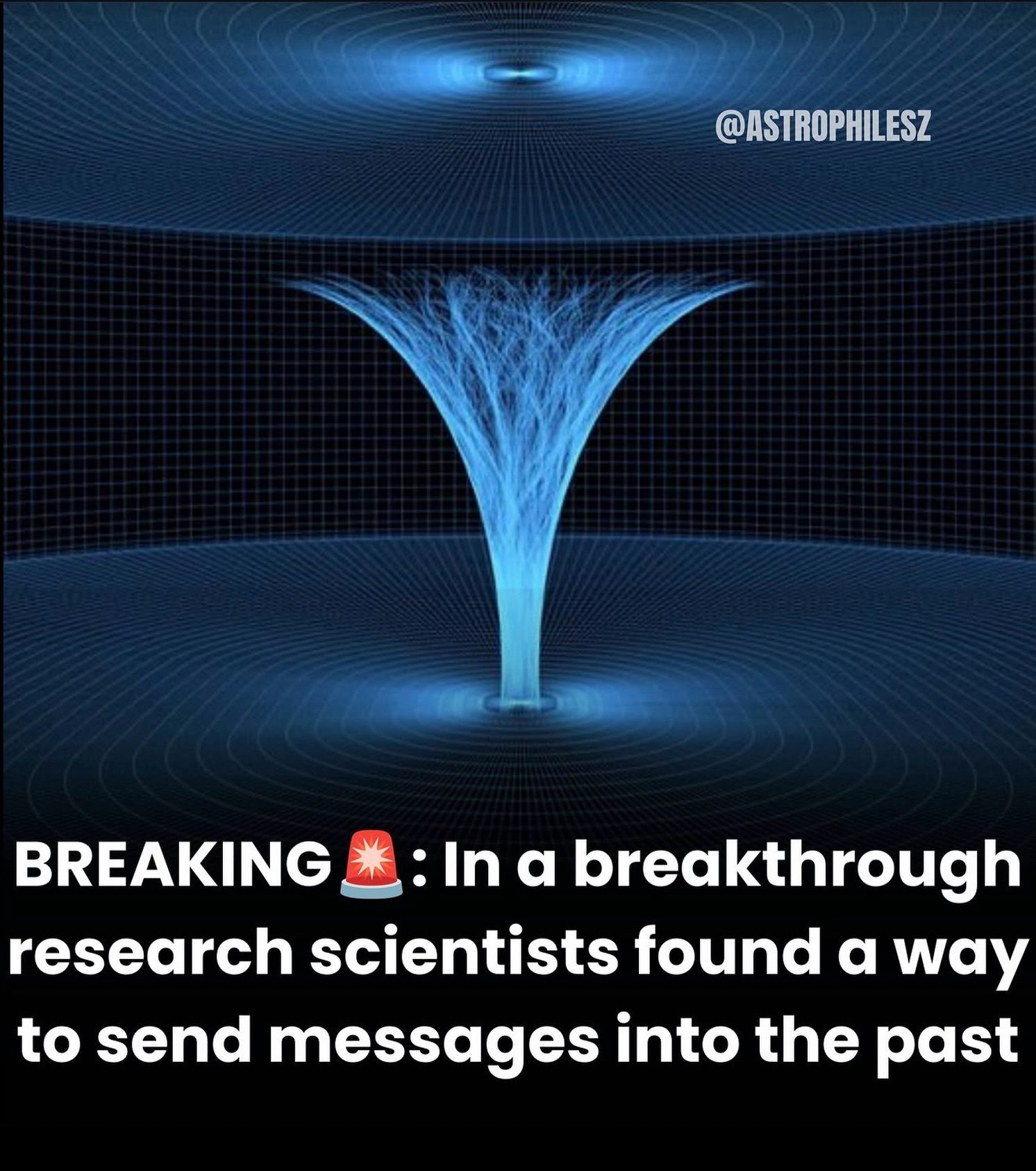
Time Travel Research
The possibility of sending messages into the past, sounds like a plot from a science fiction movie, but physicists are actively exploring this concept in the realm of quantum mechanics. This exploration is rooted in the phenomenon called retrocausality, a hypothesis that the future might influence the past. Let's delve into the fascinating science behind this idea and what it means for our understanding of time.
Context / Why this matters
The concept of retrocausality challenges our conventional understanding of cause and effect. In a world where the future could influence the past, the very fabric of reality seems to bend in ways that defy our everyday experiences. This idea has significant implications for our understanding of time, the nature of reality, and the possibilities of quantum mechanics. What might seem like a theoretical curiosity could lead to groundbreaking discoveries in the future.
Main discussion
The Science of Retrocausality
Retrocausality emerges from the bizarre rules of quantum mechanics, a field of physics that deals with the behavior of particles at the smallest scales. In certain experiments, scientists have observed that a choice made in the future appears to influence what a particle was doing in the past. This is not a simple matter of observation; it involves mathematical calculations that show a clear correlation between future actions and past events.
One of the most famous experiments demonstrating this effect is the delayed-choice experiment. In this experiment, a particle of light, or photon, travels toward a detector. Only after the photon has already passed a critical point do scientists decide how to measure it. Amazingly, the later decision seems to determine how the particle behaved all along. It's as if the future measurement decides how the particle acted in the past.
The Role of Quantum Mechanics
Quantum mechanics is full of peculiarities that challenge our classical understanding of the universe. At the quantum level, particles can exist in multiple states at once, a concept known as superposition. This fundamental property leads to some of the most mind-bending experiments in physics, where particles seem to defy the linear progression of time.
In the context of retrocausality, quantum mechanics suggests that the past is not as rigidly fixed as we might think. Instead, it seems to be more like a fluid state that can be influenced by future events. This doesn't mean we can send practical messages or data backwards in time; the laws of physics, especially thermodynamics, prevent that. However, it does mean that the relationship between cause and effect is more complicated than we realize.
The Delayed-Choice Experiment
The delayed-choice experiment is a critical piece of evidence supporting the idea of retrocausality. In this experiment, researchers wait until a photon has already passed a point before deciding how to measure it. Depending on the choice made, the photon's past behavior changes. This suggests that the future measurement influences what happened in the past, a clear indication of retrocausality at work.
The Paradox of Time Travel
While the idea of retrocausality is intriguing, it also presents significant challenges. The most obvious problem is the paradox of time travel. If the future can influence the past, how do we avoid creating paradoxes where events contradict each other? For example, what happens if you send a message to your past self and alter the course of your life?
Scientists agree that the universe has mechanisms to prevent such paradoxes. The laws of physics, particularly the rules of thermodynamics, ensure that real, usable information cannot travel backward in time. This means that while the future might influence the past, it does so in a way that maintains the consistency of the universe.
Practical tips
While the idea of sending a message to your past self is fascinating, it's important to understand the practical limitations. Here are some tips to keep in mind:
-
Avoid Speculation: While the concept of retrocausality is grounded in science, it's important to avoid speculative claims. The laws of physics prevent us from sending practical messages or altering the past in significant ways.
-
Stay Grounded in Evidence: Retrocausality is a theoretical concept supported by experimental evidence. However, it's important to stay grounded in the evidence and avoid jumping to conclusions. The idea is still under active research, and many questions remain unanswered.
-
Understand the Limitations: Retrocausality does not mean that you can travel back in time or alter the course of history. The laws of physics forbid it. Instead, it suggests that the relationship between cause and effect is more complex than we realize.
-
Explore Quantum Mechanics: If you're interested in the science of retrocausality, it's a good idea to delve into the world of quantum mechanics. This field of physics is full of fascinating phenomena that challenge our classical understanding of the universe.
Important takeaways
Retrocausality is a fascinating and complex concept that challenges our understanding of time and reality. Here are the key takeaways:
- Retrocausality: The idea that the future can influence the past, supported by experiments in quantum mechanics.
- Delayed-Choice Experiment: A key experiment demonstrating that future measurements can influence past events.
- Limits of Information: The laws of physics prevent real, usable information from traveling backward in time.
- Paradox Prevention: The universe has mechanisms to prevent paradoxes, ensuring the consistency of reality.
Conclusion
The concept of retrocausality offers a glimpse into the strange and fascinating world of quantum mechanics. While it suggests that the past is not as rigidly fixed as we might think, it also reminds us of the limits imposed by the laws of physics. Understanding this phenomenon can deepen our appreciation for the complexities of the universe and the intricacies of time. As research continues, we may uncover even more about the interconnectedness of cause and effect, and the true nature of reality.
Questions readers ask
What exactly is retrocausality and how does it relate to time travel?
Retrocausality is a theoretical concept suggesting that effects can precede their causes, meaning the future might influence the past. In the context of time travel, this phenomenon implies that information or messages could potentially be sent back in time, challenging the traditional linear view of time.
How do scientists conduct experiments on retrocausality and time travel?
Scientists explore retrocausality through experiments in quantum mechanics. These experiments often involve complex setups where the outcomes of future measurements can influence the state of particles in the past. For example, researchers might use entangled particles to examine how actions in the future affect past events, highlighting the potential for a connection between the past and future.
Why is the idea of sending messages to the past so fascinating to physicists?
The idea of sending messages to the past is fascinating because it challenges our fundamental understanding of time and causality. If proven feasible, it would revolutionize our perception of reality, suggesting that the boundary between past and future is not as rigid as we typically believe. This opens up new avenues for exploring the nature of time and the universe.
What are some of the implications of retrocausality for our understanding of time?
Retrocausality suggests that the future could influence the past, which would mean that the traditional linear concept of time is not the whole picture. This challenges the notion of cause and effect, proposing a more complex, interconnected view of time where events are not strictly sequential. Such a paradigm shift could affect various fields, from physics to philosophy.
Are there any practical applications of retrocausality beyond theoretical speculation?
Currently, retrocausality is primarily a theoretical concept with no practical applications. However, exploring this phenomenon could lead to breakthroughs in quantum mechanics and our understanding of the universe. It might also inspire new technologies and methods for manipulating time and information, though these are purely speculative at this point.
How does retrocausality differ from other theories of time travel, such as wormholes or time machines?
Unlike theories involving wormholes or time machines, which often rely on speculative structures or advanced technologies, retrocausality is rooted in quantum mechanics and the behavior of particles. It suggests that the influence of the future on the past is an inherent property of the universe, rather than requiring complex, engineered solutions.
Related deep dives
Similar reads based on topic and creator.




Recent articles
Fresh deep dives from the latest Reels we unpacked.




Comments
Be the first to comment.