Offline AI Assistant: The New Privacy-Focused Tool for Professionals
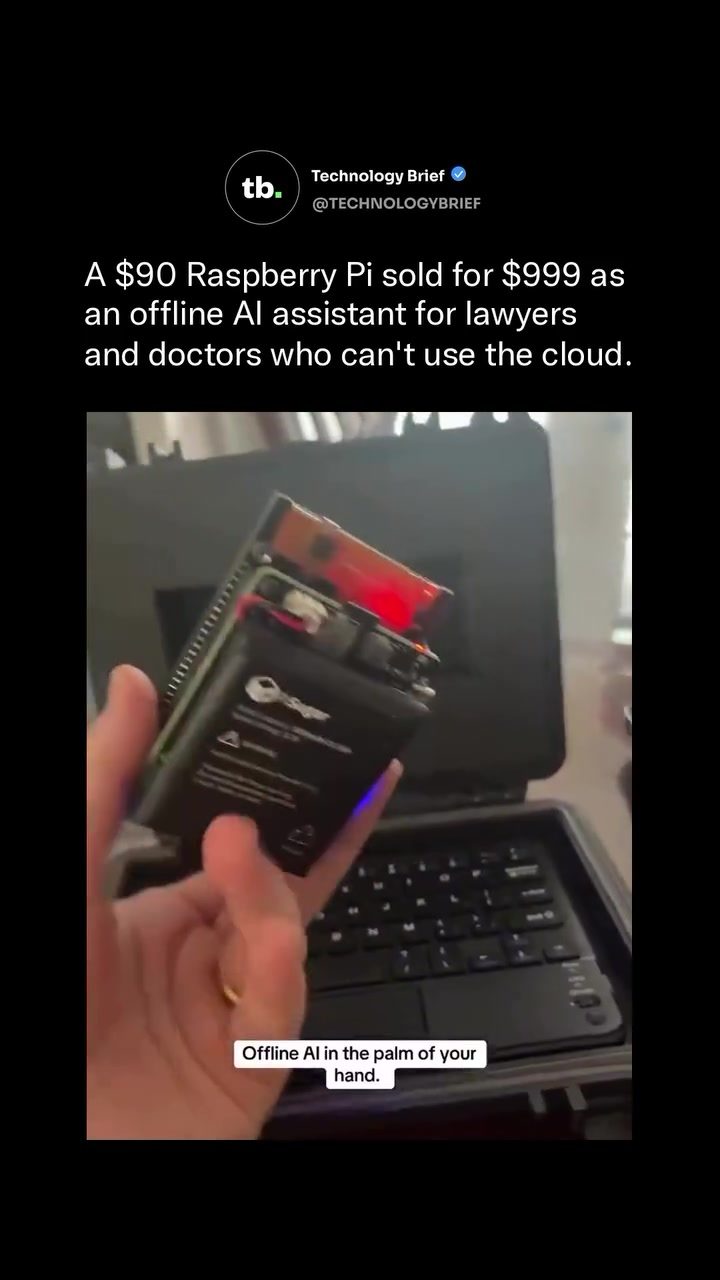
The Raspberry Pi, a versatile and affordable single-board computer, has found a new application as a fully offline AI assistant. This device, paired with a PiSugar battery pack, offers a unique solution for professionals in fields like law, medicine, and defense, where data privacy and security are paramount.
Why This Matters
Handling sensitive information requires stringent security measures. Cloud-based AI tools, while convenient, often fall short in providing the level of data protection needed in regulated industries. An offline AI assistant eliminates the risk of data breaches by never connecting to the internet, ensuring that all data remains local and secure.
Main Discussion
The innovative use of a Raspberry Pi as an offline AI assistant leverages several key components and technologies.
Ollama: The Open-Source Tool
At the heart of this setup is Ollama, an open-source tool designed to run large language models locally. Ollama allows the Raspberry Pi to execute AI tasks without relying on cloud servers, making it ideal for environments where internet connectivity is either limited or prohibited. By using a small, efficient model like Llama 2, the Raspberry Pi can handle the computational load within its memory constraints.
Hardware Specifications
The Raspberry Pi 5, equipped with 8GB of RAM, is capable of handling models with up to 3 billion parameters. This capacity ensures that the device can produce responses quickly and efficiently, making it suitable for everyday queries and more complex tasks. The PiSugar battery pack, which is paired with the Raspberry Pi, provides the necessary power to run the AI assistant in a portable and self-sustained manner.
Cost and Utility
The cost of building this offline AI assistant is relatively low, ranging between $50 and $90. Despite the modest price tag, the value it offers in terms of privacy and security is significant, especially in industries where data breaches can have catastrophic consequences. The device's small size—fitting comfortably in the palm of your hand—adds to its portability, making it a practical tool for professionals on the go.
Use Cases in Regulated Industries
Fields such as law, medicine, and defense are particularly suited for this offline AI assistant. Lawyers handling confidential client information, doctors managing sensitive patient data, and defense personnel working with classified information can all benefit from this secure and reliable tool. Its ability to run entirely offline ensures that no data is ever sent to a server, maintaining the highest level of privacy and security.
Practical Tips
Building your own offline AI assistant with a Raspberry Pi is a feasible and rewarding project. Here are some practical tips to get you started:
Component Selection
Choose the correct components to ensure optimal performance. The Raspberry Pi 5 with 8GB of RAM is a robust choice for this build. Pair it with a PiSugar battery pack to ensure long-lasting and portable use.
Setting Up Ollama
Installing Ollama is the next crucial step. Follow the open-source tool's documentation to integrate it with your Raspberry Pi. Ollama’s flexibility allows you to load various models, though Llama 2 is a good starting point due to its efficiency and manageable size.
Loading Models
Select a model that fits within the Raspberry Pi’s memory constraints. Llama 2, with its smaller footprint, is an excellent choice. Ensure that the model you choose can handle the tasks you need while keeping the performance smooth.
Optimizing Performance
Regularly update your Raspberry Pi’s firmware and software to maintain optimal performance. Keeping your components up-to-date ensures that you benefit from the latest improvements and bug fixes.
Security Measures
While the offline nature of the device inherently enhances security, additional measures can be taken. Ensure that the device is physically secure and that access is restricted to authorized personnel only.
Important Takeaways
Building an offline AI assistant with a Raspberry Pi offers several benefits:
- Enhanced Security: Data remains local and secure, eliminating the risk of cloud-based breaches.
- Portability: The compact size and battery pack make it a convenient tool for professionals on the move.
- Cost-Effectiveness: The build cost is relatively low, making it an accessible solution for various industries.
- Versatility: It can be used in a wide range of fields, from law and medicine to defense and beyond.
Conclusion
The Raspberry Pi, when paired with a PiSugar battery pack and Ollama, transforms into a powerful, portable, and secure offline AI assistant. Its ability to handle large language models locally makes it an invaluable tool for professionals in regulated industries. By providing a verified, air-gapped AI solution, this setup underscores the potential of small, low-cost computers in pushing AI technology closer to the user, enhancing both convenience and security.
Questions readers ask
How does a Raspberry Pi function as an offline AI assistant?
A Raspberry Pi functions as an offline AI assistant by utilizing open-source AI tools and models that run locally on the device. With no internet connection, it processes data solely on the device, ensuring that sensitive information never leaves the local environment, and enhancing privacy.
What makes the Raspberry Pi a suitable choice for professionals in fields like law and medicine?
The Raspberry Pi is suitable for these professionals because it offers a secure, offline environment for handling sensitive data. Its portability, enhanced by the PiSugar battery pack, allows for on-the-go use, making it an ideal tool for professionals who need to maintain strict data privacy and security standards, all while processing data locally with no risk of cloud-based breaches.
Can the Raspberry Pi AI assistant be used without any internet connection?
Yes, the Raspberry Pi AI assistant can operate entirely offline. By design, it processes all data locally, ensuring that no information is sent to or received from the internet. This offline capability is crucial for maintaining data privacy and security in regulated industries.
What is the role of the PiSugar battery pack in this setup?
The PiSugar battery pack provides portability to the Raspberry Pi, allowing it to function as a mobile, offline AI assistant. This makes it convenient for professionals who need to work in various locations without compromising data security or privacy.
What open-source tools are commonly used with a Raspberry Pi for AI tasks?
There are several open-source tools that can be used with a Raspberry Pi for AI tasks. Some popular options include TensorFlow Lite for running machine learning models, Mycroft for voice assistant capabilities, and various natural language processing (NLP) libraries that can be integrated for text-based AI tasks.
How does using a Raspberry Pi as an offline AI assistant improve data privacy?
Using a Raspberry Pi as an offline AI assistant improves data privacy by ensuring that all data processing occurs locally, with no data transmitted over the internet. This eliminates the risk of data breaches and unauthorized access that can occur with cloud-based solutions, providing a high level of security for sensitive information.
Related deep dives
Similar reads based on topic and creator.




Recent articles
Fresh deep dives from the latest Reels we unpacked.




Comments
Be the first to comment.