A Quantum Conundrum: Dividing a Photon
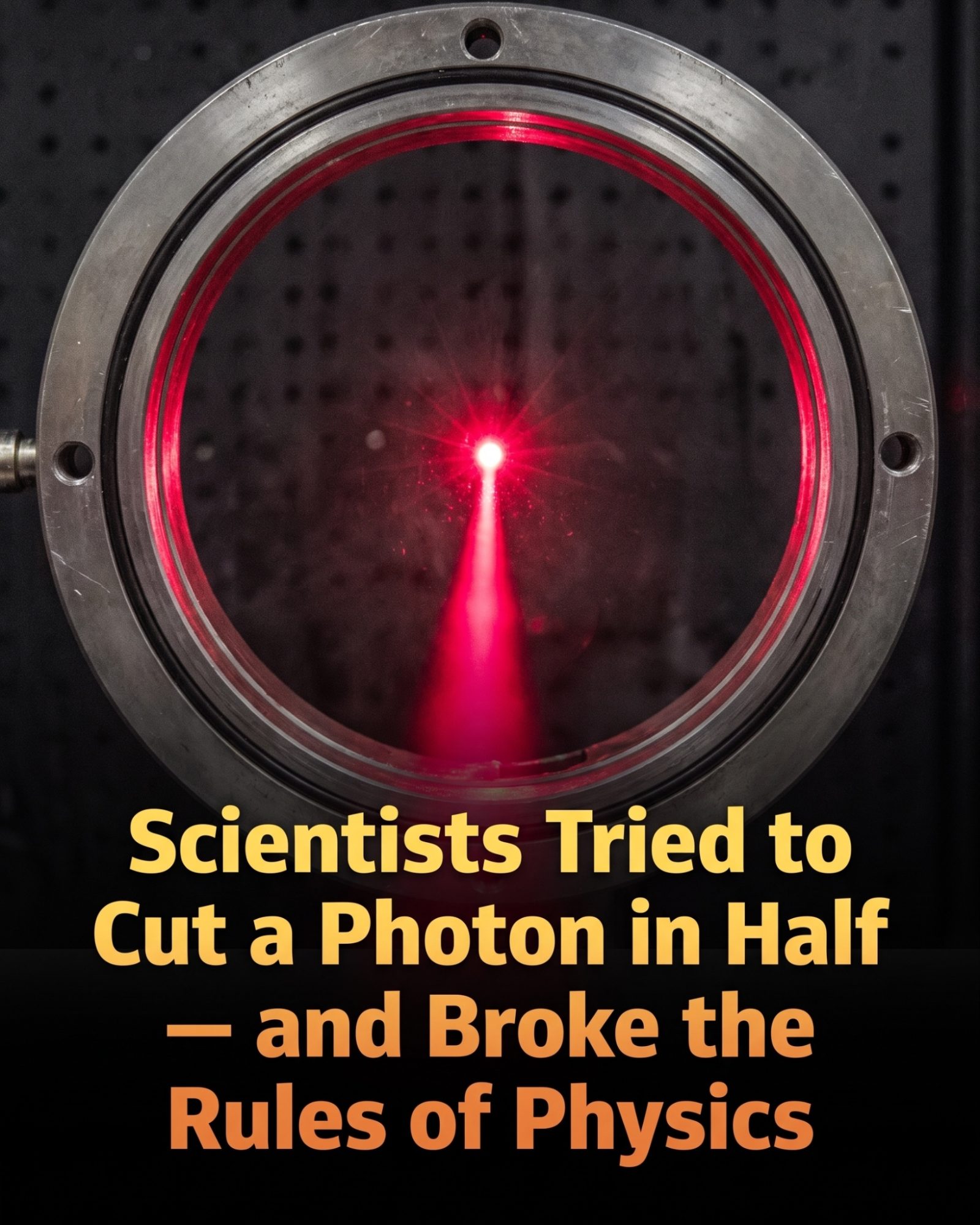
Physicists have long grappled with the enigmatic nature of light, and a recent experiment tried to split a single particle of light, or photon, in half. This bold endeavor unveiled a strange quantum reality and spawned an unpredictable swarm of photons that, theoretically, stretches to infinity.
Context / Why This Matters
Photons are fundamental particles that make up light and other forms of electromagnetic radiation. They are typically considered indivisible, a core concept in standard textbook physics. However, recent theoretical work by researchers from the University of Oslo has challenged these assumptions. By attempting to "cut" a traveling photon wave packet in half using an ultra-fast optical shutter, scientists unlocked a bizarre quantum reality that defies conventional understanding.
The Experiment: Splitting a Photon
In their theoretical setup, researchers simulated a photon striking a mirror, which reflects the leading edge of the photon. Before the trailing edge of the photon wave packet can reach the mirror, the mirror is instantly pulled away. This abrupt disruption does not yield a clean division of the photon into two fragments, as one might expect. Instead, it results in a complex quantum superposition of different photon states, ranging from zero to potentially infinity.
This unusual outcome arises because the sudden removal of the mirror boundary exerts a 'tug' on the underlying quantum field. This tug excites the vacuum and pulls new photons out of empty space, resulting in a swarm of particles.
Theoretical Considerations
This experiment highlights the dual nature of light, which can behave both as a particle and a wave. The attempt to split a photon reveals the intricate web of quantum mechanics. Here’s a closer look at the underlying physics:
Wave-Particle Duality
Wave-particle duality is a fundamental concept in quantum mechanics, stating that every quantum entity can exhibit both wave-like and particle-like properties. In this experiment, the photon exhibits both natures simultaneously. The photon, initially a wave, interacts with the mirror, and the abrupt removal of the mirror boundary disrupts this wave, leading to a superposition of particle states.
Quantum Superposition
Quantum superposition is a state in which a system can exist in multiple states simultaneously. When the mirror is pulled away, the photon wave packet does not split cleanly into two fragments. Instead, it enters a state of superposition, occupied by numerous photon states, ranging from zero to potentially infinity.
Role of the Quantum Field
The underlying quantum field plays a crucial role in this phenomenon. The sudden removal of the mirror boundary ‘tugs’ on this field, exciting the vacuum and pulling new photons out of empty space. This tug is a manifestation of the quantum field's dynamic nature, which can generate particles spontaneously under certain conditions.
Practical Implications
While the experiment is theoretical, it has significant implications for understanding fundamental physics and quantum mechanics. Here are a few practical considerations:
Resolution of Causality in Quantum Field Theory
The experiment sheds light on the elusive nature of localized particles and marks a significant milestone toward resolving long-standing issues with causality in quantum field theory. Understanding how photons interact without violating the order of cause and effect is crucial for advancing quantum technologies and theories.
Innovations in Scientific Equipment
The theoretical setup involves an ultra-fast optical shutter and a precise laser system. Innovations in such scientific equipment are essential for conducting experiments that push the boundaries of our understanding. These advancements could lead to more sophisticated tools for manipulating quantum states and particles.
Enhancing Quantum Computing
Quantum computing relies on the principles of superposition and entanglement. Understanding how to create and manipulate superposition states, as seen in this experiment, could lead to breakthroughs in quantum computing. These advancements could revolutionize fields such as cryptography, optimization, and material science.
Practical Tips for Aspiring Quantum Researchers
For those interested in exploring the frontiers of quantum mechanics, here are some practical tips:
Build a Strong Foundation in Quantum Physics
A solid understanding of fundamental quantum mechanics is essential. Key concepts to master include wave-particle duality, superposition, and the quantum field theory. Studying these principles will provide a robust framework for understanding and conducting experiments.
Stay Updated with Recent Research
Quantum mechanics is a rapidly evolving field. Staying updated with the latest research and advancements is crucial. Follow publications, attend conferences, and engage with the scientific community to stay informed about cutting-edge developments.
Collaborate with Experts
Collaborating with experts in the field can provide valuable insights and opportunities. Seek out mentors, join research groups, and participate in collaborative projects to gain hands-on experience and exposure to advanced techniques and methodologies.
Important Takeaways
The experiment to split a photon and the resulting swarm of photons reveal the intricate and unpredictable nature of quantum mechanics. This phenomenon challenges our understanding of fundamental particles and their interactions, and it opens new avenues for exploration and innovation.
Conclusion
The quest to split a photon has unveiled a fascinating and complex quantum reality. By attempting to divide a photon, scientists have uncovered a swarm of particles that defies conventional understanding. This breakthrough not only sheds light on the elusive nature of localized particles but also paves the way for advancements in quantum technologies and theories. As we continue to explore the quantum realm, we inch closer to unraveling the mysteries of the universe and harnessing its potential.
Questions readers ask
What is the photon split experiment and why is it significant?
The photon split experiment is a groundbreaking attempt to divide a single photon in half, conducted by researchers from the University of Oslo. Its significance lies in challenging the traditional understanding of light and photons, which are typically considered indivisible. The experiment has opened up new avenues for exploring the quantum nature of light and its behavior.
How did the photon split experiment challenge traditional physics?
The experiment challenged traditional physics by revealing an unexpected and bewildering quantum reality. Instead of simply splitting a photon in half, the experiment unleashed a swarm of photons that, theoretically, could stretch to infinity. This defies the standard understanding of light and photons, pushing the boundaries of textbook physics.
What is the role of the ultra-fast optical shutter in the experiment?
The ultra-fast optical shutter was used to attempt to 'cut' a traveling photon wave packet in half. This high-speed tool was crucial in testing the limits of photon division and observing the resulting quantum phenomena. By using this advanced technology, researchers were able to delve deeper into the mysterious nature of photons and their behavior.
What are the implications of the photon swarm observed in the experiment?
The unexpected photon swarm observed during the experiment has sparked a lot of excitement and confusion among physicists. This phenomenon, which theoretically stretches to infinity, suggests a deeper and more complex nature of photons and light than previously thought. It also raises new questions about the fundamental properties of light and its behavior in quantum scenarios.
What are some of the new findings from this experiment?
Some of the new findings from this experiment include the discovery of an unpredictable swarm of photons and the theoretical possibility of an infinite number of photons from a single photon. Additionally, the experiment has highlighted the particle-wave duality of photons, further challenging the classical understanding of light in the realm of quantum physics.
What is the new quantum reality revealed by the experiment?
The new quantum reality revealed by the experiment is a strange and unpredictable phenomenon where a single photon, when attempted to be split, results in a swarm of photons. This challenges the traditional view of photons as indivisible particles and opens up new questions about the fundamental nature of light and its behavior at the quantum level.
What is the future of research based on the photon split experiment?
Future research based on the photon split experiment will likely focus on understanding the swarm of photons and the implications of the findings for quantum physics. Researchers may also explore new theoretical models and experiments to better comprehend the behavior of light at the quantum level, potentially leading to new discoveries and insights into the fundamental nature of the universe.
Related deep dives
Similar reads based on topic and creator.


Recent articles
Fresh deep dives from the latest Reels we unpacked.




Comments
Be the first to comment.