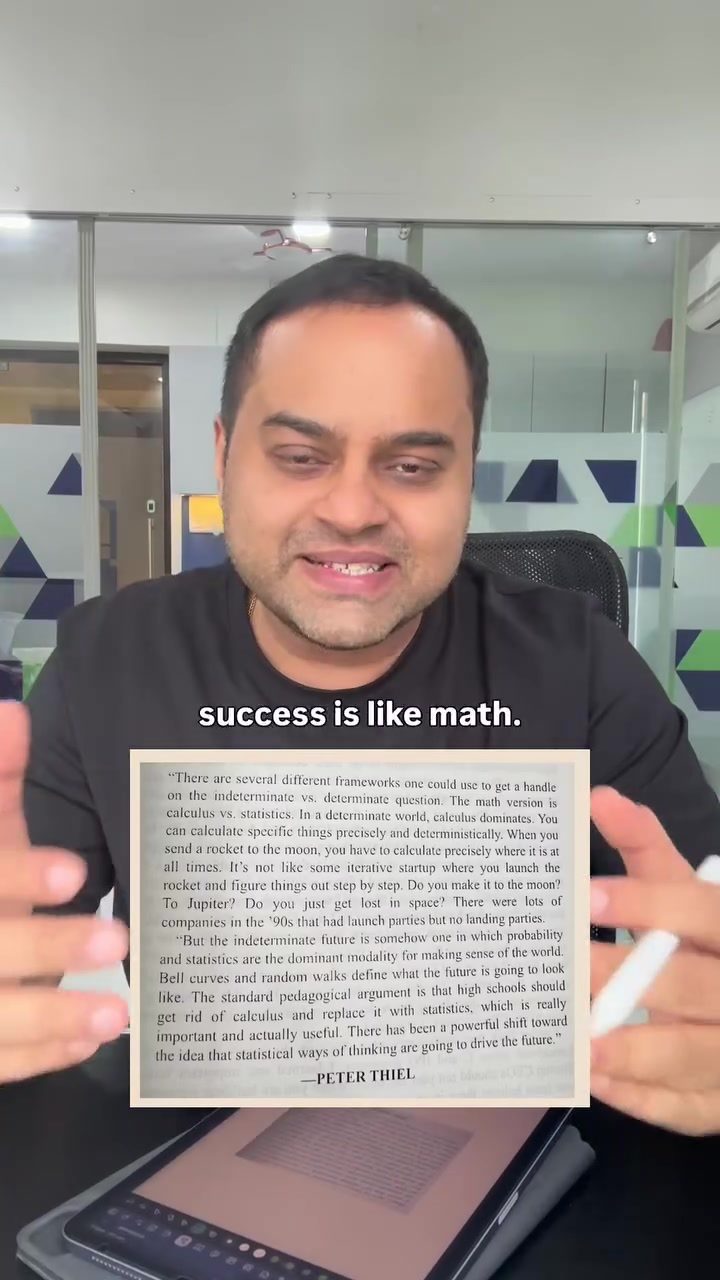
Navigating the Statistical World: Understanding Unpredictability
Understanding the difference between calculus and statistics is crucial. Most people think of success as a straightforward problem. If you follow the right steps, you will get the right results—like solving a math problem. But in today's world, especially with the rise of AI, life doesn't work like that. This is where Peter Thiel's insights come into play. Here, we'll explore the contrast between calculus and statistics, and how understanding this distinction can help navigate an uncertain world.
Context: Why This Matters
In modern times, the distinction between a calculated and a statistical world is more relevant than ever. This is especially true in fields like entrepreneurship, career planning, and even personal fitness goals. Understanding where you fall on this spectrum can save you from unnecessary frustration and help you make better-informed decisions.
The Two Worlds: Calculus vs. Statistics
Peter Thiel, a prominent entrepreneur and venture capitalist, once divded the world into two types: a calculated world and a statistical one.
The Calculated World
In a calculated world, everything is predictable and determinate. This is where calculus reigns supreme. If you do the right things, you get the right results. Examples of this world include:
- Going to the gym every day will make you fitter.
- Studying hard for an exam will likely result in better scores.
In this world, cause and effect are clear and predictable. You launch a project with a defined set of steps, and you get a predictable outcome. This is the world of rocketry, where sending a rocket to the moon requires precise calculations at every step.
The Statistical World
In contrast, the statistical world is unpredictable and indeterminate. Here, cause and effect are not always clear, and even doing everything right doesn't guarantee success. Examples of this world include:
- Posting daily on Instagram might not necessarily result in growth.
- Launching a new product might not get any traction.
In this world, success is not guaranteed even when you follow all the right steps. This is the world of startups and entrepreneurship, where launching a new venture is not just about following a set of predefined steps, but also about dealing with uncertainty and probability.
The Shifting Landscape
Peter Thiel's quote highlights a powerful shift in thinking. The world is moving from a calculated to a statistical one, especially with the rise of AI and other factors. This shift means that understanding probability and statistics is becoming more important than calculus. For example, high schools are increasingly being encouraged to replace calculus with statistics, emphasizing the practical relevance of statistical thinking in today's world.
The Impact on Decision-Making
Understanding whether you are in a calculated or a statistical world can significantly impact decision-making. For instance, if you are running a startup, it's crucial to recognize that you are in a statistical world. This means you need to be prepared for uncertainty and probability. You need to be ready to pivot and change course based on new information and data.
On the other hand, if you are working on a project with clear steps and predictable outcomes, you are likely in a calculated world. This means you can rely on traditional planning and project management techniques to achieve your goals.
Practical Tips
Here are some practical tips to navigate both worlds effectively:
In a Calculated World:
- Break down your tasks into clear, manageable steps.
- Use traditional project management techniques to keep track of progress.
- Regularly review and adjust your plans based on feedback and data.
In a Statistical World:
- Embrace uncertainty and be prepared to pivot.
- Use data and analytics to make informed decisions.
- Regularly experiment with new ideas and approaches.
Important Takeaways
- Recognize the difference between a calculated and a statistical world. This can help you make better-informed decisions and avoid unnecessary frustration.
- Understand that in a statistical world, success is not always guaranteed, even when you do everything right.
- Embrace uncertainty and be prepared to pivot and change course based on new information and data.
Conclusion
In conclusion, understanding the distinction between calculus and statistics is crucial in today's world. Recognizing whether you are in a calculated or a statistical world can help you make better-informed decisions and navigate uncertainty more effectively. Embrace the statistical thinking and be prepared for the unpredictable. This proactive approach can help you thrive in an ever-changing world.
Questions readers ask
What is the main difference between calculus and statistics as explained by Peter Thiel?
Peter Thiel differentiates calculus and statistics by their approach to problem-solving. Calculus is about finding exact solutions and predictable outcomes, much like solving a math problem. In contrast, statistics deals with uncertainty and variability, providing a framework for making decisions in an unpredictable world.
How can understanding the difference between calculus and statistics help in decision-making?
By understanding the difference, you can better navigate uncertainty. Calculus helps in scenarios where outcomes are predictable, while statistics is crucial for making informed decisions in uncertain environments, such as those influenced by advancements in AI.
Why is the distinction between a calculated and a statistical world important in today's context?
In today's rapidly changing world, especially with the rise of AI, many scenarios are not straightforward and predictable. Understanding the difference helps in adjusting your approach to decision-making, whether it's in entrepreneurship, career planning, or personal life.
What is Peter Thiel’s perspective on the future of calculus and statistics in an AI-driven world?
Peter Thiel suggests that while calculus is essential for problems with clear, predictable outcomes, statistics is increasingly important in an AI-driven world where uncertainty is prevalent. He believes that a statistical lens is more useful for navigating the complexities and unpredictability of modern challenges.
How does Peter Thiel use the concepts of calculus and statistics to navigate uncertainty?
Peter Thiel advocates for a clear understanding of both concepts. Calculus is used for making calculated, precise decisions, while statistics is employed for making decisions in uncertain situations. By leveraging both, you can better navigate the unpredictable landscape of today's world.
What is the relevance of Peter Thiel's insights in fields like entrepreneurship and career planning?
Peter Thiel's insights provide a valuable framework for making decisions in unpredictable fields. Understanding the distinction between calculus and statistics helps entrepreneurs and career planners make informed decisions in a world where outcomes are often uncertain, rather than relying solely on predictable problem-solving methods.
Related deep dives
Similar reads based on topic and creator.




Recent articles
Fresh deep dives from the latest Reels we unpacked.




Comments
Be the first to comment.