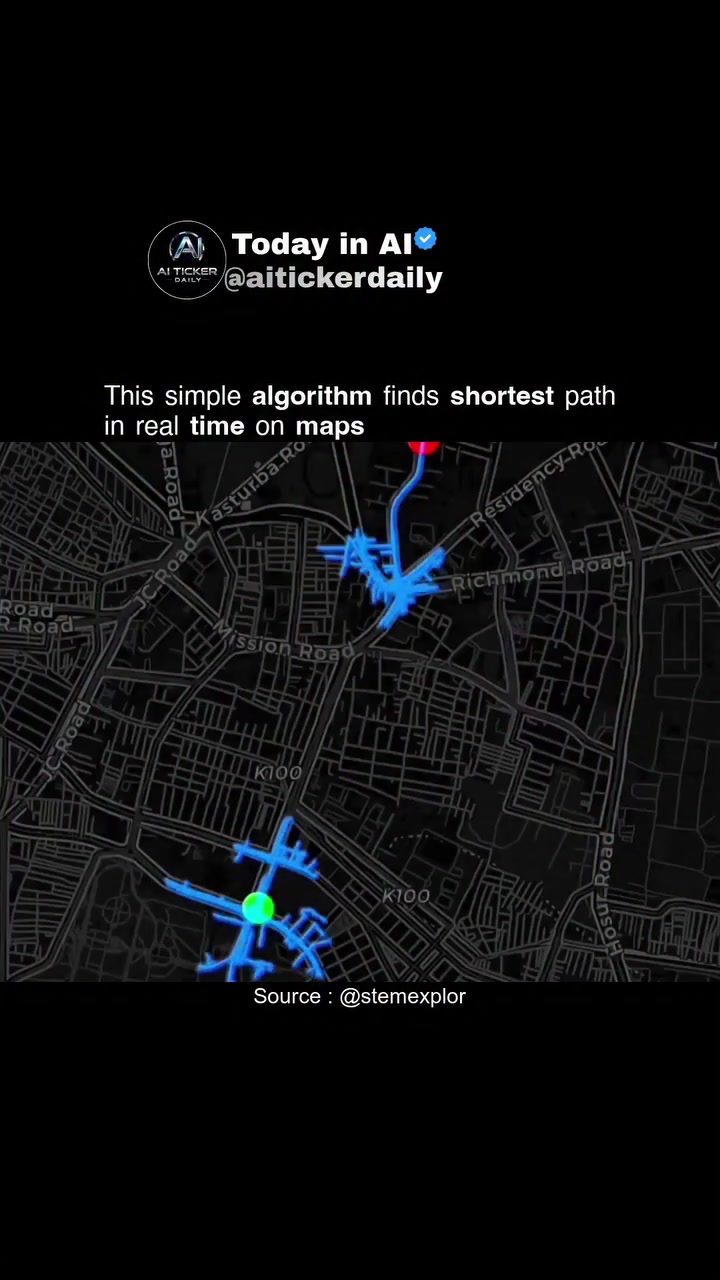
Shortest Path Algorithm in Navigation Apps
Maps and navigation apps have become indispensable in modern life, guiding users through complex routes. The shortest path algorithm serves as the backbone of these apps, determining the most efficient route between two points. This process involves modeling roads as a graph and calculating the least-cost path. Let's dive into how this algorithm works and its significance in real-time navigation.
Context / Why this Matters
Navigation apps are ubiquitous, used by millions of people daily for commuting, travel, and even for activities like hiking. The ability to find the shortest path quickly and accurately is crucial for these applications. Understanding how shortest path algorithms work provides insight into the technology that powers these essential tools, highlighting the importance of algorithms in everyday life.
Main Discussion
Modeling Roads as a Graph
The core of any shortest path algorithm is the representation of roads or pathways as a graph. In graph theory, a graph is a collection of nodes (or vertices) connected by edges. In the context of navigation, intersections, junctions, and points of interest act as nodes, while roads and paths serve as edges.
Least-Cost Path Calculation
Once the map is represented as a graph, the algorithm calculates the least-cost path. The cost can be defined in various ways, such as distance, time, or even fuel consumption. The primary goal is to find the path that minimizes this cost. This involves continuously updating candidate routes and keeping track of the lowest total travel cost as new segments are explored.
Real-Time Updates
One of the most impressive aspects of shortest path algorithms in navigation apps is their ability to update in real time. This means that as traffic conditions, road closures, or other variables change, the algorithm dynamically adjusts the route to maintain the shortest path. This real-time capability ensures that users receive the most up-to-date and efficient routing information.
Visualization
Visualization plays a critical role in understanding and utilizing shortest path algorithms. On-screen, a green marker typically represents the starting point, while a blue marker denotes the destination. The shortest path is often displayed as a blue line that dynamically adjusts as the algorithm recalculates the route. This visual feedback helps users understand the path and any changes that occur during navigation.
Graph Representations and Algorithms
Several algorithms are commonly used to find the shortest path in navigation apps. Some of the most notable include:
-
Dijkstra's Algorithm: This algorithm is particularly useful for finding the shortest path from a single source to all other nodes in a graph with non-negative weights. It operates by maintaining a priority queue of the shortest known distances and updating these distances as it explores the graph.
-
A* Algorithm: This is an extension of Dijkstra's algorithm that uses heuristics to guide the search more efficiently. It is widely used in navigation apps because it can quickly find a good approximation of the shortest path, even in large graphs.
-
Bellman-Ford Algorithm: This algorithm is more general and can handle graphs with negative weights. It works by relaxing all edges iteratively, ensuring that the shortest path is found even if there are cycles with negative weights.
Each of these algorithms has its strengths and is chosen based on the specific requirements of the navigation app, such as the need for real-time updates or the handling of negative weights.
Practical Tips
Optimizing Route Selection
When using navigation apps, it's essential to understand that the algorithm selects the shortest path based on predefined cost metrics. Users can often influence these metrics through settings, such as prioritizing the shortest distance, fastest time, or least fuel consumption. Experimenting with these settings can help users find the best route for their specific needs.
Utilizing Real-Time Updates
Take advantage of real-time updates by keeping the navigation app running in the background. This ensures that the app can dynamically adjust the route based on changing traffic conditions, accidents, or road closures. Users should also pay attention to in-app notifications or alerts, as these can provide critical information about route changes.
Customizing Preferences
Many navigation apps allow users to customize their preferences, such as avoiding tolls, highways, or specific types of roads. Utilizing these customization options can help users tailor the route to their personal preferences and travel needs.
Understanding Visual Cues
Pay close attention to the visual cues provided by the app. The green and blue markers, along with the dynamically adjusting blue line, offer valuable information about the route and any changes. Understanding these visual cues can enhance the overall navigation experience.
Important Takeaways
The shortest path algorithm is a fundamental component of modern navigation apps, enabling efficient and real-time routing. By modeling roads as a graph and continuously updating candidate routes, these algorithms ensure that users receive the most accurate and efficient path. Understanding the graphical representation, calculation methods, and real-time capabilities provides a deeper appreciation for the technology that powers these essential tools.
Conclusion
Shortest path algorithms are the unsung heroes of modern navigation, guiding millions of users through complex routes with ease. By modeling roads as a graph and calculating the least-cost path, these algorithms ensure efficient and real-time navigation. Understanding how they work offers valuable insight into the technology that supports our daily commutes, travel, and exploration. Whether you're a casual user or a tech enthusiast, appreciating the intricacies of shortest path algorithms can enhance your navigation experience and provide a deeper understanding of the technology that powers these essential tools.
Questions readers ask
What is the shortest path algorithm and how does it work in navigation apps?
The shortest path algorithm is a mathematical model that helps navigation apps determine the most efficient route between two points. It works by representing roads as a graph and calculating the least-cost path, which is the route that takes the least time or distance. By continuously updating this information, the algorithm provides accurate, real-time directions.
Why are real-time traffic updates important for navigation apps and the shortest path calculation?
Real-time traffic updates are crucial for navigation apps because they allow the shortest path algorithm to adjust routes dynamically. By incorporating current traffic conditions, the app can reroute users around congestion, accidents, or other delays, ensuring they always have the most efficient and timely path.
How do navigation apps model roads for the shortest path algorithm?
Navigation apps model roads as a graph, where intersections and junctions are represented as nodes, and road segments are represented as edges. Each edge has a weight, typically representing the cost of travel in terms of time or distance. The shortest path algorithm then calculates the least-cost path through this graph to determine the best route.
What is the difference between turn-by-turn directions and shortest path algorithms?
Turn-by-turn directions are the step-by-step instructions provided by navigation apps to guide users along a route. Shortest path algorithms, on the other hand, are the underlying technology that calculates the most efficient route. Turn-by-turn directions are the user-friendly output of the shortest path algorithm, helping users navigate complex routes with ease.
How do navigation apps provide the most accurate and up-to-date directions in real-time?
Navigation apps provide accurate and up-to-date directions through a combination of real-time traffic data, shortest path algorithms, and continuous updates. By integrating real-time traffic data, the shortest path algorithm can recalculate routes in real time to account for current conditions, ensuring users receive the most efficient and up-to-date directions available.
How do best navigation apps ensure efficient route planning for daily navigation?
The best navigation apps ensure efficient route planning by employing sophisticated shortest path algorithms and real-time data. These apps continuously analyze and update the map shortest path based on current traffic, road closures, and other factors, helping users plan the most efficient routes for their daily commutes and travel needs.
Related deep dives
Similar reads based on topic and creator.




Recent articles
Fresh deep dives from the latest Reels we unpacked.




Comments
Be the first to comment.