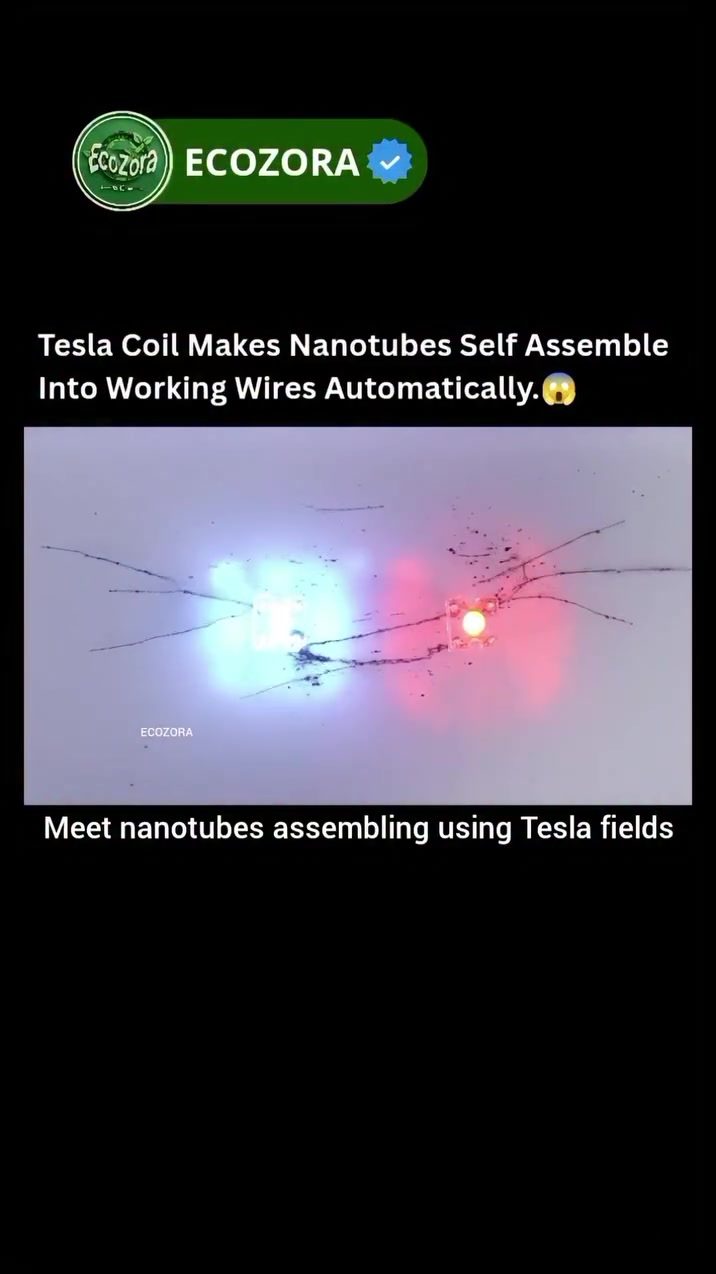
Nanotube Self-Assembly with Tesla Fields
Nanotube self-assembly using Tesla fields is a groundbreaking phenomenon that opens up new possibilities in the realm of nanotechnology. This process, demonstrated by researchers at Rice University, involves the use of a Tesla coil to create powerful electric fields that cause carbon nanotubes to self-assemble into conductive wires. The implications of this discovery are vast, ranging from wireless power circuits to advanced nanoelectronics and beyond.
Context / Why this Matters
The ability to manipulate matter at the nanoscale has long been a goal of scientists and engineers. Traditional methods often involve complex and precise mechanical manipulations, which can be time-consuming and expensive. However, the discovery of Teslaphoresis—a phenomenon where carbon nanotubes self-assemble into conductive wires under the influence of a Tesla coil's electric field—presents a revolutionary approach. This method not only simplifies the process but also enables the creation of structures that were previously unattainable.
Main Discussion
The Science Behind Teslaphoresis
Teslaphoresis leverages the powerful electric fields generated by a Tesla coil to induce rapid oscillations of positive and negative charges in carbon nanotubes. These oscillations create forces that cause the nanotubes to align, connect, and form long, conductive chains. The process is remarkable in its simplicity and effectiveness, allowing for the remote alignment and formation of wires without any physical contact.
Remote Alignment and Formation
One of the most intriguing aspects of this technology is the ability to remotely align and form wires. The nanotubes, when exposed to the electric field, move towards the Tesla coil, almost as if pulled by an invisible tractor beam. This remote manipulation capability is a significant advancement, offering new possibilities for wireless power circuits and other applications.
Potential Applications
The potential applications of nanotube self-assembly using Tesla fields are vast and exciting. Researchers believe that this discovery could one day contribute to self-building electronics, advanced nanoelectronics, and even biomedical technologies. For instance, the ability to create conductive wires wirelessly could pave the way for innovative power solutions, such as wireless charging and remote power transmission.
Experimental Demonstrations
In one experiment, the nanotubes formed a bridge between two LEDs, creating a complete electrical path. The circuit then harvested energy wirelessly from the Tesla coil, successfully lighting the LEDs without conventional wiring. This demonstration showcases the real-world potential of Teslaphoresis, highlighting its ability to challenge previous limits on how electric fields can manipulate matter.
Practical Tips
Setting Up a Tesla Coil for Nanotube Self-Assembly
While the exact setup may vary, the basic components typically include a Tesla coil, carbon nanotubes, and a power source. The key is to ensure that the electric field generated by the Tesla coil is strong enough to induce the necessary oscillations in the nanotubes. Researchers and hobbyists interested in experimenting with this phenomenon should start by studying the original paper and replicating the conditions described.
Safety Considerations
Working with high-voltage equipment like a Tesla coil requires careful attention to safety. Always follow proper safety protocols, including wearing appropriate protective gear and ensuring that the workspace is free from conductive materials that could short out the equipment.
Optimizing the Process
To optimize the nanotube self-assembly process, consider the following tips:
- Calibration: Ensure that the Tesla coil is properly calibrated to generate the desired electric field strength.
- Material Quality: Use high-quality carbon nanotubes to ensure consistent results.
- Environmental Control: Maintain a controlled environment to minimize external factors that could interfere with the process.
Important Takeaways
- Breakthrough in Nanotechnology: The discovery of Teslaphoresis represents a significant breakthrough in the field of nanotechnology, enabling the self-assembly of carbon nanotubes into conductive wires.
- Remote Manipulation: The ability to remotely align and form wires using electric fields opens up new possibilities for wireless power circuits and other applications.
- Potential Applications: The technology has potential applications in self-building electronics, advanced nanoelectronics, and biomedical technologies.
- Experimental Validation: Successful experiments, such as lighting LEDs wirelessly, validate the real-world potential of this phenomenon.
Conclusion
Nanotube self-assembly using Tesla fields is a fascinating and promising area of research with far-reaching implications. This technology not only simplifies the process of manipulating matter at the nanoscale but also opens up new possibilities for wireless power circuits and advanced nanoelectronics. As researchers continue to explore and refine this phenomenon, the future of nanotechnology looks brighter than ever. The ability to create structures and circuits wirelessly could revolutionize various industries, from electronics to medicine, paving the way for innovative and efficient solutions.
Questions readers ask
What exactly is a Tesla coil and how is it used in nanotube self-assembly?
A Tesla coil is a type of electrical circuit that generates high-voltage, low-current, high-frequency alternating-current electricity. In the context of nanotube self-assembly, a Tesla coil is used to create powerful electric fields, which facilitate the assembly of carbon nanotubes into conductive wires through a process known as Teslaphoresis.
How does the Teslaphoresis process enable remote manipulation of matter at the nanoscale?
The Teslaphoresis process uses the electric fields generated by a Tesla coil to remotely manipulate carbon nanotubes. These fields exert forces on the nanotubes, causing them to align and assemble into conductive wires without the need for direct physical contact, thus enabling remote nanoscale manipulation.
What are the potential applications of self-assembled carbon nanotubes in nanoelectronics manufacturing?
Self-assembled carbon nanotubes can be used to create advanced nanoelectronics with unique properties, such as high conductivity and flexibility. These nanotubes can be integrated into circuits for various applications, including flexible electronics, sensors, and even quantum computing components. Additionally, Tesla fields can be used to manipulate nanotubes into specific patterns, making them a powerful tool in nanoscale manufacturing.
Can this process be used for wireless power transmission, and if so, how?
Yes, one of the promising applications of nanotube self-assembly using Tesla fields is wireless power transmission. By assembling conductive wires from carbon nanotubes, it is possible to create circuits that can efficiently transmit power without the need for physical connections. This could revolutionize wireless charging and other power transmission technologies.
What advantages does nanotube self-assembly with Tesla fields have over traditional methods?
Nanotube self-assembly with Tesla fields offers several advantages, including remote manipulation, which reduces the need for complex and precise mechanical manipulations. This method can be faster, more cost-effective, and less labor-intensive than traditional techniques, making it a highly efficient approach to nanoscale fabrication.
What kind of infrastructure is needed to implement nanotube self-assembly using Tesla fields in a laboratory setting?
To implement nanotube self-assembly using Tesla fields, you would need a Tesla coil capable of generating powerful electric fields, a controlled environment to handle and observe the nanotubes, and possibly specialized equipment for measuring and monitoring the assembly process. Additionally, a deep understanding of nanotechnology and electrical engineering principles is crucial for optimizing the process.
Are there any safety considerations to keep in mind when working with Tesla coils and nanotube self-assembly?
When working with Tesla coils, it is important to be aware of the high-voltage, high-frequency electric fields generated, which can pose risks of electric shock and other hazards. Proper safety measures, including grounding, shielding, and personal protective equipment, should be employed. Additionally, handling carbon nanotubes requires precautions to prevent inhalation and other potential health risks.
Related deep dives
Similar reads based on topic and creator.




Recent articles
Fresh deep dives from the latest Reels we unpacked.




Comments
Be the first to comment.