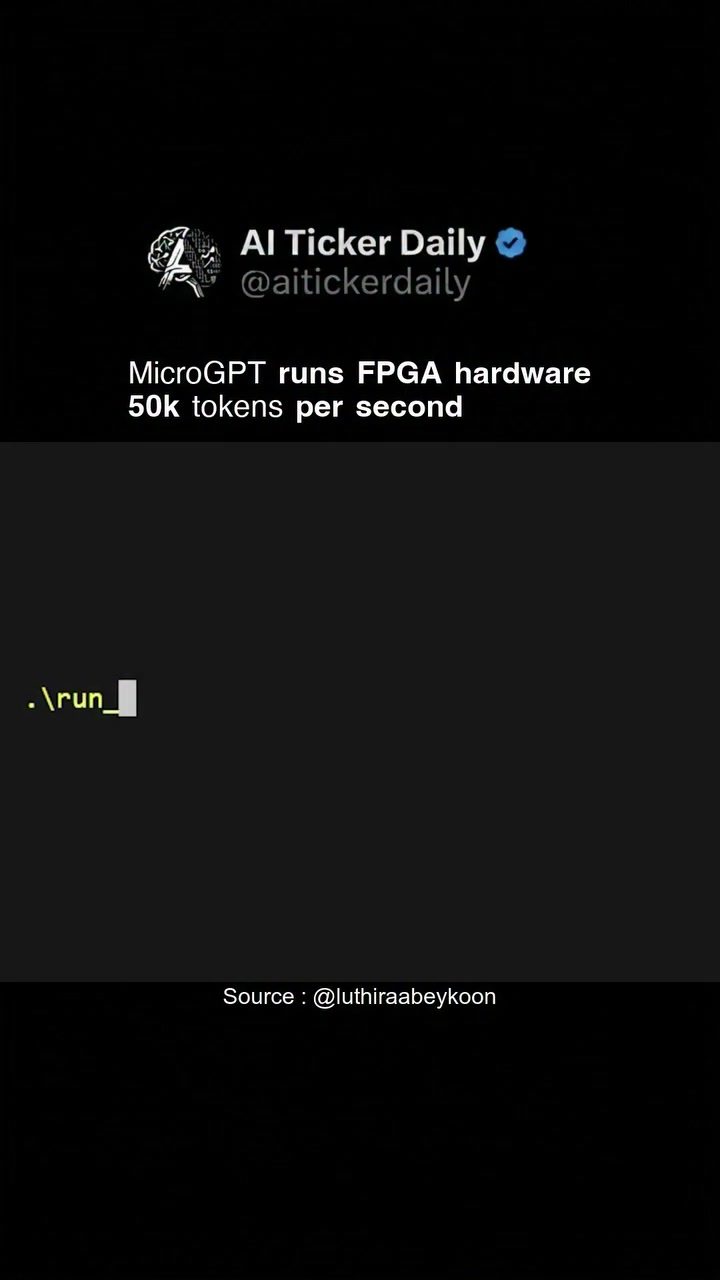
MicroGPT on FPGA Hardware
FPGA hardware has emerged as a powerful platform for running advanced machine learning models, and MicroGPT showcases how transformers can be implemented directly on FPGA fabric. The setup bypasses the need for a GPU stack, PyTorch, or traditional CPU inference loops, demonstrating that inference is not just a software problem but also a hardware challenge.
Context / Why this matters
MicroGPT, inspired by Andrej Karpathy's work, is a small yet impactful model that runs directly on FPGA hardware. This approach isn't just a technical curiosity; it has significant implications for real-world applications. By eliminating the need for a GPU stack and conventional CPU inference, MicroGPT shows that FPGA hardware can handle complex tasks efficiently. This shift could lead to more cost-effective, energy-efficient, and flexible AI solutions across various industries.
Main Discussion
Understanding MicroGPT and FPGA
MicroGPT is a streamlined version of the larger GPT models, optimized to run on FPGA hardware. FPGAs, or Field Programmable Gate Arrays, are integrated circuits designed to be configured by the end-user after manufacturing. This flexibility allows MicroGPT to run directly on the FPGA fabric, bypassing the need for traditional processing paths.
The Cyclone Chip and Performance Metrics
The hardware setup features a 'Cyclone' chip, which is integral to achieving the high performance metrics of 50,000+ tokens per second. This performance is measured on a DE-SoC (Development System on Chip), highlighting the efficiency and speed of the FPGA-based approach. The system's ability to process such a high number of tokens per second underscores the potential of FPGA hardware in handling intensive computational tasks.
The TALOS V2 System
The TALOS V2 system is another key component in this setup. It provides the necessary hardware infrastructure to support the efficient running of MicroGPT. The TALOS V2 system is designed to work seamlessly with FPGA hardware, ensuring that the model can operate at optimal performance levels.
Practical Tips
Leveraging FPGA Hardware for AI Models
If you're considering leveraging FPGA hardware for your AI models, there are several practical tips to keep in mind:
-
Understand the FPGA Fabric: Familiarize yourself with the FPGA fabric and how it can be configured to support your specific AI model. This involves understanding the hardware architecture and how to implement your model directly on the FPGA.
-
Optimize for Performance: Focus on optimizing your model for performance. MicroGPT achieves high token processing speeds by being implemented directly on the FPGA fabric, which can be a benchmark for your own models.
-
Utilize Development Tools: Use development tools that support FPGA hardware. This includes software that allows you to configure the FPGA and test your model on the hardware.
-
Consider Power and Cost Efficiency: One of the advantages of using FPGA hardware is its potential for power and cost efficiency. Ensure that your implementation takes advantage of these benefits.
-
Work with Specialized Systems: Systems like the TALOS V2 are designed to work with FPGA hardware. If you're new to FPGA, consider using specialized systems that can simplify the implementation process.
Important Takeaways
The implementation of MicroGPT on FPGA hardware highlights several critical points:
-
Efficiency: FPGA hardware can handle complex AI models efficiently, achieving high performance metrics without the need for a GPU stack or traditional CPU inference loops.
-
Flexibility: The ability to configure FPGA hardware for specific tasks makes it a versatile option for various AI applications.
-
Cost and Power: FPGA hardware can be more cost-effective and power-efficient compared to traditional methods, making it an attractive option for real-world applications.
-
Performance: The high token processing speed of 50,000+ tokens per second shows that FPGA hardware is capable of handling intensive computational tasks effectively.
Conclusion
MicroGPT's implementation on FPGA hardware, particularly with the Cyclone chip and TALOS V2 system, demonstrates the potential of FPGA technology in AI. By running directly on the FPGA fabric, MicroGPT achieves impressive performance metrics, showcasing a future where AI models are not just software problems but also hardware solutions. This shift could revolutionize how we approach AI, offering more efficient, flexible, and cost-effective solutions.
Questions readers ask
What is MicroGPT and why is it significant?
MicroGPT is a machine learning model designed to run directly on FPGA hardware. Its significance lies in its ability to process over 50,000 tokens per second, demonstrating the potential of FPGAs for efficient and cost-effective AI solutions. This model bypasses the need for traditional processing paths, such as GPUs and CPUs, highlighting the hardware's capability in handling complex AI tasks.
How does MicroGPT achieve such high performance on FPGA hardware?
MicroGPT achieves high performance by being optimized to run directly on the FPGA fabric, circumventing the need for a traditional GPU stack, PyTorch, or CPU inference loops. This direct implementation on FPGA hardware allows for faster processing speeds and more efficient use of resources, making it a standout example of advanced AI on FPGA.
What are the benefits of using FPGA hardware for AI compared to GPUs?
FPGA hardware offers several benefits for AI, including cost-effective and energy-efficient processing. Unlike GPUs, FPGAs can be programmed to match the specific needs of a task, leading to more efficient AI inference. This makes FPGAs a compelling option for industries looking to reduce operational costs and energy consumption while maintaining high performance.
Can MicroGPT be used in real-world applications, and if so, how?
Yes, MicroGPT's efficient processing capabilities make it suitable for real-world applications. By running directly on FPGA hardware, it can handle complex AI tasks in industries such as healthcare, finance, and automotive, where real-time processing and low power consumption are crucial. This makes it a practical solution for cost-effective and energy-efficient AI deployments.
What does it mean for an FPGA to process 50,000 tokens per second?
Processing 50,000 tokens per second on an FPGA means that the hardware can handle a large volume of data at a high speed, which is crucial for real-time AI applications. This performance metric indicates that FPGAs are capable of delivering rapid, efficient processing, making them a strong contender for AI tasks that require quick data analysis and inference.
How does MicroGPT's performance compare to traditional AI processing methods?
MicroGPT's performance sets it apart from traditional AI processing methods by achieving over 50,000 tokens per second on FPGA hardware, which is a significant advancement. Traditional methods, which often rely on GPUs and CPUs, may not match this level of efficiency and speed, making MicroGPT a benchmark for future AI model optimization on FPGA hardware.
Related deep dives
Similar reads based on topic and creator.




Recent articles
Fresh deep dives from the latest Reels we unpacked.




Comments
Be the first to comment.