Robotics Innovation
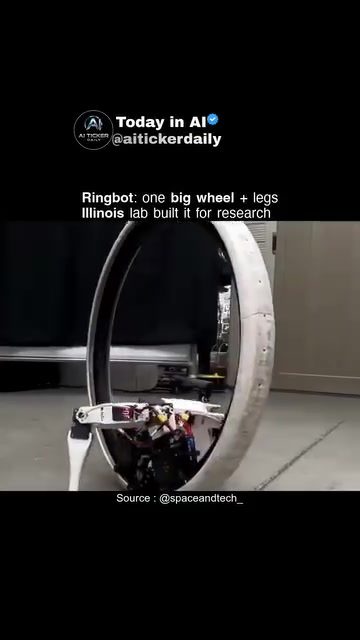
Research robots continue to push the boundaries of what's possible, with unique designs that challenge conventional wisdom. Among these innovations, the RingBot stands out. This robot, developed at the University of Illinois Urbana-Champaign by Professor Joo Young Kim's Kinetic Intelligent Machine Lab, is a fascinating blend of form and function. It features a circular wheel and two legs, inspired by iconic designs from science fiction.
Context
RingBot is more than just another robot; it's a testament to the advancements in robotics research. Developed in a university lab, this robot is designed to test new ways of movement and steering in diverse and challenging terrains. The unique design of RingBot allows it to navigate environments that would be difficult for traditional robots. This innovative robot is not designed for specific practical applications but is built to explore new possibilities in robotics.
Main discussion
Design and inspiration
The design of RingBot is notably reminiscent of the Star Wars-inspired monocycle robots, featuring a circular wheel and two legs. This design is not just for aesthetics; it serves a practical purpose. The ring-shaped wheel, along with the legs, allows the robot to move in ways that traditional robots cannot. It can use its legs to step over obstacles, lean to steer, and balance itself, making it highly maneuverable.
Movement and mobility
One of the key features of RingBot is its ability to move using both its legs and wheels. Inside the wheel, the legs are attached to two independent driving modules. These modules control the robot's velocity and orientation, allowing it to track a desired path accurately. The motors inside the driving modules can make full rotations within the wheel, enabling the robot to drive at speeds up to 5 kilometers per hour.
Advanced systems
RingBot is equipped with several advanced systems that enhance its capabilities. It has an obstacle avoidance system that helps the robot detect and navigate around obstacles in its path. This system ensures that the robot can reach its predefined destination without getting stuck or damaged. Additionally, RingBot has a fall recovery and balancing system. This means that if the robot wobbles or falls, it can stand back up using its legs, ensuring continuous operation.
Research and development
RingBot was designed and developed by Professor Joo Young Kim and his team at the Kinetic Intelligent Machine Lab, also known as Kim Lab, at the University of Illinois Urbana-Champaign. The lab focuses on creating kinetic intelligent machines, and RingBot is a prime example of their innovative work. The robot's unique design and capabilities are the result of extensive research and development, making it a significant contribution to the field of robotics.
Testing terrain
The robot's unique structure is built to test how to move and steer on weird terrain. The design allows it to navigate environments that would be challenging for traditional robots. The combination of a large ring-shaped wheel and legs makes it capable of handling diverse terrains, from smooth surfaces to rough and uneven ground.
Practical tips
For those interested in robotics, understanding the design and capabilities of RingBot can provide valuable insights into the latest advancements in the field. Here are some practical tips for anyone looking to explore similar innovations:
-
Study the design: The unique design of RingBot, with its circular wheel and legs, offers a fresh perspective on robot mobility. Exploring this design can inspire new ideas for robot construction.
-
Learn about advanced systems: Understanding the obstacle avoidance, fall recovery, and balancing systems in RingBot can help in developing similar technologies for other robots.
-
Explore research opportunities: The Kinetic Intelligent Machine Lab at the University of Illinois Urbana-Champaign is a hub for innovative research. Exploring their work and collaborating with them can provide valuable experience and knowledge.
-
Experiment with different terrains: Testing robot designs on various terrains can yield new insights into how robots can be built to navigate challenging environments.
-
Focus on practical applications: While RingBot is primarily a research tool, understanding its design and capabilities can inspire practical applications in fields like search and rescue, exploration, and more.
Important takeaways
RingBot represents a significant step forward in robotics research. Its unique design and advanced systems make it a powerful tool for testing new ways of movement and steering. The robot's ability to navigate challenging terrains and recover from falls showcases the potential of innovative robot designs. For researchers and enthusiasts alike, RingBot offers a wealth of knowledge and inspiration.
Conclusion
The RingBot is a groundbreaking innovation in the field of robotics. Its unique design, advanced systems, and capabilities make it a valuable tool for research and development. By exploring the insights and practical applications of RingBot, we can push the boundaries of what's possible in robotics and inspire new innovations in the field.
Questions readers ask
What makes RingBot's design unique compared to other robots?
RingBot's design is unique because it combines a circular wheel with two legs, inspired by Star Wars. This design allows it to navigate challenging terrains and obstacles more effectively than traditional robots.
Who developed RingBot and where is it based?
RingBot was developed by Professor Joo Young Kim's Kinetic Intelligent Machine Lab at the University of Illinois Urbana-Champaign.
What is the main purpose of RingBot in robotic research?
RingBot's main purpose is to test new methods of movement and steering in diverse and challenging environments. Its unique design helps researchers explore innovative ways for robots to navigate complex terrains and obstacles.
How does RingBot's design help it navigate difficult environments?
RingBot's circular wheel and two legs work together to provide stability and mobility. Its wheel allows it to move smoothly on flat surfaces, while its legs help it climb over obstacles and navigate uneven grounds.
Why was the design of RingBot inspired by Star Wars?
The design of RingBot was inspired by iconic designs from Star Wars, such as the circular shape of certain vehicles or vehicles with legs. This inspiration helped shape the robot's unique combination of a wheel and two legs.
What kind of terrains and obstacles can RingBot navigate?
RingBot is designed to navigate a variety of challenging terrains and obstacles. Its unique design allows it to climb over obstacles, traverse uneven surfaces, and move smoothly on flat grounds.
What research benefits does the development of RingBot provide?
The development of RingBot provides research benefits by offering a new platform to study alternative methods of movement and steering. This can lead to advancements in robotics, enhancing the capabilities of robots to operate in diverse environments.
Related deep dives
Similar reads based on topic and creator.




Recent articles
Fresh deep dives from the latest Reels we unpacked.




Comments
Be the first to comment.