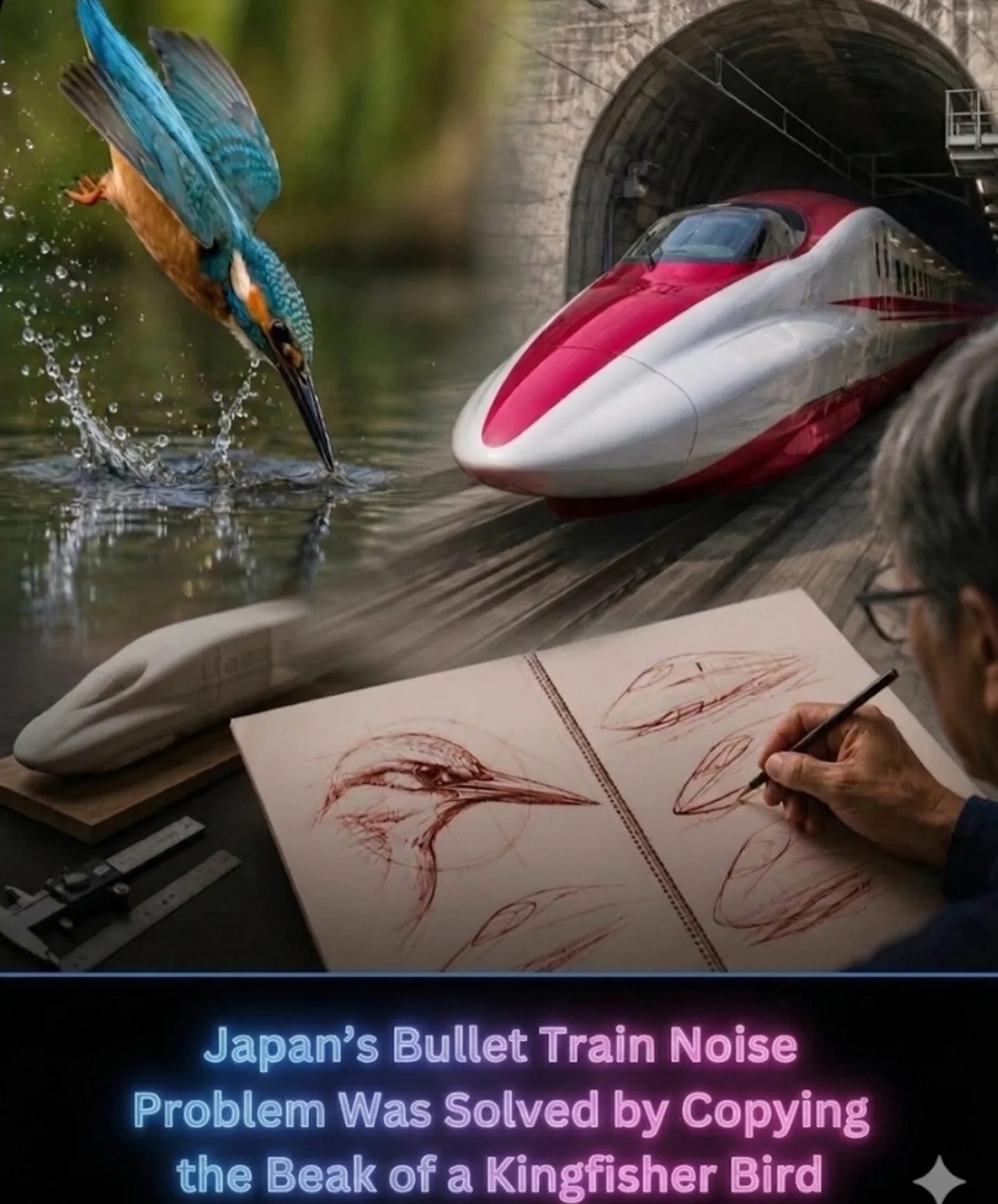
Inspiring Engineering Solutions: How the Kingfisher's Beak Revolutionized Bullet Train Design
High-speed trains, particularly Japan's Shinkansen, are marvels of engineering. However, in the 1990s, these trains faced a significant challenge known as the "tunnel boom" problem. The blunt noses of the trains created a massive atmospheric pressure wave, resulting in thunderous noise when exiting tunnels. This issue not only caused discomfort for passengers but also posed potential safety risks. The solution to this problem came from an unexpected source: the beak of the kingfisher bird.
Context
The "tunnel boom" problem was a significant hurdle for Japan's high-speed trains. The blunt noses of the trains generated a massive pressure wave when they exited tunnels, creating an extremely loud noise. This problem not only affected the comfort of passengers but also had potential safety implications. Engineers needed a creative and effective solution to mitigate this issue.
The Kingfisher's Inspiration
The inspiration for solving this problem came from the natural world. Engineer and birdwatcher Eiji Nakatsu observed the kingfisher, a bird known for its ability to dive from thin air into dense water with barely a splash. The kingfisher's beak is uniquely shaped, allowing it to enter the water smoothly and efficiently. This observation led Nakatsu to propose a revolutionary solution to the tunnel boom problem.
Main Discussion
Biomimicry: Nature's Blueprint for Engineering
Biomimicry, the practice of learning from and mimicking the strategies found in nature, has been a rich source of inspiration for engineers. By observing how the kingfisher's beak allows it to dive smoothly into water, Nakatsu and his team saw an opportunity to redesign the train's nose. The long, tapered shape of the kingfisher's beak provided a blueprint for a more aerodynamically efficient train design.
Redesigning the Train's Nose
The engineers set out to mimic the kingfisher's beak shape in the design of the train's nose. This redesign involved creating a more streamlined and tapered nose, which significantly reduced the pressure wave generated when the train exited a tunnel. The new design not only eliminated the noise pollution but also brought about several additional benefits.
Performance Improvements
The redesigned nose of the train, inspired by the kingfisher's beak, had a profound impact on the train's performance. The most significant improvements were:
- Reduced Noise Pollution: The new design effectively eliminated the thunderous noise created by the old blunt-nosed trains, greatly enhancing passenger comfort.
- Increased Speed: The more aerodynamic shape allowed the trains to achieve a 10% increase in speed.
- Energy Efficiency: The redesigned nose also resulted in a 15% reduction in electricity consumption, making the trains more energy-efficient.
The Impact on Modern Engineering
The success of this biomimicry-inspired design has had a lasting impact on modern engineering. It serves as a testament to the power of observing and learning from nature. Engineers and scientists continue to look to the natural world for inspiration in solving complex problems. This approach not only leads to innovative solutions but also promotes sustainability and efficiency.
Practical Tips
Observing Nature for Inspiration
Engineers and innovators can benefit from observing nature for inspiration. Biomimicry offers a wealth of solutions to complex problems. By studying natural phenomena, one can uncover efficient and effective designs that have been perfected over millions of years of evolution. For instance, engineers can learn from the aerodynamics of birds, the strength of spider silk, or the energy-efficient movements of marine animals.
Incorporating Biomimicry in Design
Incorporating biomimicry into design involves several steps:
- Identify the Problem: Clearly define the problem you are trying to solve.
- Study Natural Analogies: Look for natural systems or organisms that exhibit behaviors or structures similar to the problem you are addressing.
- Analyze and Adapt: Study these natural solutions in detail and adapt them to your specific problem.
- Test and Iterate: Test the new design and iterate based on the results to achieve the best performance.
Collaborating Across Disciplines
Collaboration across different disciplines is crucial for successful biomimicry. Engineers, scientists, and even artists can work together to find innovative solutions inspired by nature. For example, biologists can provide insights into natural phenomena, while engineers can transform these insights into practical designs.
Important Takeaways
The story of how the kingfisher's beak inspired the redesign of Japan's bullet trains highlights the power of biomimicry in engineering. Nature has provided countless solutions to complex problems, and by observing and learning from these solutions, we can create more efficient, sustainable, and innovative designs. This approach not only solves immediate problems but also opens up new avenues for future innovations.
Conclusion
The journey from the kingfisher's beak to the streamlined nose of Japan's bullet trains is a remarkable example of how nature can inspire engineering solutions. By mimicking the aerodynamics of the kingfisher's beak, engineers were able to solve a significant problem and improve train performance dramatically. This success underscores the value of biomimicry in modern engineering and encourages us to look to nature for more innovative solutions. As we continue to face complex challenges, let us remember the lessons from the natural world and use them to shape a better future.
Questions readers ask
How did the kingfisher's beak inspire bullet train design?
Engineers observed that the kingfisher's beak has a unique shape that allows it to dive from air into water with minimal splash. Mimicking this design helped reduce the atmospheric pressure wave caused by bullet trains exiting tunnels, thereby decreasing noise and improving efficiency.
What is the tunnel boom problem?
The tunnel boom problem refers to the loud noise generated when high-speed trains emerge from tunnels. This occurs due to the pressure wave created by the train's blunt nose, which can be disruptive to passengers and potentially hazardous.
How does the kingfisher beak design improve bullet train efficiency?
By adopting the kingfisher beak's streamlined shape, bullet trains can reduce drag and decrease energy consumption. This design innovation allows for smoother transitions in and out of tunnels, enhancing the overall efficiency of the train.
What specific changes were made to the Japanese bullet train design based on the kingfisher's beak?
Japanese engineers redesigned the nose of the bullet train to mimic the kingfisher's beak, creating a longer, slimmer shape. This modification helps to disperse the pressure wave more gradually, reducing the noise and vibrations experienced by passengers.
Can other types of trains benefit from the kingfisher beak design?
While the kingfisher beak design is particularly beneficial for high-speed trains facing the tunnel boom problem, its principles of streamlined design and pressure wave reduction can be applied to other types of trains to improve their overall performance and passenger comfort.
What other benefits does the kingfisher-inspired design offer besides noise reduction?
In addition to noise reduction, the kingfisher-inspired design enhances the aerodynamic efficiency of bullet trains, leading to lower energy consumption. This can result in cost savings for train operators and a reduced environmental impact.
How was the effectiveness of the kingfisher beak design for bullet trains validated?
The effectiveness of the kingfisher beak design was validated through extensive testing and real-world trials. Engineers conducted simulations and physical tests to measure the reduction in noise and improvements in efficiency, confirming the design's benefits before implementing it on commercial trains.
Related deep dives
Similar reads based on topic and creator.




Recent articles
Fresh deep dives from the latest Reels we unpacked.




Comments
Be the first to comment.