Andrej Karpathy's LLM Wiki Layer: A Game Changer for AI Agents
Andrej Karpathy, a founding member of OpenAI and former head of AI at Tesla, introduced an innovative LLM Wiki architecture in April 2026. This groundbreaking system has already garnered over 5,000 GitHub stars in its first week, showcasing its potential to revolutionize how AI agents process and utilize information. The core issue this architecture addresses is the inefficiency of AI agents re-reading the same raw files repeatedly, leading to token wastage and loss of context, ultimately resulting in less accurate answers.
Why This Matters
The efficiency of AI agents is pivotal in various applications, from data analysis to customer support. By optimizing how these agents handle and process information, organizations can significantly enhance their operational effectiveness and reduce costs. Karpathy's LLM Wiki Layer offers a practical solution to these challenges, making it a critical development in the field of AI.
Main Discussion
The Problem with Traditional AI Processing
Traditional AI agents often waste tokens by repeatedly re-reading the same raw files. This process not only consumes valuable computational resources but also leads to a loss of context, as the agent has to re-process the information each time it accesses the file. This inefficiency can result in less accurate and less contextually relevant answers, which is a significant drawback in applications requiring precise and reliable data processing.
The LLM Wiki Layer Solution
Karpathy's solution is deceptively simple yet highly effective. The system involves a three-folder structure:
- Raw Files Folder: All raw files are stored in this folder.
- Processing Folder: An LLM processes the raw files once, cleaning, structuring, and cross-linking the information into a compact Markdown knowledge base.
- Wiki Folder: The processed Markdown knowledge base is stored here, and from this point on, the agent reads only from the polished wiki, never re-accessing the original raw files.
This approach dramatically reduces token usage. For instance, one user consolidated 383 scattered files and over 100 meeting transcripts using this method and cut their token usage by 95%. This efficiency is achieved through the structured and compact nature of the Markdown knowledge base, which makes it easier for the AI agent to access the necessary information without redundant processing.
Benefits of the LLM Wiki Layer
- Efficiency: By structuring raw files into a Markdown knowledge base, the system minimizes the number of times the AI agent needs to process the raw data, significantly reducing token usage.
- Accuracy: The structured and cross-linked information in the Markdown knowledge base ensures that the AI agent has a comprehensive and contextually rich understanding of the data, leading to more accurate answers.
- Local Operation: The entire system operates locally, eliminating the need for cloud storage and ensuring data privacy and security. This local operation also reduces latency and dependence on external resources, making the system more reliable and cost-effective.
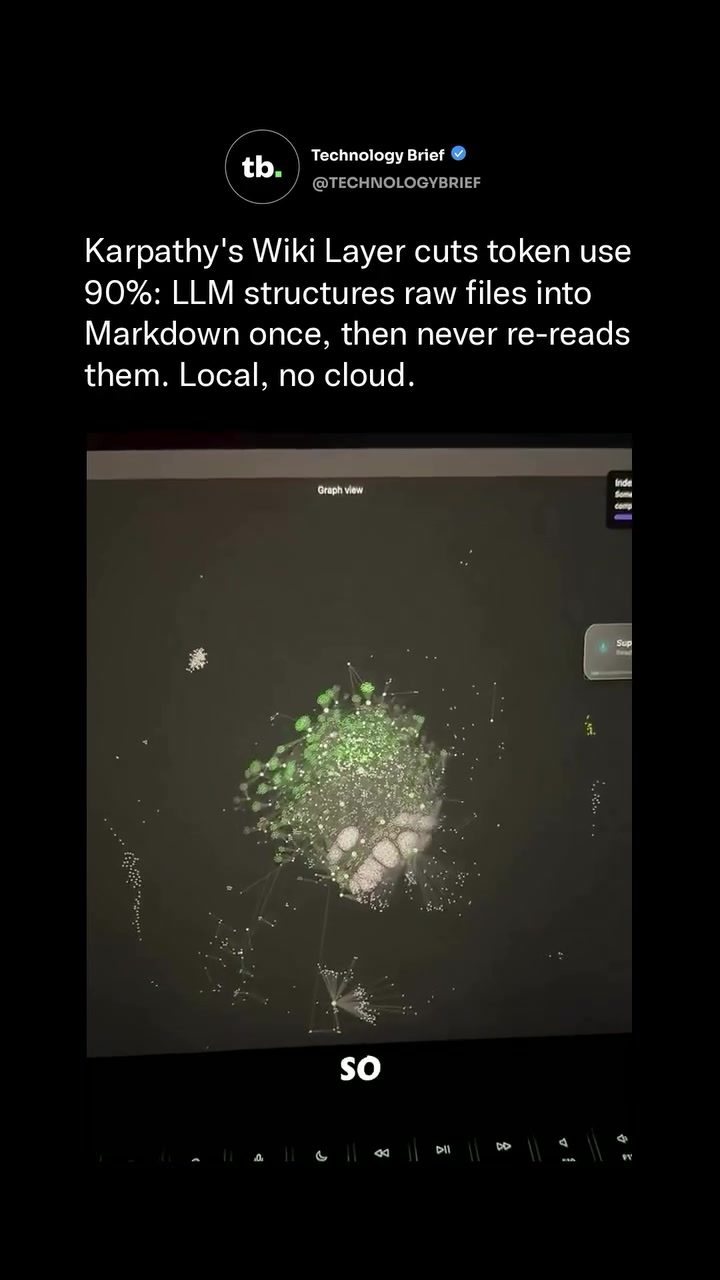
- Visualization: The linked wiki files can be visualized as a knowledge graph inside Obsidian, providing a clear and intuitive way to navigate and understand the structured data.
Real-Time Tracking and Analytics
The system also includes real-time tracking and analytics features, allowing users to monitor usage statistics and performance metrics. For example, the interface displays live usage statistics for Claude Code and Codex Sessions, providing insights into how the system is being utilized and where improvements can be made.
Practical Tips
Implementing the LLM Wiki Layer
To implement the LLM Wiki Layer, follow these steps:
- Set Up the Folder Structure: Create three folders—one for raw files, one for processing, and one for the wiki.
- Process Raw Files: Use an LLM to process the raw files, structuring them into a Markdown knowledge base.
- Store the Knowledge Base: Move the processed Markdown files to the wiki folder.
- Configure the AI Agent: Set the AI agent to read from the wiki folder instead of the raw files folder.
- Monitor Performance: Use the real-time tracking and analytics features to monitor the system's performance and make necessary adjustments.
Optimizing Performance
- Regular Updates: Ensure that the raw files are regularly updated and re-processed to maintain the accuracy and relevance of the knowledge base.
- Customization: Tailor the processing and structuring of the raw files to suit the specific needs and context of your application.
- Integration: Integrate the LLM Wiki Layer with other tools and systems to enhance its functionality and utility.
Important Takeaways
- Efficiency: The LLM Wiki Layer significantly reduces token usage by processing raw files once and structuring them into a compact Markdown knowledge base.
- Accuracy: The structured and cross-linked information in the Markdown knowledge base ensures more accurate and contextually relevant answers from AI agents.
- Local Operation: The system operates locally, enhancing data privacy, security, and reliability.
- Visualization: The linked wiki files can be visualized as a knowledge graph, providing a clear and intuitive way to navigate and understand the structured data.
Conclusion
Andrej Karpathy's LLM Wiki Layer is a groundbreaking solution that addresses the inefficiencies of traditional AI processing. By structuring raw files into a compact and cross-linked Markdown knowledge base, the system reduces token usage, enhances accuracy, and operates locally, making it a valuable tool for various applications. Implementing this architecture can significantly improve the efficiency and effectiveness of AI agents, leading to more accurate and contextually relevant results.
Questions readers ask
What is the primary problem that the LLM Wiki Layer architecture aims to solve?
The LLM Wiki Layer architecture, developed by Andrej Karpathy, addresses the inefficiency of AI agents repeatedly re-reading the same raw files. This repetitive process leads to token wastage and context loss, resulting in less accurate and contextually irrelevant outcomes.
How does the LLM Wiki Layer architecture improve AI agent efficiency?
By organizing and processing information more effectively, the LLM Wiki Layer reduces the need for AI agents to re-read raw files. This optimization leads to more accurate and relevant answers, enhancing overall efficiency and reducing costs.
What are the key benefits of implementing the LLM Wiki Layer architecture in AI systems?
The architecture offers several benefits, including improved accuracy, better context relevance, and cost reduction. It allows AI agents to handle information more effectively, ultimately enhancing AI data processing and AI information handling.
Who developed the LLM Wiki Layer architecture, and what is their background?
Andrej Karpathy, a notable figure in AI research, developed the LLM Wiki Layer architecture. He is a founding member of OpenAI and the former head of AI at Tesla, bringing extensive expertise to this innovative solution.
How does the LLM Wiki Layer architecture enhance AI agent learning and task automation?
By optimizing how AI agents handle and process information, the LLM Wiki Layer architecture can significantly improve AI learning. This enhanced data processing capability allows for better task automation, as AI agents can more efficiently complete tasks without redundant data processing.
What impact has the LLM Wiki Layer architecture had since its introduction?
The LLM Wiki Layer architecture, introduced in April 2026, has already garnered over 5,000 stars on GitHub in its first week. This rapid adoption highlights its potential to revolutionize AI data processing and AI document processing, making it a pivotal development in the AI field.
Can the LLM Wiki Layer architecture be integrated with existing AI systems, and how does it improve them?
Yes, the LLM Wiki Layer architecture can be integrated with existing AI systems to enhance their functionality. By optimizing AI agents' data processing and AI information handling, it improves the accuracy and relevance of AI-generated responses, making AI systems more efficient and cost-effective.
Related deep dives
Similar reads based on topic and creator.




Recent articles
Fresh deep dives from the latest Reels we unpacked.




Comments
Be the first to comment.