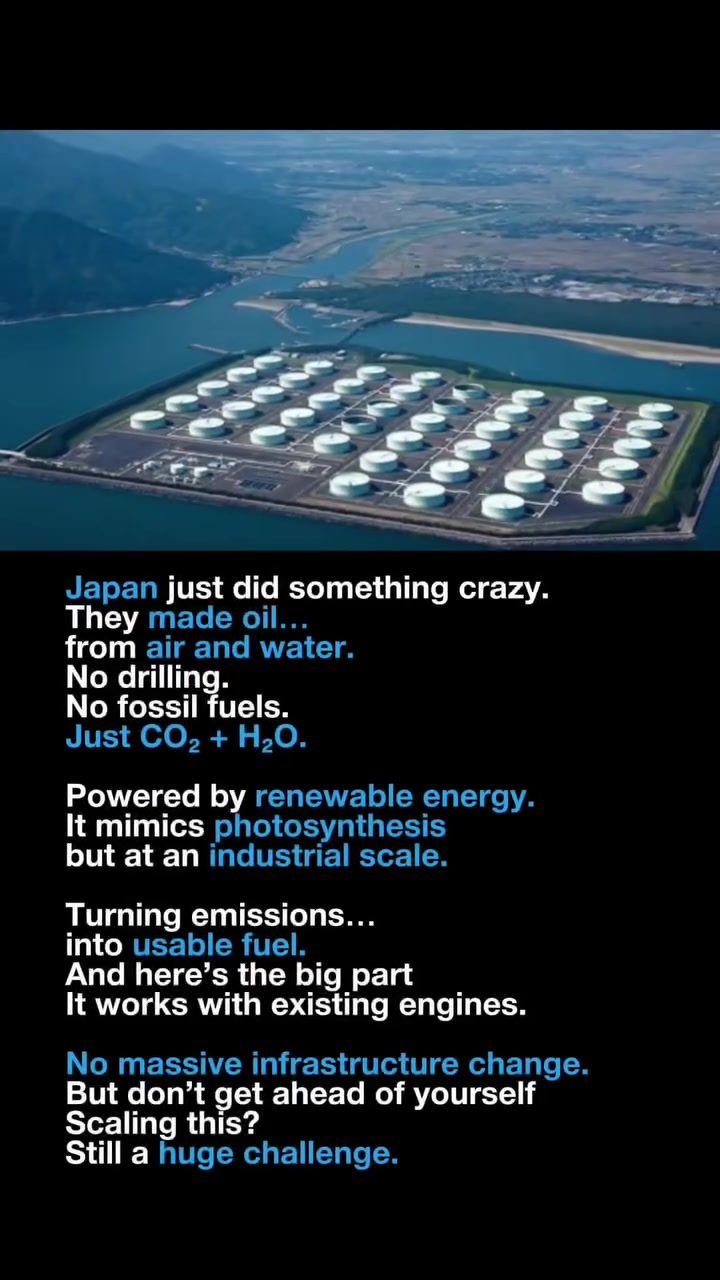
Renewable Fuel Production: Japan's Innovative Approach to Turning Air and Water into Fuel
Japan has made a significant leap in the realm of renewable energy by developing a method to produce liquid hydrocarbon fuel using carbon dioxide and water. This groundbreaking process, powered by renewable energy, uses photocatalysts to mimic photosynthesis on an industrial scale, effectively turning emissions into usable fuel. While the technology holds immense promise, scaling it efficiently and economically remains a major challenge.
Context: Why This Matters
The global push towards sustainable energy solutions has become more urgent than ever. Traditional fossil fuels are finite and their extraction often has significant environmental impacts. By contrast, renewable energy sources like solar, wind, and hydro are abundant and have far lower environmental footprints. However, one of the challenges with renewable energy is its intermittency—sunlight isn't always available, and wind doesn't always blow. This is where the concept of producing liquid fuels from air and water becomes crucial. Such fuels can be stored and used when renewable energy sources are not available, providing a more stable and reliable energy supply.
The Process: Turning Emissions into Fuel
Mimicking Photosynthesis
At the heart of this innovative process is the use of photocatalysts that mimic the natural process of photosynthesis. Photosynthesis is the process by which plants convert light energy into chemical energy stored in glucose. In nature, this process requires chlorophyll, water, and carbon dioxide. Similarly, the Japanese method uses photocatalysts to convert CO₂ and H₂O into liquid hydrocarbons using renewable energy.
Industrial-Scale Production
The process occurs at an industrial scale, making it a viable solution for large-scale fuel production. By using renewable energy sources like solar and wind power, the process ensures that the fuel produced is both clean and sustainable. The liquid hydrocarbons generated can be used in existing engines without the need for significant infrastructure changes, making it a practical solution for current fuel needs.
Compatibility with Existing Engines
One of the most significant advantages of this technology is its compatibility with existing engines. Unlike some alternative fuels that require specialized engines or infrastructure, the liquid hydrocarbons produced through this method can be used directly in current combustion engines. This means that the transition to cleaner energy systems can occur more smoothly without the need for massive overhauls of existing infrastructure.
Practical Tips: Implementing the Technology
Scaling the Production Process
While the concept is promising, the biggest challenge lies in scaling the production process. Researchers need to find ways to increase output while keeping costs manageable. This involves optimizing the use of photocatalysts, improving the efficiency of the conversion process, and ensuring a steady supply of renewable energy.
Efficiency and Economic Viability
To make this technology economically viable, researchers must focus on improving the efficiency of the photocatalysts and reducing the energy required for the process. This will help lower the overall cost of production, making it more competitive with traditional fossil fuels.
Infrastructure and Integration
Another important aspect is the integration of this technology with existing infrastructure. While the fuel produced is compatible with current engines, the production and distribution infrastructure need to be developed. This includes setting up large-scale facilities for fuel production and establishing distribution networks to ensure the fuel reaches consumers efficiently.
Important Takeaways
Turning Pollution into a Resource
The ability to convert CO₂ emissions into usable fuel is a game-changer. It not only reduces the amount of greenhouse gases in the atmosphere but also turns a harmful pollutant into a valuable resource. This dual benefit makes the technology a critical piece in the transition towards cleaner energy systems.
A Step Towards Cleaner Energy
The compatibility of the fuel with existing engines means that the transition to cleaner energy can occur more seamlessly. This reduces the initial investment required and makes the switch more accessible for a wider range of consumers and industries.
Challenges and Opportunities
While the challenges of scaling the technology are significant, the potential benefits are immense. Addressing these challenges will require ongoing research and innovation, but the rewards—both environmental and economic—make it a worthwhile endeavor.
Conclusion
Japan's innovative approach to producing liquid hydrocarbon fuel from air and water represents a significant step forward in the quest for sustainable energy solutions. By mimicking photosynthesis on an industrial scale, this technology offers a viable and practical way to turn emissions into usable fuel. While challenges remain, particularly in scaling the process efficiently and economically, the potential benefits are enormous. As we continue to explore and develop this technology, it could play a crucial role in the transition towards cleaner, more sustainable energy systems.
Questions readers ask
How exactly does Japan's method convert CO2 and water into fuel?
Japan's method uses photocatalysts to drive a chemical reaction that converts carbon dioxide and water into liquid hydrocarbon fuels, similar to how plants use photosynthesis to convert CO2 and water into glucose. This process is powered by renewable energy sources, making it a sustainable way to produce fuel.
What are photocatalysts and how do they contribute to this process?
Photocatalysts are materials that absorb light and use that energy to drive chemical reactions. In this context, they facilitate the conversion of carbon dioxide and water into liquid hydrocarbon fuels, enabling the process to mimic photosynthesis.
How does this technology address the issue of industrial emissions?
By converting carbon dioxide emissions into usable fuel, this technology helps to reduce the amount of CO2 released into the atmosphere. This not only mitigates the environmental impact of industrial activities but also creates a valuable resource from what would otherwise be waste.
What are the main challenges in scaling up this technology?
The primary challenges are economic and technological. While the process holds great promise, making it efficient and cost-effective on a large scale is still a work in progress. Researchers are working to improve the efficiency of the photocatalysts and reduce the overall cost of the process.
What types of renewable energy sources can power this fuel production process?
This process can be powered by various renewable energy sources, including solar, wind, and hydroelectric power. The use of renewable energy ensures that the fuel production process itself is sustainable and does not contribute to further emissions.
What are the potential benefits of using synthetic hydrocarbon fuels?
Synthetic hydrocarbon fuels produced through this method can serve as a reliable and sustainable alternative to traditional fossil fuels. They can be used in existing infrastructure without significant modifications, making the transition to sustainable energy sources more feasible.
How does Japan's approach compare to other methods of producing fuel from air?
Japan's approach stands out due to its use of photocatalysts and renewable energy, which makes the process more sustainable. Other methods might rely on different technologies or energy sources, but Japan's focus on mimicking natural photosynthesis and using readily available resources like CO2 and water sets it apart.
Recent articles
Fresh deep dives from the latest Reels we unpacked.




Comments
Be the first to comment.