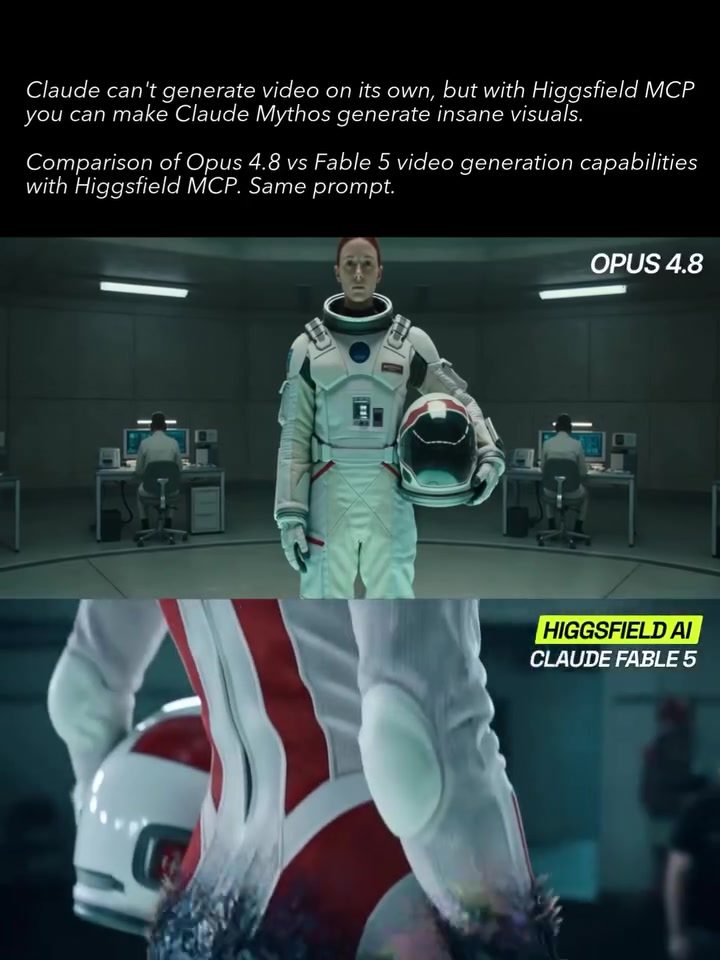
AI Video Generation: Opus 4.8 vs. Claude Fable 5
AI video generation has taken a significant leap forward with the introduction of Anthropic's Claude Fable 5 and its comparison with Opus 4.8. These models, when paired with Higgsfield MCP, showcase the next phase of AI capabilities in video creation.
Context / Why this matters
The rapid advancement in AI video generation tools has opened new avenues for content creators, filmmakers, and game developers. The ability to generate high-quality videos, websites, and games from simple prompts significantly reduces the time and effort required for production. This technology not only streamlines the creative process but also democratizes content creation, making it accessible to a broader audience.
Main discussion
The Rise of Claude Fable 5
Claude Fable 5, Anthropic’s first public Mythos-class model, is designed for long, complex tasks. This model can generate full cinematic videos, build working websites, and even produce playable games. The key to its versatility lies in its ability to work seamlessly with Higgsfield MCP, allowing users to go from an initial idea to a finished product without leaving the conversation.
Opus 4.8: The Stable Force
Opus 4.8, on the other hand, is a well-established model known for its reliability and efficiency. It has been a go-to for many creators looking to generate high-quality videos quickly. Opus 4.8 is particularly praised for its user-friendly interface and consistent output quality.
Higgsfield MCP: The Connector
Higgsfield MCP acts as a connector, bridging the gap between different AI models and enabling seamless integration. With Higgsfield MCP, users can input a single prompt and receive a comprehensive output, whether it's a video, website, or game. This connector simplifies the creative process and enhances the capabilities of both Opus 4.8 and Claude Fable 5.
Real-World Applications
The combination of these models and the Higgsfield MCP has real-world applications that go beyond just video generation. For instance, in the film industry, production teams can quickly generate concept videos, trailers, and even full-length films. Game developers can create playable prototypes and marketing materials with ease. Web designers can build functional websites with minimal effort, allowing them to focus more on design and aesthetics.
Practical tips
Choosing the Right Model
When deciding between Opus 4.8 and Claude Fable 5, consider the complexity and scale of your project. Opus 4.8 is ideal for straightforward video generation tasks, while Claude Fable 5 is better suited for more complex and extensive projects.
Leveraging Higgsfield MCP
To maximize the potential of these models, it's essential to understand how to use Higgsfield MCP effectively. Start by familiarizing yourself with the connector's interface and capabilities. Experiment with different prompts to see how the models respond and adjust your inputs accordingly.
Experiment and Iterate
Utilize the power of AI to enhance your creativity. Don't be afraid to experiment with different prompts and settings. The beauty of these tools is their ability to iterate quickly, allowing you to refine your output until it meets your vision.
Important takeaways
- Versatility: Both Opus 4.8 and Claude Fable 5 offer versatile solutions for video generation, website building, and game development.
- Integration: Higgsfield MCP is a crucial component that enhances the functionality of these models, making the creative process more streamlined.
- Scalability: Claude Fable 5 is particularly suited for large, complex projects, while Opus 4.8 excels in more straightforward tasks.
- Efficiency: The combination of these tools can significantly reduce the time and resources required for content creation, making it more accessible to a wider audience.
Conclusion
The advancements in AI video generation tools like Opus 4.8 and Claude Fable 5, paired with Higgsfield MCP, are ushering in a new era of content creation. These tools not only simplify the creative process but also open up new possibilities for what can be achieved with AI. Whether you're a filmmaker, game developer, or web designer, embracing these technologies can help you stay ahead in a rapidly evolving digital landscape.
Questions readers ask
What are the key differences between Anthropic's Claude Fable 5 and Opus 4.8 in video generation?
Claude Fable 5 and Opus 4.8 both leverage Higgsfield MCP to enhance AI video generation, but Fable 5 offers improved detail and coherence in generated videos compared to Opus 4.8. Fable 5 is designed to produce more realistic and contextually accurate content, making it a stronger option for complex video creation tasks.
How does Higgsfield MCP enhance the capabilities of these AI models?
Higgsfield MCP (Massive Content Platform) significantly improves the generation of high-fidelity content by both Fable 5 and Opus 4.8. It enables the creation of intricate details and ensures the coherence of generated videos, websites, and games. The integration of Higgsfield MCP allows these tools to produce more sophisticated and visually appealing content from simple prompts.
What types of content can be created using these AI video generation tools?
With Anthropic's Claude Fable 5 and Opus 4.8, paired with Higgsfield MCP, creators can generate a wide range of content, including high-quality videos, dynamic websites, and immersive games. These tools excel at producing complex and engaging media from simple text prompts, making them versatile for various creative projects.
Who can benefit from using AI video generation tools like Fable 5 and Opus 4.8?
Content creators, filmmakers, and game developers can greatly benefit from using these AI tools. They streamline the production process, reduce the time and effort required, and democratize content creation, allowing a broader audience to produce professional-quality videos, websites, and games.
What are the benefits of using AI in video production?
AI in video production offers numerous benefits, including the ability to generate high-quality content from simple prompts, reduced production time, and cost-efficiency. AI tools can handle complex tasks, such as creating detailed visuals and maintaining context, allowing creators to focus on the creative aspects of their projects.
How do AI video generation tools compare to traditional video production methods?
AI video generation tools offer a significant advantage over traditional methods by automating many aspects of video creation. These tools can quickly produce high-quality content from simple prompts, eliminating the need for extensive manual work and specialized skills. This makes AI tools more accessible and efficient for a wide range of users.
What are some of the best use cases for AI video generators like Fable 5 and Opus 4.8?
These AI video generators excel in scenarios requiring rapid content creation, such as generating promotional videos, creating game assets, or developing dynamic website content. They are particularly useful for projects that need high-quality visuals and coherence but have limited resources or time for traditional production methods.
Related deep dives
Similar reads based on topic and creator.



Recent articles
Fresh deep dives from the latest Reels we unpacked.




Comments
Be the first to comment.