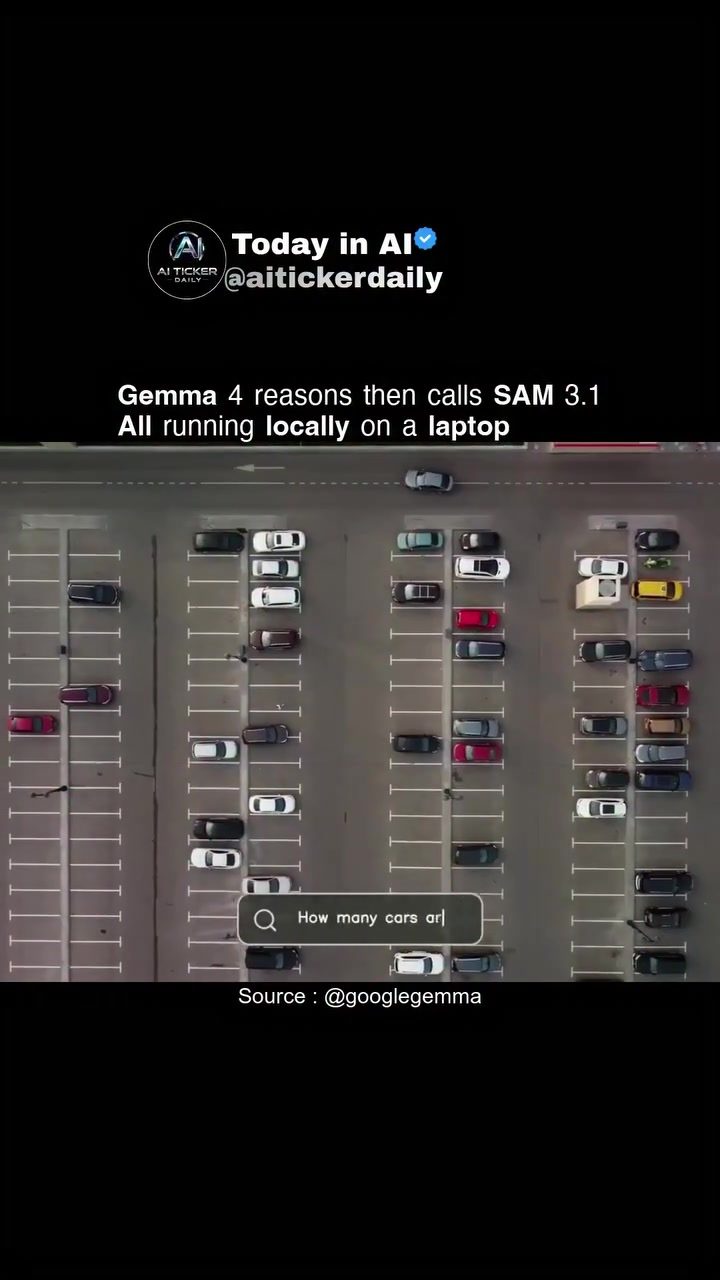
Local AI Orchestration for Real-Time Car Counting
AI models Gemma 4 and SAM 3.1 work together to count cars in a parking lot, all running locally on a laptop. This setup showcases a multi-model vision workflow without cloud dependency, highlighting the efficiency and capability of local AI processing.
Why This Matters
Local AI orchestration is becoming increasingly important as it allows for real-time processing without the need for cloud connectivity. This is particularly useful in scenarios where immediate decisions are crucial, such as traffic management or security monitoring. By running AI models locally, organizations can reduce latency, enhance data privacy, and lower operational costs. The demonstration of this technology on a laptop indicates that powerful AI capabilities are becoming more accessible and portable.
Main Discussion
The Role of Gemma 4 and SAM 3.1
Gemma 4 and SAM 3.1 are key components in this AI orchestration process. Gemma 4 is responsible for interpreting the scene and deciding the next query, while SAM 3.1 handles the segmentation of vehicles. This division of labor allows for efficient and accurate car counting.
Real-Time Object Detection
The demo showcases real-time object detection capabilities. The AI model segments all vehicles first and then refines the count to white vehicles as a follow-up instruction. This two-step process ensures that the AI can handle complex scenes and provide accurate counts even in busy parking lots.
Local Processing
One of the standout features of this setup is its ability to run locally on a laptop. This means that the entire process, from scene interpretation to segmentation, is handled by the laptop's processing power. This local processing eliminates the need for cloud dependency, making the system more reliable and less susceptible to connectivity issues.
Multi-Model Vision Workflows
The demo highlights multi-model vision workflows, where different AI models work together to achieve a common goal. In this case, Gemma 4 and SAM 3.1 collaborate to count cars efficiently. This approach can be applied to various other scenarios, such as object detection in manufacturing, surveillance, and autonomous vehicles.
Practical Tips
Choosing the Right AI Models
When implementing a similar AI orchestration setup, it's crucial to choose the right AI models for the task. Models like Gemma 4 and SAM 3.1 are designed for specific tasks, such as scene interpretation and segmentation. Understanding the strengths and limitations of each model can help in designing an efficient workflow.
Optimizing for Local Processing
Running AI models locally requires optimizing the system for performance. This includes ensuring that the laptop has sufficient processing power and memory to handle the AI tasks. Additionally, optimizing the AI models for local processing can help reduce latency and improve accuracy.
Ensuring Reliability
Local AI processing can be more reliable than cloud-based solutions, especially in scenarios where connectivity is an issue. However, it's essential to ensure that the local system is robust and can handle various environmental conditions. Regular maintenance and updates can help maintain the system's reliability.
Important Takeaways
- AI models Gemma 4 and SAM 3.1 can work together to count cars in a parking lot.
- The entire process runs locally on a laptop, eliminating the need for cloud dependency.
- Real-time object detection and segmentation are made possible without connectivity issues.
- Local AI processing offers benefits such as reduced latency, enhanced data privacy, and lower operational costs.
Conclusion
AI orchestration using models like Gemma 4 and SAM 3.1 demonstrates the potential of local AI processing. By running these models on a laptop, it's possible to achieve real-time object detection and segmentation efficiently. This setup can be applied to various scenarios, making it a valuable tool for organizations looking to enhance their AI capabilities without relying on cloud connectivity. As AI technology continues to evolve, local processing is likely to become even more accessible and powerful, opening up new possibilities for real-time data analysis and decision-making.
Questions readers ask
How do Google's AI models, Gemma 4 and SAM 3.1, work together for real-time car counting?
Gemma 4 and SAM 3.1 collaborate by processing visual data locally on a laptop. Gemma 4 likely handles initial object detection and tracking, while SAM 3.1 refines and verifies the counts, ensuring accuracy in real-time. This division of labor enables efficient and reliable car counting without the need for cloud processing.
What advantages does local AI processing offer over cloud-based solutions?
Local AI processing reduces latency, which is crucial for real-time applications like car counting. It also enhances data privacy by keeping data on-site, and lowers operational costs by eliminating the need for cloud storage and computation fees.
Can this local AI setup be used for other types of real-time monitoring besides car counting?
Yes, the local AI orchestration demonstrated by Google can be adapted for various real-time monitoring tasks. These include traffic management, security surveillance, and inventory tracking, where immediate decisions are necessary and data privacy is a concern.
How does this setup improve reliability in real-time decision-making?
By processing data locally, the AI models can provide instant results, reducing the risk of delays or disruptions that can occur with cloud-based systems. This immediate feedback is essential for reliable decision-making, such as opening additional lanes during heavy traffic or alerting security personnel to unusual activities.
Is a powerful computer necessary to run these AI models locally?
The demonstration on a laptop shows that advanced AI models do not always require high-end hardware. A standard laptop with sufficient processing power and memory can effectively run these models, making the technology accessible for a wide range of applications and environments.
What are the privacy benefits of using local AI processing for real-time car counting?
Local AI processing ensures that video and data from the parking lot does not need to be sent to the cloud, reducing the risk of data breaches. This is particularly important for maintaining the privacy of individuals and vehicles in the area, as all data processing and decision-making occur on-site.
How might this technology reduce operational costs for organizations?
By eliminating the need for cloud storage and computation, organizations can significantly lower their expenses. Local AI processing reduces the demand for external data centers, decreases bandwidth usage, and minimizes the need for continuous internet connectivity, all contributing to reduced operational costs.
Related deep dives
Similar reads based on topic and creator.




Recent articles
Fresh deep dives from the latest Reels we unpacked.




Comments
Be the first to comment.