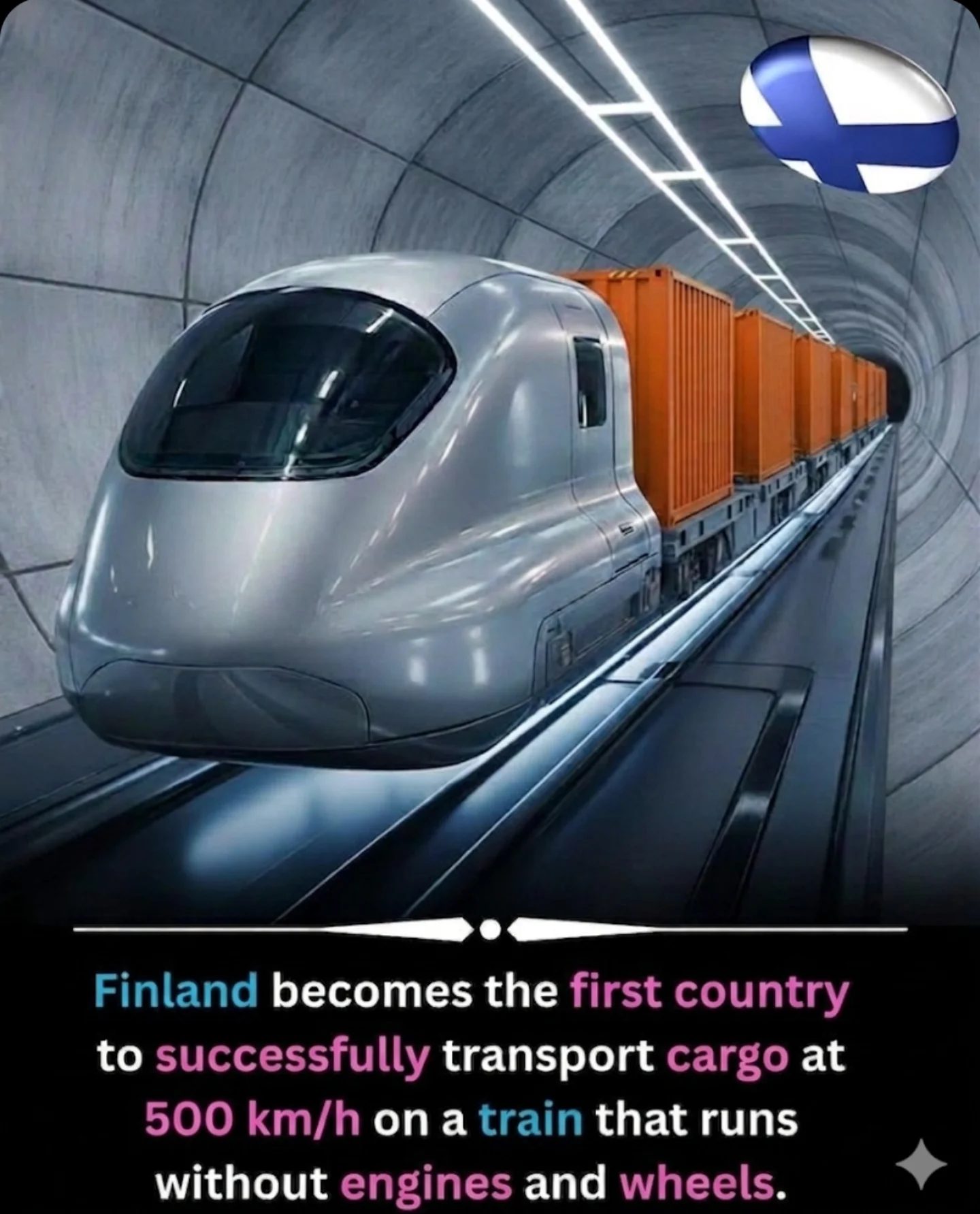
High-Speed Cargo Transport: Separating Fact from Fiction
The claim that Finland has launched a wheel-less, engine-free cargo train traveling at 500 km/h has gained significant attention, but it is important to separate fact from fiction. This piece of misinformation depicts a futuristic Maglev or Hyperloop-style system, but such infrastructure does not currently exist in Finland for commercial cargo transport.
Context / Why this matters
Understanding the current state of high-speed cargo transport is crucial for several reasons. As global trade continues to grow, the demand for efficient and fast cargo transportation increases. High-speed rail systems, including Maglev and Hyperloop technologies, promise significant advancements in this area. However, distinguishing between speculative concepts and tangible technological achievements is essential for making informed decisions and investments.
Current State of Cargo Transportation in Finland
Finland's national rail network relies on standard locomotive technology. Passenger trains in Finland can reach speeds of up to 220 km/h, but cargo trains typically operate at much lower speeds. This discrepancy highlights the challenges and limitations of high-speed cargo transport.
Magnetic Levitation (Maglev) technology allows for frictionless travel, making it ideal for high-speed passenger lines. Currently, this technology is primarily used in a few high-speed passenger lines in Asia, notably in China and Japan. However, transporting heavy shipping containers at 500 km/h is economically unfeasible due to the massive energy consumption and stringent safety requirements involved.
Maglev Technology and Cargo Transport
Magnetic Levitation (Maglev) technology uses magnetic fields to levitate trains above the tracks, eliminating friction and allowing for high speeds. This technology has been successfully implemented in several high-speed passenger lines, most notably in China and Japan. In China, the Shanghai Maglev Train can reach speeds of up to 431 km/h, making it one of the fastest commercially operated trains in the world. In Japan, the Chuo Shinkansen, a planned high-speed Maglev line, aims to connect Tokyo and Nagoya with speeds of up to 500 km/h.
However, adapting Maglev technology for cargo transport presents significant challenges. The energy requirements for maintaining magnetic fields and the safety concerns associated with transporting heavy cargo at high speeds make this option economically unfeasible.
Hyperloop Concept
The Hyperloop concept, proposed by Elon Musk, envisions a network of low-pressure tubes through which pods travel at high speeds using magnetic levitation. This concept promises to revolutionize cargo and passenger transport by significantly reducing travel times and energy consumption.
Currently, the Hyperloop concept is in the experimental testing phase. Several companies, including Virgin Hyperloop and Hyperloop Transportation Technologies, are working on developing and testing Hyperloop systems. However, the technology has not yet reached the level of a functional national cargo network.
Practical Tips for Evaluating High-Speed Cargo Transport Claims
When evaluating claims about high-speed cargo transport, it is essential to consider the following factors:
- Verify the source of the information. Official announcements from reputable organizations and government agencies are more reliable than social media posts.
- Look for structural inconsistencies in images and videos. AI-generated graphics often have subtle flaws that can be identified with a critical eye.
- Consider the economic and technological feasibility of the claims. High-speed cargo transport involves significant energy consumption and safety requirements, making some claims economically unfeasible.
- Stay informed about the current state of high-speed transportation technologies. Maglev and Hyperloop technologies are still in the development and testing phases, and their implementation for cargo transport is not yet a reality.
Important Takeaways
The claim that Finland has launched a wheel-less, engine-free cargo train traveling at 500 km/h is a sophisticated piece of AI-generated misinformation. While the visual depicts a futuristic Maglev or Hyperloop-style system, no such infrastructure currently exists in Finland for commercial cargo transport. Finland’s national rail network utilizes standard locomotive technology, with passenger speeds peaking at 220 km/h.
Magnetic Levitation (Maglev) technology allows for frictionless travel but is currently limited to a few high-speed passenger lines in Asia. Transporting heavy shipping containers at 500 km/h is economically unfeasible due to the massive energy consumption and safety requirements involved. The Hyperloop concept remains in the experimental testing phase globally and has not reached the level of a functional national cargo network. Social media graphics often blend speculative technology with real nations to generate engagement but should not be mistaken for verified news.
Conclusion
The high-speed cargo transport landscape is evolving, with promising technologies like Maglev and Hyperloop on the horizon. However, it is crucial to approach claims about new developments with a critical eye. By verifying information, considering economic and technological feasibility, and staying informed about the current state of transportation technologies, we can make informed decisions and contribute to the advancement of high-speed cargo transport.
Questions readers ask
Does Finland currently operate a 500 km/h cargo train?
No, Finland does not currently operate a cargo train capable of reaching 500 km/h. The viral claim is misinformation, and Finland relies on standard rail networks for cargo transport.
What type of rail technology does Finland currently use for cargo transport?
Finland's current cargo transport infrastructure is based on standard rail networks, which do not include futuristic technologies like Maglev or Hyperloop systems.
Are there plans for a Maglev or Hyperloop system in Finland?
As of now, there are no announced plans for a Maglev or Hyperloop system in Finland for either cargo or passenger transport.
What is the maximum speed of trains in Finland's current rail network?
The maximum speed of trains on Finland's national rail network is around 220 km/h for high-speed passenger trains. Cargo trains operate at lower speeds to accommodate the weight and type of freight being transported.
How does Finland's cargo transport system compare to other countries?
Finland's cargo transport system is typical of many European countries, relying on standard rail networks. Other countries may be exploring or implementing high-speed technologies but the logistics of such are complex and expensive.
What are Maglev and Hyperloop technologies, and how do they differ from traditional rail systems?
Maglev (magnetic levitation) trains use magnetic forces to float above the tracks, allowing for higher speeds and reduced friction compared to traditional rail systems. Hyperloop is a concept for a vacuum-sealed tube system, designed to transport passengers and cargo at very high speeds using pressurized capsules. Both technologies are still in development phases.
Related deep dives
Similar reads based on topic and creator.




Recent articles
Fresh deep dives from the latest Reels we unpacked.




Comments
Be the first to comment.