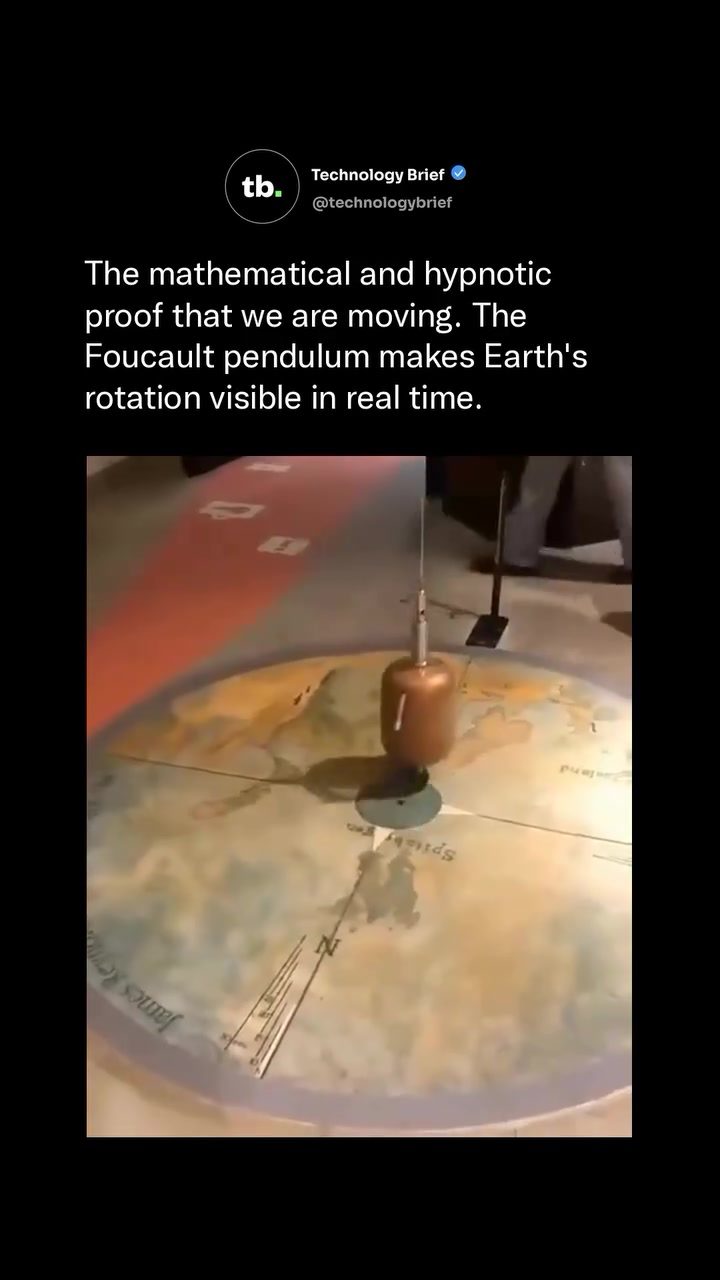
Foucault Pendulum: A Visual Proof of Earth's Rotation
The Foucault pendulum is a captivating demonstration of Earth's rotation, devised by French physicist Léon Foucault in 1851. This ingenious device, first displayed at the Panthéon in Paris, uses a simple yet powerful concept: a pendulum swinging in a fixed plane while the Earth rotates beneath it. The slow drift of the pendulum's swing path visually proves the planet's continuous movement.
Context / Why this matters
Understanding the Foucault pendulum is not just about appreciating a historical scientific demonstration; it's about grasping a fundamental aspect of our planet's dynamics. The pendulum's ability to visualize Earth's rotation has made it a staple in science museums and universities around the world. It serves as a tangible proof of a concept that, while crucial to our understanding of the universe, is often abstract and difficult to comprehend without a visual aid.
Main discussion
The Mechanism of the Foucault Pendulum
The Foucault pendulum consists of a heavy weight (or bob) suspended from a long wire. When set in motion, the pendulum swings in a fixed plane. However, as the Earth rotates beneath it, the plane of the pendulum's swing appears to rotate. This is because the pendulum maintains its plane of motion while the Earth turns around its axis.
The effect is most pronounced at the poles. At the North or South Pole, the pendulum's plane of swing completes a full 360-degree rotation in about 24 hours. This is due to the Earth's rotation being perpendicular to the pendulum's swing at these points. As you move towards the equator, the effect becomes less pronounced, eventually disappearing altogether. At the equator, the pendulum's plane of swing does not appear to change at all because the Earth's rotation is parallel to the pendulum's plane.
Historical Context and Significance
Léon Foucault's original demonstration used a 67-meter wire and a heavy iron bob. The pendulum was suspended from the dome of the Panthéon, and its slow, hypnotic swing captivated audiences. This was the first time that Earth's rotation was proven in a way that was visually compelling and easy to understand. The pendulum became a sensation, and its demonstration helped solidify the acceptance of the Earth's rotation among the scientific community and the general public.
Modern Installations
Today, Foucault pendulums can be found in numerous science museums and universities worldwide. These installations often use electromagnetic drives to counteract air resistance, allowing the pendulum to swing indefinitely. Some of the most impressive installations use cables over 90 meters tall, suspended inside cathedral ceilings and multi-story towers. These grand displays continue to captivate and educate visitors, providing a tangible connection to the abstract concept of Earth's rotation.
Practical tips
Building Your Own Foucault Pendulum
Creating a Foucault pendulum at home can be a rewarding project. Here are some tips to get you started:
- Choose the Right Location: Find a place where the pendulum can swing freely without obstacles. A high ceiling or an open space is ideal.
- Select the Right Materials: Use a heavy bob (like a large metal weight) and a long, sturdy wire or string. The longer the wire, the more pronounced the effect will be.
- Set It in Motion: Start the pendulum swinging in a fixed plane. Ensure it has enough momentum to swing for an extended period.
- Observe the Rotation: Watch the pendulum swing over time. You should notice the plane of swing appearing to rotate, especially if you are in a location away from the equator.
Maximizing the Visual Effect
To make the most of your Foucault pendulum demonstration, consider the following:
- Use a Long Wire: The longer the wire, the more pronounced the effect will be. This is because the longer wire allows for a greater change in the plane of swing over time.
- Minimize Air Resistance: Use a heavy bob to reduce the impact of air resistance. Some advanced setups use electromagnetic drives to keep the pendulum swinging indefinitely.
- Choose the Right Latitude: The effect is strongest near the poles. If possible, set up your pendulum in a location far from the equator to see the most dramatic changes in the plane of swing.
Important takeaways
The Foucault pendulum is a remarkable tool for visualizing Earth's rotation. Its simplicity belies a deep understanding of physics and the dynamics of our planet. By observing the slow drift of the pendulum's swing, we gain a tangible sense of the Earth's continuous motion, a concept that is often abstract and difficult to grasp.
The Universality of the Pendulum's Message
The beauty of the Foucault pendulum lies in its universality. Whether you are a scientist, a student, or a general enthusiast, the pendulum provides a clear and compelling demonstration of a fundamental aspect of our planet. It serves as a reminder of the ingenuity of human thought and our ability to visualize and understand complex natural phenomena.
The Pendulum and Global Science Education
The widespread use of Foucault pendulums in science museums and universities underscores their importance in global science education. They provide a hands-on, visual experience that enriches the learning process and makes abstract concepts more accessible. The pendulum's enduring presence in educational settings is a testament to its effectiveness and enduring appeal.
Conclusion
The Foucault pendulum is more than just a scientific curiosity; it is a visual proof of Earth's rotation that has captivated audiences for over a century. From its historic demonstration at the Panthéon in Paris to its modern installations in museums and universities, the pendulum continues to inspire and educate. Whether you are building your own pendulum or observing one in a museum, the experience is sure to leave a lasting impression. The next time you see a Foucault pendulum in action, take a moment to appreciate the intricate dance of the swing and the profound message it conveys about the movement of our planet.
Questions readers ask
What is the significance of the Foucault Pendulum in understanding Earth's movement?
The Foucault Pendulum is significant because it provides a visual and tangible proof of Earth's rotation. By swinging in a fixed plane while the Earth rotates beneath it, the pendulum's changing swing path demonstrates the planet's continuous movement, making it a valuable tool for grasping this fundamental aspect of our planet's dynamics.
Who invented the Foucault Pendulum and when?
The Foucault Pendulum was invented by French physicist Léon Foucault in 1851. He first demonstrated the device at the Panthéon in Paris, using it to visually prove the Earth's rotation.
How does the Foucault Pendulum work to show Earth's rotation?
The Foucault Pendulum works by swinging in a fixed plane. As the pendulum swings, the Earth rotates beneath it, causing the swing path to slowly drift. This drift is a direct result of Earth's rotation and provides a clear visual demonstration of this movement.
What is the history of the Foucault Pendulum?
The Foucault Pendulum was first unveiled by Léon Foucault in 1851 at the Panthéon in Paris. Since then, it has become a popular exhibit in science museums and universities worldwide due to its ability to visually demonstrate Earth's rotation.
Does the location of the Foucault Pendulum affect its demonstration?
Yes, the location of the Foucault Pendulum affects its demonstration. The pendulum's plane of swing drifts at different rates depending on the latitude. At the poles, the plane of swing rotates 360 degrees in 24 hours, while at the equator, there is no drift at all. At mid-latitudes, the drift is a fraction of a full circle per day.
What factors influence the swing path of a Foucault Pendulum?
The swing path of a Foucault Pendulum is primarily influenced by the Earth's rotation and the pendulum's latitude. The length of the pendulum and the initial force applied can also affect the period and stability of the swing, but the key factor in the drift of the swing path is the rotation of the Earth beneath the pendulum.
Can a Foucault Pendulum be constructed at home for personal demonstration?
While it is possible to construct a simple pendulum at home, recreating the full effect of a Foucault Pendulum can be challenging due to the precision required. To accurately demonstrate Earth's rotation, the pendulum needs to swing in a very stable, fixed plane, and the environment must be controlled to minimize external influences. However, simple pendulum experiments can still be insightful and fun to conduct.
Related deep dives
Similar reads based on topic and creator.




Recent articles
Fresh deep dives from the latest Reels we unpacked.




Comments
Be the first to comment.