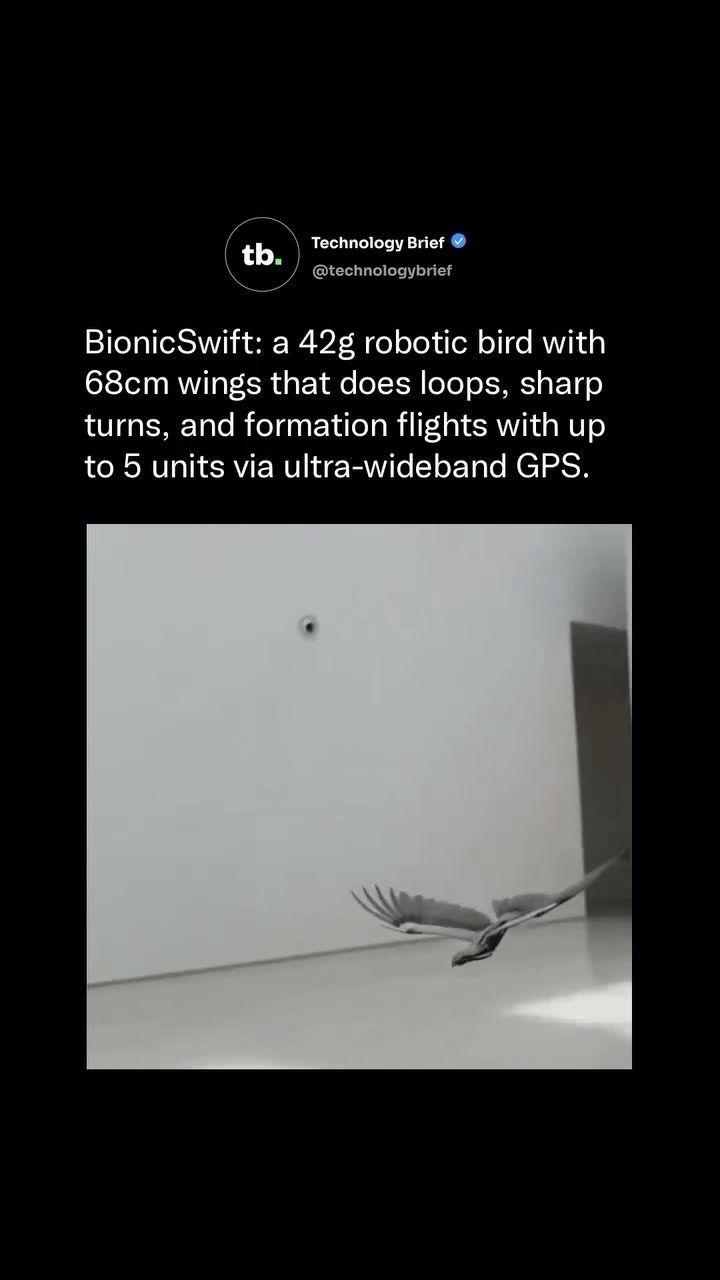
Festo’s BionicSwift: The Revolutionary Robotic Bird
Festo's BionicSwift is an astonishing feat of engineering, showcasing the potential of robotic birds in industrial applications. Weighing only 42 grams and boasting a 68 cm wingspan, this robotic bird mirrors the size and flight mechanics of a real swift. Its unique design, constructed from overlapping sheets of ultralight foam attached to carbon rods, mimics the natural movement of bird feathers, enhancing lift and efficiency.
Why This Matters
The development of robotic birds like the BionicSwift is not just about emulating nature; it's about leveraging nature's designs to revolutionize industrial processes. Imagine smart factories where autonomous flying robots navigate complex environments, tracking goods, and optimizing overhead space. This technology could significantly enhance efficiency, reduce errors, and open up new possibilities for automated systems.
Main Discussion
The Design and Construction
The BionicSwift's design is a marvel of biomimicry. Its wings are built from overlapping sheets of ultralight foam attached to carbon rods, mimicking the feathers of a real bird. This design allows the wings to fan open on the upstroke and snap shut on the downstroke, generating lift efficiently. The result is a lightweight, agile robot that can perform intricate maneuvers with ease.
Flight Capabilities
The BionicSwift can execute full loops, steep turns, and tight formation flights, all without human intervention. This is made possible by an advanced indoor radio-based GPS system that uses ultra-wideband signals. Fixed anchors mounted around the room track each bird’s exact position, feeding the data to a central computer that plots and adjusts flight paths automatically. This system ensures that up to five BionicSwifts can fly together seamlessly, performing complex maneuvers without colliding.
Industrial Applications
Festo developed the BionicSwift to explore how autonomous flying robots could navigate a smart factory. The potential applications are vast. These robots could track goods, optimize the use of overhead space, and even perform inspections in hard-to-reach areas. The ability to navigate autonomously and coordinate with other units makes the BionicSwift a valuable tool for enhancing industrial efficiency and safety.
Ultra-Wideband GPS
The ultra-wideband GPS system is a critical component of the BionicSwift’s functionality. It allows for precise tracking and coordination of multiple units, ensuring that they can perform complex maneuvers without collisions. This technology is not just about navigation; it's about creating a seamless, integrated system where robots can work together efficiently.
Practical Tips
Understanding the GPS System
To fully appreciate the BionicSwift’s capabilities, it’s essential to understand how the ultra-wideband GPS system works. This system uses radio signals to track the exact position of each bird, feeding this data to a central computer. The computer then plots and adjusts flight paths automatically, ensuring smooth and coordinated flight.
Maintaining the Robotic Bird
Maintaining the BionicSwift involves regular checks on the foam and carbon rod structure to ensure they are intact and functioning correctly. The GPS system also requires periodic calibration to maintain its accuracy. Regular software updates for the central computer ensure that the flight paths are optimized and that the system remains secure.
Exploring Further Applications
While the BionicSwift is currently being explored for industrial applications, its potential extends beyond factories. Future developments could see these robotic birds being used in environmental monitoring, search and rescue operations, and even in urban planning. The key is to continue exploring new applications and refining the technology to make it more versatile and efficient.
Important Takeaways
- The BionicSwift’s lightweight design and natural flight mechanics make it an efficient and agile robotic bird.
- The ultra-wideband GPS system enables precise tracking and coordination of multiple units, ensuring complex maneuvers without collisions.
- The potential applications of the BionicSwift in smart factories are vast, including tracking goods, optimizing space, and performing inspections.
- Regular maintenance and software updates are crucial for keeping the BionicSwift operational and efficient.
Conclusion
Festo’s BionicSwift represents a significant step forward in the development of autonomous flying robots. Its design, functionality, and potential applications make it a valuable tool for enhancing industrial efficiency and safety. As technology continues to advance, we can expect to see more innovative applications and improvements, further cementing the BionicSwift’s role in the future of automation.
Questions readers ask
What are the key features of Festo’s BionicSwift robotic bird?
The BionicSwift is designed to resemble a real swift, with a 68 cm wingspan and a weight of just 42 grams. It uses ultralight foam and carbon rods to replicate the natural movement of bird feathers, which enhances its lift and efficiency during flight.
How does the BionicSwift’s design enable it to navigate complex industrial spaces?
The BionicSwift’s lightweight design and agile flight mechanics, inspired by real swifts, allow it to navigate through intricate spaces with ease. This capability is particularly useful for tasks like tracking goods and optimizing overhead space in industrial settings.
What materials are used in the construction of the BionicSwift?
The BionicSwift is constructed from overlapping sheets of ultralight foam attached to carbon rods. This combination provides the necessary strength and flexibility to mimic the natural movement of bird feathers, ensuring efficient and agile flight.
What are the potential applications of the BionicSwift in industrial settings?
The BionicSwift can be used for a variety of tasks in industrial spaces, such as navigating complex environments to track goods, inspecting hard-to-reach areas, and optimizing overhead space usage. Its agility and maneuverability make it a valuable tool for enhancing efficiency in industrial processes.
How does the BionicSwift’s flight mechanics benefit industrial processes?
By replicating the flight mechanics of a swift, the BionicSwift can perform precise and agile maneuvers, making it ideal for tasks that require navigating through narrow or cluttered spaces. This enhances the efficiency and effectiveness of industrial operations.
What is the significance of the BionicSwift’s lightweight design?
The lightweight design of the BionicSwift, weighing only 42 grams, allows it to fly with greater efficiency and agility. This is crucial for navigating industrial spaces and performing tasks that require precise movements and minimal energy consumption.
Can the BionicSwift be adapted for use in environments other than industrial settings?
While the BionicSwift is primarily designed for industrial applications, its versatile design and flight capabilities make it a potential candidate for use in other environments, such as environmental monitoring, search and rescue missions, and even in artistic or entertainment settings where agile robotic flight is beneficial.
Related deep dives
Similar reads based on topic and creator.




Recent articles
Fresh deep dives from the latest Reels we unpacked.




Comments
Be the first to comment.