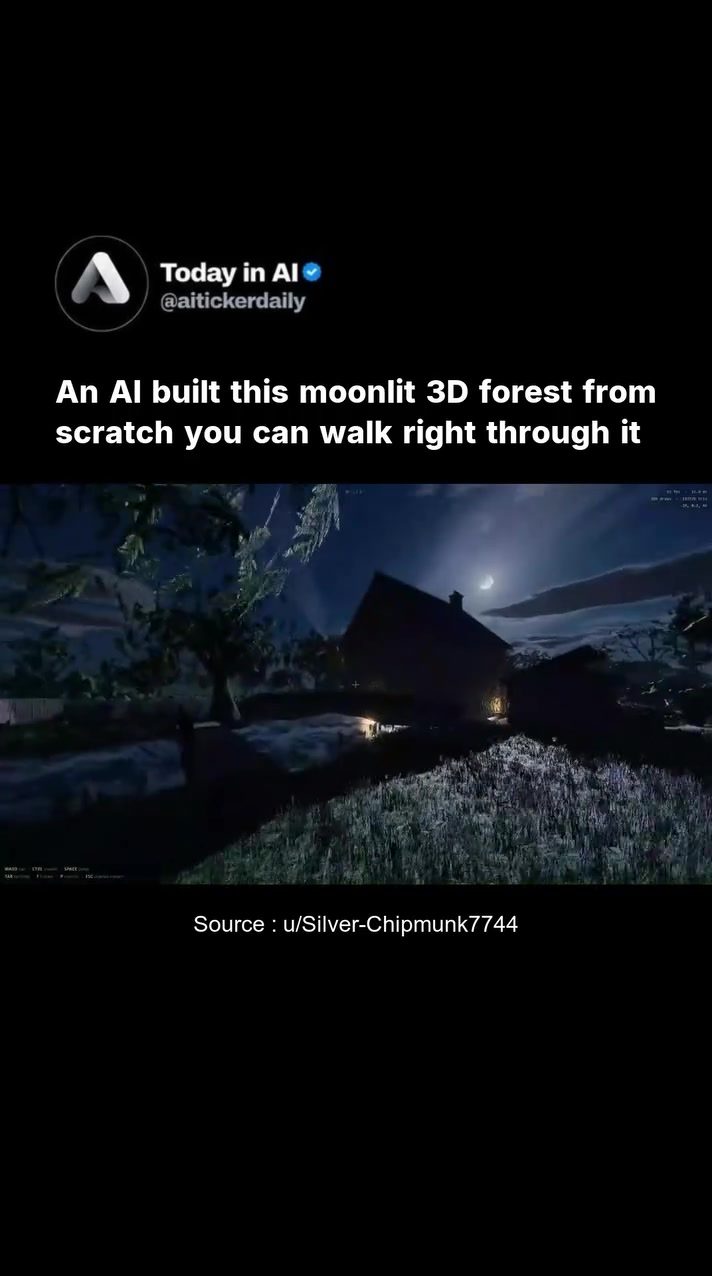
AI-Generated 3D Environments: The Moonlit Forest
The creation of a 3D moonlit forest scene by artificial intelligence showcases the advancements in AI-generated environments. This project, credited to u/Silver-Chipmunk7744, demonstrates that AI can generate every asset from scratch, rather than relying on pre-existing libraries.
Context / Why This Matters
The ability to create 3D environments from scratch using AI has significant implications for various industries. From gaming and virtual reality to architectural visualization and film production, these technologies can streamline workflows, reduce costs, and open up new creative possibilities. Understanding how AI can generate detailed and immersive 3D environments is crucial for anyone interested in the future of digital media and design.
Main Discussion
The Creation Process
The 3D forest environment was initially planned as a dawn scene but accidentally produced a moonlit version during testing. The creator favored this unexpected result, leading to the final product. The process involved roughly three hours of iteration, resulting in a world file that runs to over 900kb of hand-generated JavaScript. This highlights the efficiency and detailed output that AI can achieve.
Key Features of the 3D Environment
The AI-generated forest includes several notable features:
- Walkable World: The environment is designed to be explorable, allowing users to navigate through the forest.
- God-rays: These are visible light rays that shine through the trees, adding depth and realism to the scene.
- Atmospheric Moonlight: The moonlit effect creates a serene and immersive atmosphere, enhancing the overall experience.
- Dense Grass: The inclusion of dense grass adds texture and realism to the environment, making it feel more lifelike.
The Role of AI in 3D Environment Creation
AI models like Claude 5 Opus can generate every asset itself, from trees and foliage to the grass and overall atmosphere. This capability allows for the creation of unique and detailed environments without relying on pre-existing assets. The AI can produce high-quality, realistic 3D models, textures, and lighting effects, making it a powerful tool for digital artists and designers.
How AI Models Generate Assets
AI models can generate assets by analyzing vast amounts of data and learning from it. This involves:
- Training on Data: The AI model is trained on a large dataset of 3D environments, allowing it to understand the characteristics and details of different elements.
- Generating Assets: Using the learned patterns, the AI can generate new assets that are unique and realistic. This includes textures, models, and lighting effects.
- Refining and Iterating: The generated assets are refined through iterative processes, ensuring that they meet the desired quality and standards.
Practical Tips
Getting Started with AI-Generated 3D Environments
If you're interested in creating your own AI-generated 3D environments, here are some practical tips to get you started:
- Choose the Right AI Model: Select an AI model that specializes in 3D environment generation, such as Claude 5 Opus.
- Gather Data: Collect a comprehensive dataset of 3D environments to train your AI model. This can include various types of environments, such as forests, cities, and landscapes.
- Train the Model: Train the AI model on your dataset, allowing it to learn the characteristics and details of different elements.
- Generate Assets: Use the trained model to generate assets, including textures, models, and lighting effects.
- Refine and Iterate: Refine the generated assets through iterative processes, ensuring that they meet your desired quality and standards.
Enhancing Realism
To enhance the realism of your AI-generated 3D environments, consider the following tips:
- Incorporate Natural Elements: Include natural elements like trees, foliage, and grass to add texture and depth to your environment.
- Use Advanced Lighting Effects: Implement advanced lighting effects, such as god-rays, to create a more immersive and realistic atmosphere.
- Optimize Performance: Ensure that your environment is optimized for performance, allowing for smooth navigation and exploration.
Important Takeaways
AI-generated 3D environments, like the moonlit forest created by u/Silver-Chipmunk7744, demonstrate the incredible potential of artificial intelligence in digital media. The ability to generate detailed and immersive environments from scratch opens up new possibilities for various industries, from gaming to film production.
The Future of 3D Environment Creation
As AI technology continues to advance, we can expect to see even more sophisticated and realistic 3D environments. The integration of AI in 3D environment creation will likely become more prevalent, transforming the way we design and interact with digital spaces.
The Importance of Experimentation and Iteration
The creation of the moonlit forest highlights the importance of experimentation and iteration in the design process. By testing different scenarios and refining the output, creators can achieve unique and innovative results, pushing the boundaries of what's possible with AI-generated 3D environments.
Conclusion
AI-generated 3D environments, like the moonlit forest, showcase the transformative potential of artificial intelligence in digital media. From gaming to film production, AI's ability to create detailed and immersive 3D environments from scratch opens up new creative possibilities. As technology continues to evolve, we can look forward to even more innovative and realistic 3D environments, driven by the power of AI.
Questions readers ask
How does AI generate a 3D forest environment like the moonlit forest scene?
AI generates a 3D forest environment by using complex algorithms and machine learning models. These models learn from vast amounts of data to create detailed assets such as trees, plants, and terrain from scratch, rather than using pre-existing 3D models. The AI then assembles these assets into a cohesive and immersive digital world.
What are some of the applications of AI-generated 3D environments?
AI-generated 3D environments have a wide range of applications, from enhancing gaming and virtual reality experiences to revolutionizing film production and architectural visualization. These environments can reduce production times, cut costs, and provide new creative options for designers and artists.
Who created the 3D moonlit forest scene featured in the article?
The 3D moonlit forest scene was created by a user named u/Silver-Chipmunk7744. This project highlights the capabilities of AI in generating detailed and immersive 3D environments from scratch, showcasing the potential for AI in digital art and design.
What are the benefits of using AI to create 3D environments?
Using AI to create 3D environments offers several benefits, including increased efficiency, cost savings, and the ability to generate unique and detailed digital worlds. AI can produce complex and immersive environments more quickly than traditional methods, making it an attractive option for various industries.
Can AI-generated 3D environments be explored in real-time?
Yes, AI-generated 3D environments can be designed to be explorable in real-time. This allows users to walk through and interact with the digital world, enhancing the immersive experience. This capability is particularly valuable in gaming, virtual reality, and architectural visualization.
Related deep dives
Similar reads based on topic and creator.




Recent articles
Fresh deep dives from the latest Reels we unpacked.




Comments
Be the first to comment.