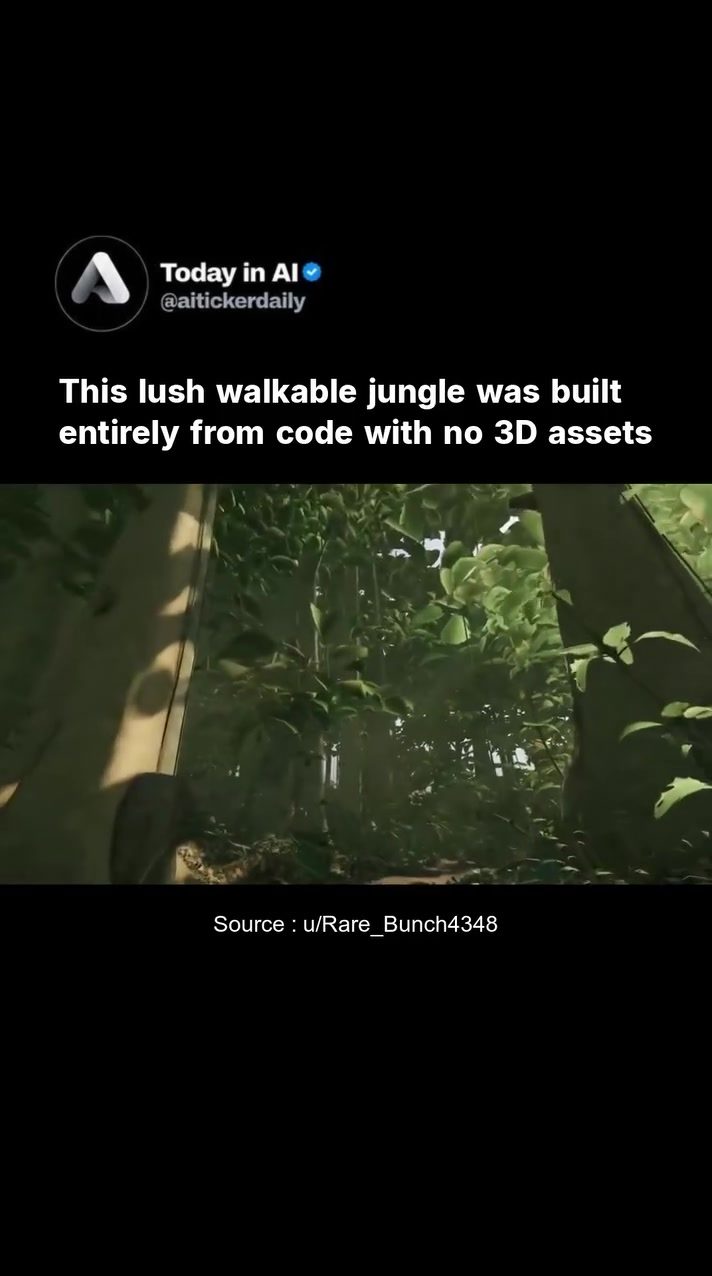
AI-Generated Jungle: Exploring Code-Created Environments
A lush, walkable jungle environment, built entirely from code without any pre-made 3D assets, showcases the remarkable capabilities of AI in creating immersive 3D environments. This jungle, generated purely from code, exemplifies a significant shift in how virtual environments are constructed, moving away from traditional methods that rely on pre-made models and textures.
Context: The Evolution of 3D Environment Creation
Traditionally, 3D environments have been assembled using a library of meshes and textures. This approach, while effective, has limitations in terms of flexibility and creativity. The AI-generated jungle represents a revolutionary step forward, where the entire scene is described in code, allowing for dynamic and interactive features. This method opens up new possibilities for creating complex, intricate environments that can respond to user input in real-time.
The Power of Code-Driven Environments
The Advantages of Code-Generated Environments
Creating a 3D environment from scratch using code offers several advantages. First, it allows for greater customization and flexibility. Every element, from the foliage to the light rays, can be finely tuned to meet specific design requirements. This level of control is virtually impossible with pre-made assets, which often come with limitations and inconsistencies.
Second, code-generated environments can be more efficient. Since the entire scene is described in code, there is no need to load and manage individual 3D assets. This can result in faster rendering times and reduced computational overhead, making the environment more responsive and interactive.
The Challenges and Considerations
While the benefits are clear, there are also challenges to consider. Creating a fully code-generated environment requires a deep understanding of programming and 3D graphics. Developers must be proficient in languages and tools that can handle complex mathematical calculations and render high-quality visuals. Additionally, the process can be time-consuming, as every detail must be programmed from scratch.
Main Discussion
The Technological Underpinnings
The AI-generated jungle is a testament to the advancements in machine learning and computer graphics. At the core of this technology is the ability of AI models to understand and generate complex, realistic environments. The jungle example showcases how these models can interpret code to create detailed, interactive scenes that mimic real-world environments.
The Implications for Game Development
For game developers, the ability to create walkable, interactive environments entirely from code opens up new horizons. Games can be more immersive and dynamic, with environments that respond to player actions in real-time. This level of interactivity can enhance the overall gaming experience, making it more engaging and lifelike.
Beyond Gaming: Architectural Visualization and Virtual Reality
The applications of code-generated environments extend beyond gaming. In architectural visualization, for instance, architects can use AI to create detailed, interactive models of buildings and landscapes. This can help stakeholders visualize projects more effectively, leading to better decision-making and more efficient project management.
Virtual reality (VR) is another area that can benefit significantly from this technology. VR environments can be more immersive and interactive, providing users with a more realistic and engaging experience. This can be particularly useful in fields like education, training, and entertainment, where realistic simulations are crucial.
Practical Tips for Creating Code-Generated Environments
Start with a Clear Vision
Before diving into code, it's essential to have a clear vision of what you want to achieve. Sketch out your ideas and plan the key features of your environment. This will serve as a roadmap and help you stay focused throughout the development process.
Learn the Basics of 3D Graphics Programming
Creating code-generated environments requires a solid understanding of 3D graphics programming. Familiarize yourself with relevant languages and tools, such as WebGL, Unity, and Unreal Engine. Online tutorials and courses can be invaluable resources for learning these skills.
Experiment and Iterate
Creating a fully code-generated environment is an iterative process. Start with simple elements and gradually build complexity. Experiment with different techniques and tools, and don't be afraid to make mistakes. Each iteration will bring you closer to your vision.
Utilize AI and Machine Learning
Leverage AI and machine learning to enhance the realism and interactivity of your environment. AI models can help generate realistic textures, lighting, and animations, making your environment more lifelike and engaging.
Community and Collaboration
Engage with the community of developers and creators who are exploring similar technologies. Platforms like GitHub offer repositories and resources that can be invaluable for your projects, such as the jungle-trail project. Collaborating with others can provide fresh perspectives, insights, and support.
Important Takeaways
Creating a lush, walkable jungle entirely from code is a groundbreaking achievement in the field of 3D environment creation. This approach offers greater flexibility, efficiency, and interactivity compared to traditional methods. By leveraging AI and machine learning, developers can push the boundaries of what's possible in virtual environments, opening up new possibilities in gaming, architectural visualization, and virtual reality.
Conclusion
The AI-generated jungle represents a significant milestone in the evolution of 3D environment creation. By moving away from pre-made assets and embracing code-driven approaches, developers can create more dynamic, interactive, and immersive experiences. As technology continues to advance, the possibilities for code-generated environments are boundless, offering exciting opportunities for innovation and creativity across various industries.
Questions readers ask
How does an AI-generated jungle environment differ from traditional 3D environments?
Traditional 3D environments are typically built using pre-made models and textures, whereas an AI-generated jungle environment is created entirely from code. This code-based approach allows for more dynamic and interactive virtual environments, offering greater flexibility and customization.
What are the benefits of using AI to generate a 3D jungle environment?
AI-generated environments can create immersive and highly detailed scenes without the need for manual creation of assets. This can save time and resources, while also providing a more dynamic and interactive experience for users. Additionally, AI can generate a vast amount of variety, ensuring each user experience is unique.
What kind of code is used to create an AI-generated jungle environment?
The specific code used can vary, but it often involves languages and frameworks that support 3D graphics, such as C++, Python, or specialized game engines like Unity or Unreal Engine. AI algorithms, including procedural generation and machine learning, are integrated to create the environment dynamically.
Can AI-generated environments be walked through or interacted with?
Yes, AI-generated environments, such as a lush jungle, can be made fully walkable and interactive. AI can generate not only the visual elements but also the underlying geometry and physics, allowing users to explore and interact with the environment in real-time.
What are some potential applications for AI-generated environments?
AI-generated environments have a wide range of applications, including video games, virtual reality experiences, and architectural simulations. They can also be used in scientific research for creating detailed simulations, and in creative fields for generating unique and immersive landscapes.
How does AI handle the creation of detailed textures and models in a jungle environment?
AI uses algorithms to generate detailed textures and models from scratch, rather than relying on pre-made assets. This involves training machine learning models on large datasets of textures and shapes, enabling the AI to produce highly realistic and varied elements that make up the jungle environment.
What challenges might arise when using AI to generate a 3D jungle environment?
While AI offers many advantages, challenges can include the need for significant computational power, the complexity of training AI models, and ensuring the generated content is both realistic and functional. Additionally, maintaining consistency in the environment and avoiding repetitive patterns can be challenging.
Related deep dives
Similar reads based on topic and creator.




Recent articles
Fresh deep dives from the latest Reels we unpacked.




Comments
Be the first to comment.