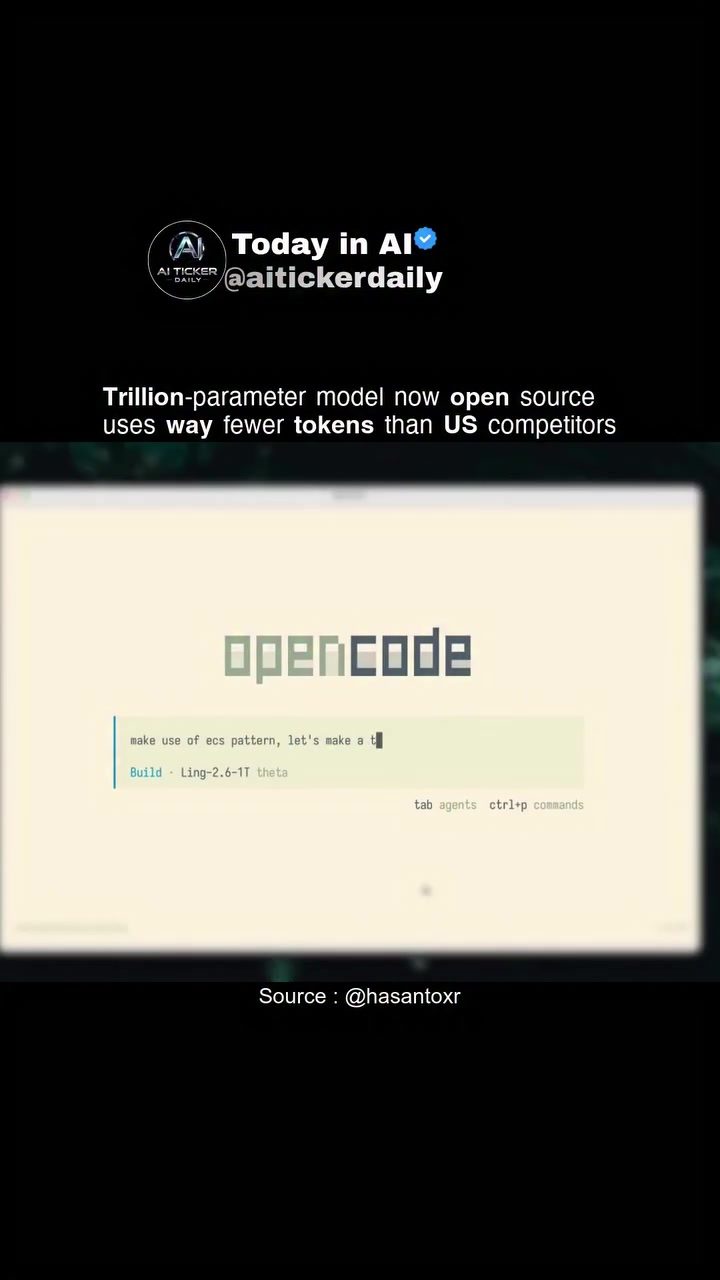
AI Model and ECS Architecture
The Ling-2.6-1T release, a trillion-parameter AI model from aitickerdaily, offers a groundbreaking open-source model that can be downloaded and tested. This model stands out for its token efficiency, which sets it apart from competitors, particularly US-based models.
Why This Matters
In the rapidly advancing field of artificial intelligence, the availability of open-source models like Ling-2.6-1T is a significant development. Unlike many proprietary models, Ling-2.6-1T allows users to benchmark, test, and reproduce claims, fostering a more transparent and collaborative AI development environment. This openness can accelerate research, development, and innovation in AI.
The Power of Token Efficiency
One of the standout features of Ling-2.6-1T is its token efficiency. Tokens are the basic units of text that AI models process, and reducing the number of tokens needed to achieve the same performance can significantly lower computational costs. This efficiency not only saves on computing resources but also makes the model more accessible to a wider range of users, including those with limited computational power.
Comparing Token Efficiency
When stacked against US competitors, Ling-2.6-1T uses far fewer tokens to achieve similar results. This efficiency can be a game-changer, especially for applications that require extensive text processing, such as natural language understanding, machine translation, and content generation. By using fewer tokens, Ling-2.6-1T can process more information faster and at a lower cost, making it a more practical choice for many applications.
The ECS Architecture
The ECS (Entity-Component-System) architecture is a powerful paradigm for developing software, particularly in the context of AI and games. In the demonstration, a tank battle game is built using ECS, showcasing the model's capability to handle complex simulations and real-time interactions.
ECS for Complex Simulations
ECS is particularly well-suited for complex simulations because it separates data (components) from behavior (systems). This separation allows for more modular and reusable code, making it easier to manage and scale. In the context of AI, ECS can help in creating more dynamic and adaptable models capable of handling a wide range of scenarios.
Practical Applications
The ECS architecture demonstrated in the tank battle game highlights its potential for various applications, including:
- Game Development: ECS is widely used in game development for its ability to handle large numbers of entities and complex interactions efficiently.
- Robotics: In robotics, ECS can help manage the various components and behaviors of a robot, making it easier to develop and update.
- AI Simulations: For AI simulations, ECS can help manage the different aspects of the simulation, such as physics, AI behavior, and rendering, in a modular and efficient manner.
Practical Tips
Getting Started with Ling-2.6-1T
To get started with Ling-2.6-1T, follow these steps:
- Download the Model: The model is available for download, allowing you to start testing and benchmarking immediately.
- Benchmarking and Testing: Use the model to benchmark and test against other models, focusing on key metrics such as token efficiency and computational cost.
- Explore the Code: The source code is available, providing insights into how the model works and how you can optimize it for your specific needs.
- Join the Community: Engage with the community to share your findings, get support, and stay updated on the latest developments.
Optimizing for Token Efficiency
To maximize the benefits of Ling-2.6-1T's token efficiency, consider the following tips:
- Optimize Input Data: Ensure that the input data is well-formatted and optimized for the model. This can include preprocessing steps such as tokenization, normalization, and removing unnecessary information.
- Fine-Tune the Model: Fine-tuning the model on your specific dataset can help improve its performance and efficiency. This involves further training the model on a more specialized dataset to better suit your needs.
- Use Efficient Algorithms: Implement efficient algorithms for data processing and model training. This can help reduce the computational load and improve overall performance.
Important Takeaways
The Advantages of Open-Source Models
Open-source models like Ling-2.6-1T offer several advantages:
- Transparency: Open-source models allow for greater transparency, enabling users to understand how the model works and how it makes decisions.
- Collaboration: The open-source community provides a platform for collaboration, allowing researchers and developers to share insights, improve the model, and develop new applications.
- Accessibility: By being open-source, Ling-2.6-1T is more accessible to a wider range of users, including those with limited computational resources.
The Future of AI Architecture
The ECS architecture demonstrated in the tank battle game highlights its potential for various applications, including game development, robotics, and AI simulations. The ability to separate data from behavior makes ECS a powerful tool for creating more dynamic and adaptable models.
Conclusion
Ling-2.6-1T represents a significant advancement in AI modeling, offering unparalleled token efficiency and a transparent, open-source approach. By leveraging the ECS architecture, Ling-2.6-1T demonstrates its capability to handle complex simulations and real-time interactions, making it a valuable tool for developers and researchers. Whether you're looking to optimize computational costs, explore new applications, or contribute to the open-source community, Ling-2.6-1T provides a robust and efficient platform for innovation.
Questions readers ask
What makes Ling-2.6-1T different from other AI models?
Ling-2.6-1T stands out due to its exceptional token efficiency and open-source nature. Unlike many proprietary models, it allows users to download, test, and benchmark the model, making it a unique and powerful resource in the AI community.
Who developed the Ling-2.6-1T AI model?
The Ling-2.6-1T AI model was developed by aitickerdaily, a notable contributor to the AI landscape. This model is a result of their efforts to push the boundaries of open-source AI development.
How can I access and use the Ling-2.6-1T model?
Ling-2.6-1T is openly accessible, which means you can download the model and test it. This allows for benchmarking, testing, and reproducing claims, fostering a more transparent and collaborative AI development environment.
What advantages does token efficiency bring to text processing tasks?
Token efficiency in the Ling-2.6-1T model means that it can process text more effectively, reducing the number of tokens required for tasks. This results in faster processing times and lower computational costs, giving it a competitive edge over other models.
Why is the open-source nature of Ling-2.6-1T significant?
The open-source nature of Ling-2.6-1T allows for a more collaborative and transparent AI development environment. It enables users to benchmark, test, and reproduce claims, accelerating research, development, and innovation in the field of AI.
What is the significance of the trillion-parameter architecture in Ling-2.6-1T?
The trillion-parameter architecture in Ling-2.6-1T allows for a high level of complexity and nuance in text processing tasks. This makes the model highly capable, particularly in understanding and generating human-like text, setting it apart from competitors.
How can open-source AI models like Ling-2.6-1T foster innovation in AI?
Open-source AI models like Ling-2.6-1T foster innovation by allowing users to collaborate, experiment, and build upon existing models. This collaborative environment encourages the development of new features, improvements, and applications, driving progress in the field of AI.
Related deep dives
Similar reads based on topic and creator.




Recent articles
Fresh deep dives from the latest Reels we unpacked.




Comments
Be the first to comment.