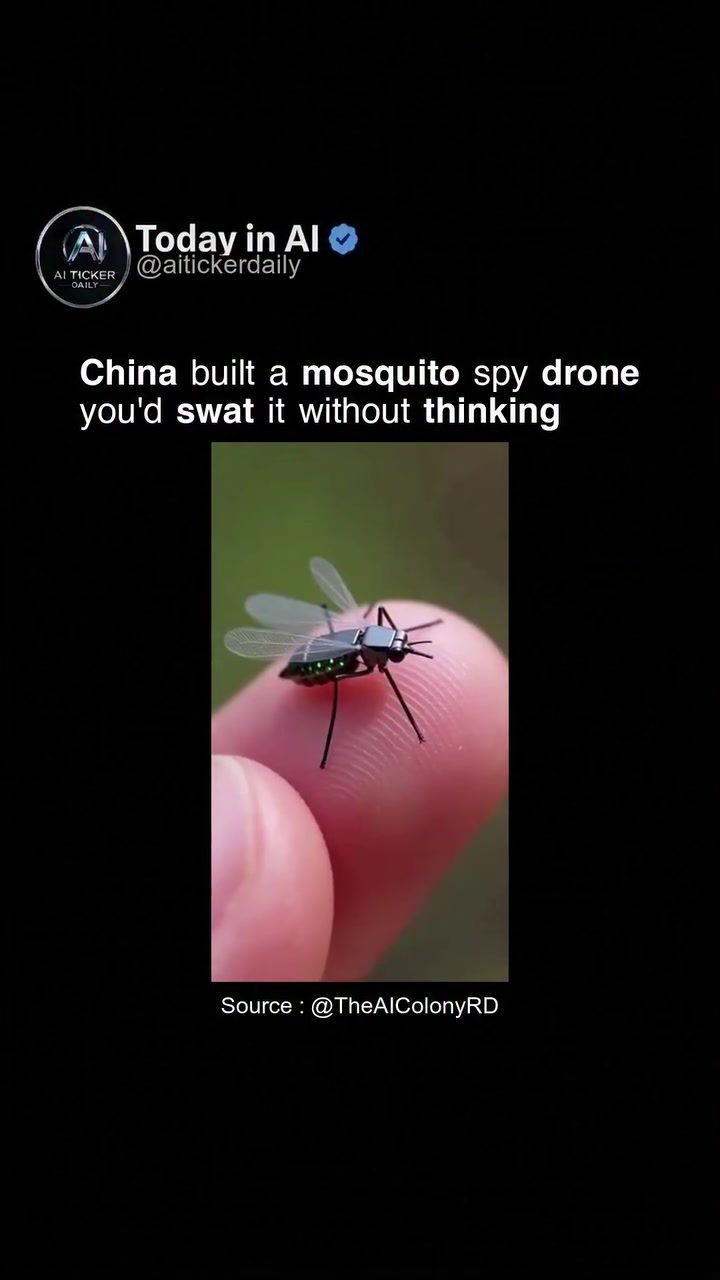
AI Mosquito Spy Drones
China has developed a groundbreaking advancements in drone technology that imitates the appearance and behavior of a mosquito. The result is a mosquito-like drone designed for covert surveillance and military missions. This innovative drone, developed by NUDT, weighs under 0.3 grams and its wings flap at an astonishing rate of 500 times per second. This unique design allows it to move silently and unnoticed, packing covert surveillance sensors into a body so small that you might swat it without a second thought.
Context / Why this matters
The advent of mosquito spy drones represents a significant leap in drone technology and surveillance capabilities. These drones could revolutionize military and civilian applications, offering unparalleled stealth and maneuverability. Their ability to go undetected makes them valuable for various covert operations, from military reconnaissance to environmental monitoring. As technology continues to advance, understanding the capabilities and implications of these miniature drones is crucial.
Main discussion
Design and Capabilities
The design of the mosquito spy drone is both ingenious and deceptively simple. Weighing under 0.3 grams, it is incredibly lightweight, making it nearly imperceptible in flight. Its wings flap at a rapid rate of 500 times per second, mimicking the flight pattern of a real mosquito. This design not only allows the drone to fly silently but also makes it difficult to detect with the naked eye.
The drone's covert surveillance sensors are another key feature. Packed into its tiny body, these sensors can capture high-quality footage and data without drawing attention. This capability is particularly useful in military and intelligence operations, where discretion is paramount. The drone's size and design make it an ideal tool for infiltration and reconnaissance, offering a level of stealth that traditional drones cannot match.
Military and Civilian Applications
The primary application of the mosquito spy drone is in covert military operations. Its small size and silent flight make it perfect for infiltrating enemy territory undetected. The drone can be used for reconnaissance missions, gathering intelligence on enemy movements, and assessing potential threats. Its ability to go unnoticed makes it an invaluable asset for special forces and intelligence agencies.
Beyond military applications, mosquito spy drones could have significant implications for civilian use. Law enforcement agencies could use these drones for surveillance and monitoring, helping to maintain public safety without invading privacy. Environmental researchers could deploy them to study wildlife and ecosystems without disturbing the natural habitat. The potential uses are vast, and as technology advances, so too will the applications for these miniature drones.
Ethical and Privacy Concerns
While the mosquito spy drone offers numerous benefits, it also raises important ethical and privacy concerns. The ability to conduct surveillance undetected poses a significant threat to individual privacy. There is a risk that these drones could be misused by malicious actors or rogue states, leading to widespread surveillance and potential breaches of privacy.
Additionally, the use of these drones in civilian settings could lead to a chilling effect on public behavior. Knowing that one could be under constant surveillance, even by something as small as a mosquito, could alter how people act in public spaces. Balancing the benefits of surveillance with the need for privacy will be a key challenge as these drones become more prevalent.
Future Developments
As drone technology continues to evolve, the capabilities of mosquito spy drones will likely improve. Advances in sensor technology, battery life, and flight control systems could lead to even more sophisticated and effective drones. Future developments could include enhanced sensors for capturing more detailed data, longer flight times, and improved maneuverability.
Additionally, advancements in AI and machine learning could enable these drones to operate more autonomously, making them even more effective in covert operations. AI-driven drones could be programmed to perform specific tasks, such as following a target or mapping an area, without the need for constant human intervention.
Practical tips
When dealing with the potential threat of mosquito spy drones, there are several practical steps to ensure your privacy and security remains intact.
Use Signal Jamming Devices
One effective method to counteract drone surveillance is by using signal jamming devices. These devices can disrupt the communication signals between the drone and its operator, rendering the drone ineffective. However, it's important to note that the use of signal jammers may be regulated in your area, so check local laws before deploying one.
Invest in Privacy Shields
Privacy shields can be used to block drones from entering restricted areas. These shields can be installed on windows, doors, and other entry points to create a barrier that drones cannot penetrate. While these shields will not prevent drones from entering your outdoor space, they can help to protect your indoor privacy.
Keep Drone Detection Equipment
Drone detection equipment can help you identify the presence of drones in your vicinity. These devices can alert you to the presence of a drone, allowing you to take appropriate action to protect your privacy.
Opt for Drone-Resistant Clothing
Wear clothing that is designed to be drone-resistant. These garments are made from materials that can block or distort the signals used by drones, making them less effective at capturing data. While this won't stop drones from flying around you, it can help to protect your privacy in public spaces.
Important takeaways
The development of mosquito spy drones by China represents a significant advancement in drone technology. These drones, designed to mimic the appearance and behavior of real mosquitoes, offer unparalleled stealth and maneuverability. Their applications in military and civilian contexts are vast, but they also raise important ethical and privacy concerns. As technology continues to evolve, it will be crucial to balance the benefits of these drones with the need for privacy and security.
Conclusion
Mosquito spy drones are a remarkable feat of engineering, offering a new level of stealth and capability in drone technology. While their applications are vast and varied, it is essential to consider the ethical and privacy implications of their use. As these drones become more prevalent, finding a balance between their benefits and the need for privacy will be a key challenge. By understanding the capabilities and potential uses of mosquito spy drones, we can better navigate the complexities of this emerging technology.
Questions readers ask
How does the mosquito drone achieve its stealth capabilities?
The mosquito drone achieves stealth through its incredibly small size, weighing less than 0.3 grams, and its wing flap rate of 500 times per second, which mimics the behavior of a real mosquito, making it virtually undetectable to the human eye and ear.
Who developed the mosquito-like drone technology?
The mosquito-like drone technology was developed by the National University of Defense Technology (NUDT) in China, as part of their advancements in covert surveillance and military technologies.
What are the potential applications of mosquito spy drones?
Mosquito spy drones have potential applications in both military and civilian sectors, primarily for covert surveillance and intelligence gathering. Their tiny size and stealth capabilities make them ideal for missions where detection is a critical concern.
How does the mosquito drone's design compare to other small drones?
The mosquito drone's design is unique in its ability to mimic the appearance and behavior of a real insect. Unlike other small drones, it has a very high wing flap rate and an extremely lightweight body, which enables it to move silently and blend in with its surroundings.
What sensors are packed into the mosquito drone's small body?
While specific details about the sensors are not provided, the mosquito drone is equipped with covert surveillance sensors. These sensors are designed to be as small and lightweight as possible, ensuring the drone's stealth capabilities are not compromised.
How does the tiny size of the mosquito drone impact its operational range and duration?
Given its extremely small size and lightweight design, the mosquito drone's operational range and duration may be limited. However, its primary advantage lies in its ability to perform covert surveillance in confined or sensitive areas where larger drones cannot operate.
Are there any concerns or challenges associated with the use of mosquito spy drones?
One of the main concerns with mosquito spy drones is their potential misuse for unauthorized surveillance, raising privacy concerns. Additionally, challenges include maintaining the drone's functionality and battery life given its extremely small size, as well as managing its deployments and retrievals in real-world scenarios.
Related deep dives
Similar reads based on topic and creator.




Recent articles
Fresh deep dives from the latest Reels we unpacked.




Comments
Be the first to comment.