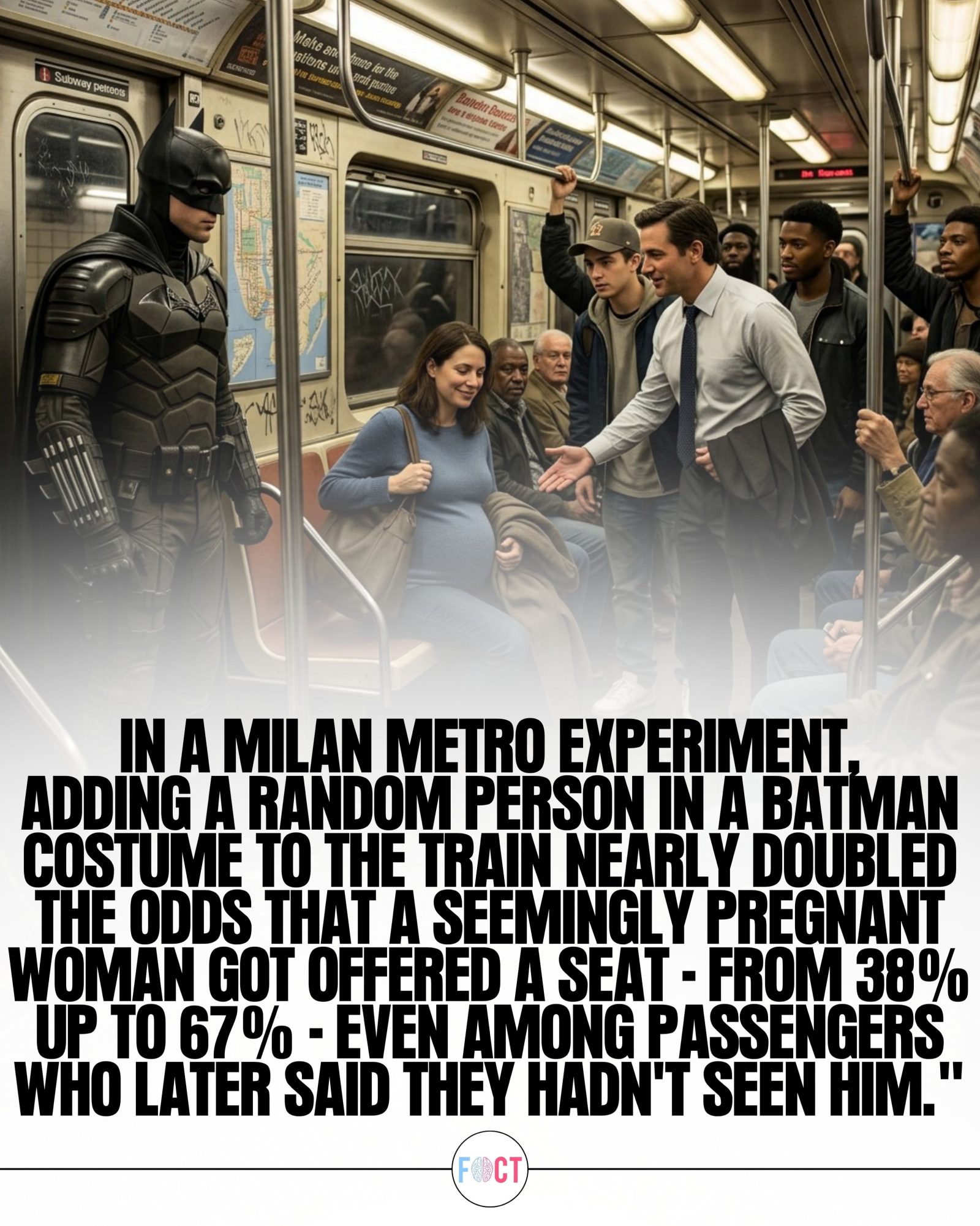
Unconventional Experiment in Milan Metro Unveils Power of Unexpected Events
The power of unexpected events on human behavior was highlighted in a unique social experiment conducted in the bustling environment of Milan's metro system. Researchers sought to understand whether a surprising element—like the appearance of a person in a Batman costume—could influence passengers' willingness to offer help to others. The experiment involved a woman wearing a fake pregnant belly board as she navigated crowded trains. In some of these rides, another researcher, dressed as Batman, would enter the train through a different door, without interacting with anyone. The results were striking: the presence of Batman nearly doubled the likelihood of passengers offering the pregnant woman a seat.
Context / Why this matters
The experiment's findings shed light on the complexity of human behavior and how unexpected events can subtly influence our actions. Understanding these dynamics can have significant implications for public transportation systems, urban planning, and even social policies aimed at fostering a more empathetic and helpful society. By exploring the power of unexpected events, we can gain insights into how to encourage positive interactions in crowded and fast-paced environments.
Main discussion
The power of unexpected events
The experiment revealed that the presence of a person in a Batman costume significantly increased the likelihood of passengers offering a seat to a pregnant woman. Without Batman, passengers offered the woman a seat 37.7% of the time. However, when the Batman character was present, this figure jumped to 67.2%. This surprising increase suggests that unexpected events can disrupt our usual "autopilot" mindset, making us more aware of our surroundings and more likely to act out of kindness and consideration for others.
The Batman costume acted as a catalyst for increased awareness and altruism. Researchers believe that the costume disrupted the typical routines and behaviors of commuters, prompting them to pay more attention to their surroundings and the people around them. This heightened awareness led to a more compassionate response, demonstrating that even small, unexpected elements can have a profound impact on our behavior.
The role of awareness in kindness
One of the most surprising findings of the study was that 44% of the people who gave up their seat during the Batman trials later said they hadn’t even noticed the Batman character. This suggests that the act of offering a seat was not driven by a conscious recognition of the Batman figure. Instead, the presence of Batman subtly influenced the environment, increasing the level of attentiveness and awareness among passengers, even without direct acknowledgment of the unexpected element.
This implies that unexpected elements can have a subconscious impact on our behavior, making us more attuned to our surroundings. This heightened awareness can then translate into more compassionate and helpful actions, even if we are not consciously aware of the specific trigger.
Implications for public transportation
The findings of this experiment have practical implications for public transportation systems. By introducing unexpected or attention-grabbing elements, such as unique art installations, interactive displays, or even temporary performances, transit authorities could potentially foster a more empathetic and considerate environment. This could lead to increased civility and a more pleasant overall experience for passengers.
For example, public art installations on train walls or platforms, while intended to beautify the space, could also have the unintended benefit of making passengers more aware of their surroundings. This increased awareness could then lead to more compassionate behavior, such as offering seats to those in need, helping with luggage, or assisting elderly or disabled passengers.
Practical tips
For those interested in creating more empathetic and considerate environments, consider the following tips inspired by the Milan metro experiment:
- Introduce unexpected elements: Incorporate surprising or attention-grabbing elements into your environment to disrupt the usual routines and behaviors.
- Promote awareness: Encourage people to be more aware of their surroundings and the people around them, even if it's through subtle means.
- Create opportunities for kindness: Provide situations where people can easily act on their empathy and kindness, such as offering seats to those in need.
- Design with empathy in mind: Use design elements that subtly encourage people to be more considerate and helpful. This could range from public art installations to informative signage that promotes kindness and consideration.
Important takeaways
The experiment in the Milan metro highlights the power of unexpected events in influencing human behavior. The presence of a person in a Batman costume significantly increased the likelihood of passengers offering a seat to a pregnant woman, suggesting that unexpected elements can disrupt our usual routines and make us more aware of our surroundings. These findings have important implications for public transportation systems, urban planning, and social policies aimed at fostering a more empathetic and helpful society.
Conclusion
The unexpected appearance of a person in a Batman costume on a Milan metro train significantly increased passengers' willingness to offer a seat to a pregnant woman. This experiment underscores the power of unexpected events in disrupting our usual routines and making us more aware of our surroundings. By understanding and leveraging this dynamic, we can create environments that foster kindness, empathy, and helpfulness, ultimately leading to a more considerate and compassionate society. Whether through public art, interactive displays, or other attention-grabbing elements, the potential to improve our interactions and experiences in public spaces is immense.
Questions readers ask
How did the appearance of a Batman character affect the behavior of Milan Metro passengers?
The presence of a person in a Batman costume significantly boosted passengers’ willingness to offer their seats to a pregnant woman. The unexpected sight of Batman nearly doubled the chances of passengers displaying helpful behavior. This demonstrated how surprising elements can influence everyday interactions. The experiment also showed that people tended to act more kindly when they were in the presence of an unexpected hero.
What was the purpose of the experiment conducted in the Milan Metro?
The experiment aimed to explore how unusual or unexpected occurrences, such as the appearance of a person in a Batman costume, could influence people's willingness to help others in a crowded urban environment. Researchers wanted to see if the presence of a superhero would make a difference in how passengers behaved.
Why was a pregnant woman involved in the experiment?
The pregnant woman was included in the experiment to provide a clear opportunity for passengers to offer a helping hand. By seeing her in the crowded metro, passengers would have an obvious situation where they could display kindness. Her mere presence on the train would prompt others to act if they felt inclined. The pregnant woman was a neutral factor, used to gauge the response of passengers to the unexpected hero.
Was the Batman character actively interacting with passengers during the experiment?
No, the Batman character did not interact with the passengers. He entered the train through a different door and maintained a passive presence. The idea was to observe how people reacted to the unexpected element, without any direct influence from Batman. The point was to see how the mere presence of a superhero impacted people's behavior.
How many times did the experiment take place in the Milan Metro?
The experiment was conducted multiple times over various rides, ensuring a broad sample size. Every time the experiment ran, a woman acting as pregnant was joined by a random selection of passengers. Sometimes Batman was present, and sometimes Batman was not. This steady repetition helped to determine the effect of Batman’s presence on passenger behavior.
How were the findings of the experiment measured and analysed?
The findings were measured by counting the number of times passengers offered their seats to the pregnant woman, both with and without the presence of Batman. The experimenters compared the two scenarios to determine the impact of the superhero’s presence. The results were clear: more people offered their seats when Batman was on the train.
Related deep dives
Similar reads based on topic and creator.



Recent articles
Fresh deep dives from the latest Reels we unpacked.




Comments
Be the first to comment.