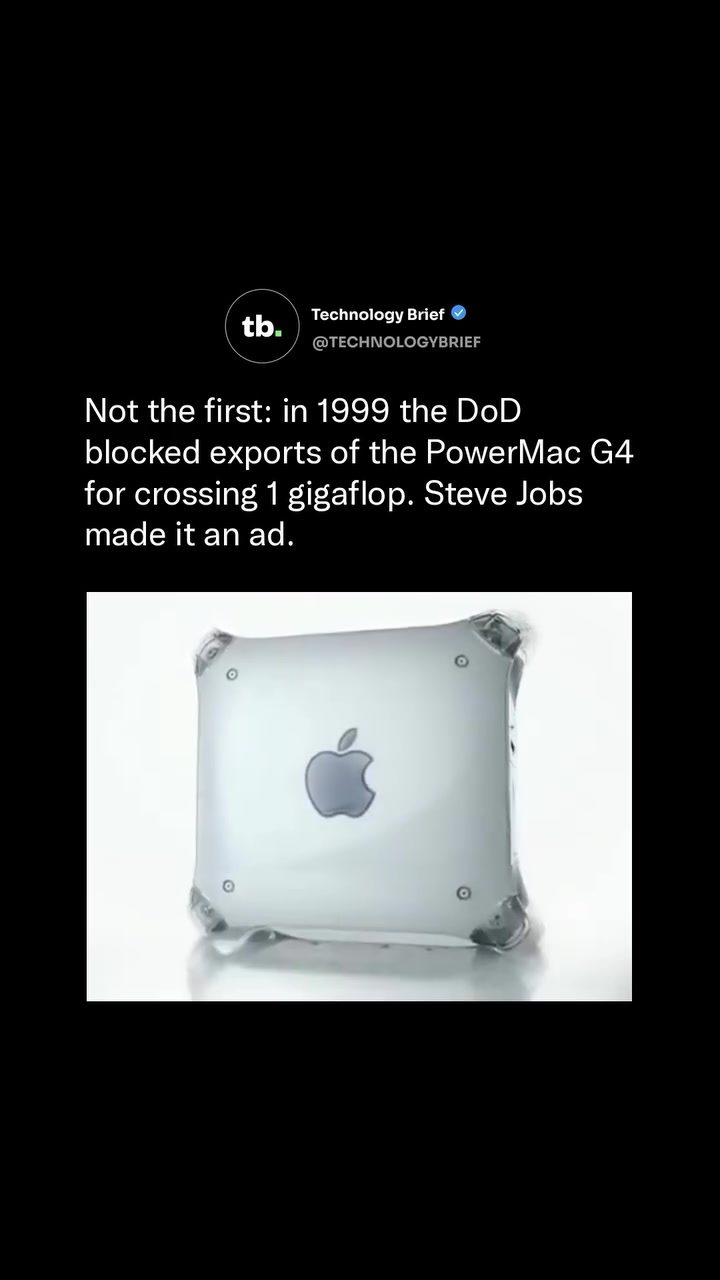
Apple's Power Mac G4: The First Personal Computer Classified as a Weapon
In 1999, Apple’s Power Mac G4 made history, but not in the way the company might have envisioned. It became the first personal computer to face U.S. munitions export restrictions. This unprecedented event occurred because the Power Mac G4 crossed the 1 gigalflop threshold, performing over one billion calculations per second. This technological milestone triggered the Cold War-era Export Administration Act of 1979, a law designed to prevent supercomputer-level capabilities from falling into the hands of rival nations.
Why This Matters
The Power Mac G4's classification as a weapon underscores the rapid evolution of computing power and the geopolitical implications of technological advancements. In 1999, the U.S. government's decision to restrict the export of the Power Mac G4 highlighted the potential military applications of high-performance computing. This move not only impacted Apple's business strategy but also marked a turning point in how the world viewed personal computers.
The Power Mac G4 and Its Limitations
The Power Mac G4 was a groundbreaking machine for its time. With the ability to perform over one billion calculations per second, it pushed the boundaries of what was possible in personal computing. However, this same capability made it a target for export restrictions. The U.S. Department of Defense (DoD) blocked exports of the Power Mac G4 to more than 50 countries, citing concerns that the machine could be used for military purposes.
Cold War Legacy
The Export Administration Act of 1979, enacted during the height of the Cold War, was designed to control the export of sensitive technologies that could enhance the military capabilities of foreign nations. The Power Mac G4's classification as a weapon was a direct result of this act. The DoD recognized that the machine's computational power could be harnessed for military applications, making it a strategic asset that needed to be protected.
Steve Jobs' Iconic Ad Campaign
Steve Jobs, then the CEO of Apple, turned the export restriction into a memorable advertising campaign. The commercial featured military tanks surrounding the Power Mac G4, emphasizing its classification as a weapon by the U.S. government. The ad ended with a deadpan jab: "As for Pentium PCs, well, they're harmless."
This clever marketing move not only highlighted the Power Mac G4's capabilities but also positioned Apple as a leader in high-performance computing. The ad became one of the most memorable in tech history, showcasing Jobs' knack for turning challenges into opportunities.
The Evolution of Computing Power
Fast forward to today, and the 1 gigaflop limit that flagged the Power Mac G4 as a military threat in 1999 is now a fraction of what a basic smartphone can do. The iPhone 12, for instance, surpasses 1,000 gigaflops, and the iPhone 15 Pro tops 2,000 gigaflops. This exponential growth in computational power makes the old law look as outdated as the tanks in Apple’s ad.
Impact on Modern Technology
The Power Mac G4's story serves as a reminder of how quickly technology advances and how laws struggle to keep pace. Today, smartphones and personal computers far exceed the capabilities of the Power Mac G4, making the export restrictions of the past seem almost laughable. However, this rapid advancement also raises new questions about the control and regulation of high-performance computing technologies.
Practical Tips for Tech Enthusiasts
For those interested in the history and evolution of personal computers, the story of the Power Mac G4 offers several insights:
Researching Historical Tech
Exploring the technological advancements of the past can provide a deeper understanding of how modern technologies have evolved. Resources like the Technology Brief can be invaluable for delving into the rich history of personal computing.
Understanding Regulatory Frameworks
Learning about the regulatory frameworks that governed technology exports in the past can offer insights into how laws and policies shape the tech industry today. This knowledge can be particularly useful for those involved in international trade and technology development.
Appreciating Iconic Marketing
The Power Mac G4 ad campaign is a classic example of how effective marketing can turn a regulatory challenge into a branding opportunity. Studying iconic ad campaigns can provide valuable lessons in marketing strategy and brand management.
Important Takeaways
The Power Mac G4's classification as a weapon by the U.S. government underscores the rapid evolution of computing power and the geopolitical implications of technological advancements. The story of the Power Mac G4, the historical context of the Export Administration Act, and Steve Jobs' iconic ad campaign provide valuable lessons in technology, regulation, and marketing.
Conclusion
The Power Mac G4's journey from a personal computer to a classified weapon is a fascinating chapter in the history of technology. It highlights the intersection of technological advancement, geopolitical concerns, and innovative marketing. As computing power continues to grow, the lessons from the Power Mac G4's story remain relevant, reminding us of the ever-evolving landscape of technology and regulation.
Questions readers ask
What specific capability of the Power Mac G4 led to its classification as a weapon?
The Power Mac G4 was classified as a weapon due to its ability to perform over 1 billion floating-point operations per second, also known as 1 Gigaflop. This level of computational power was deemed significant enough to be restricted under Cold War-era munitions regulations.
Which law led to the export restrictions on the Power Mac G4?
The Power Mac G4 faced export restrictions due to the Export Administration Act of 1979. This law was originally designed to control the export of sensitive technologies, including supercomputers, to prevent them from being used by rival nations.
How did Apple and Steve Jobs respond to the export restrictions on the Power Mac G4?
Apple and Steve Jobs had to navigate the unexpected classification of the Power Mac G4. Apple had to apply for licenses to export the computer to certain countries, adjusting the company's sales and distribution strategies to comply with new regulations.
What does the Power Mac G4's classification tell us about the geopolitical climate in 1999?
The classification of the Power Mac G4 as a weapon highlights the continuing geopolitical tensions in 1999. Despite the Cold War officially being over, concerns remained about the spread of advanced technologies to nations with potential adversarial interests.
Were there any other computers or technologies similarly restricted during that time?
The Power Mac G4 was not the only technology to face such restrictions. During the 1990s and early 2000s, other high-performance computing systems and technologies with significant military applications, such as certain types of encryption and high-speed processors, were also subject to similar export controls.
Related deep dives
Similar reads based on topic and creator.



Recent articles
Fresh deep dives from the latest Reels we unpacked.




Comments
Be the first to comment.