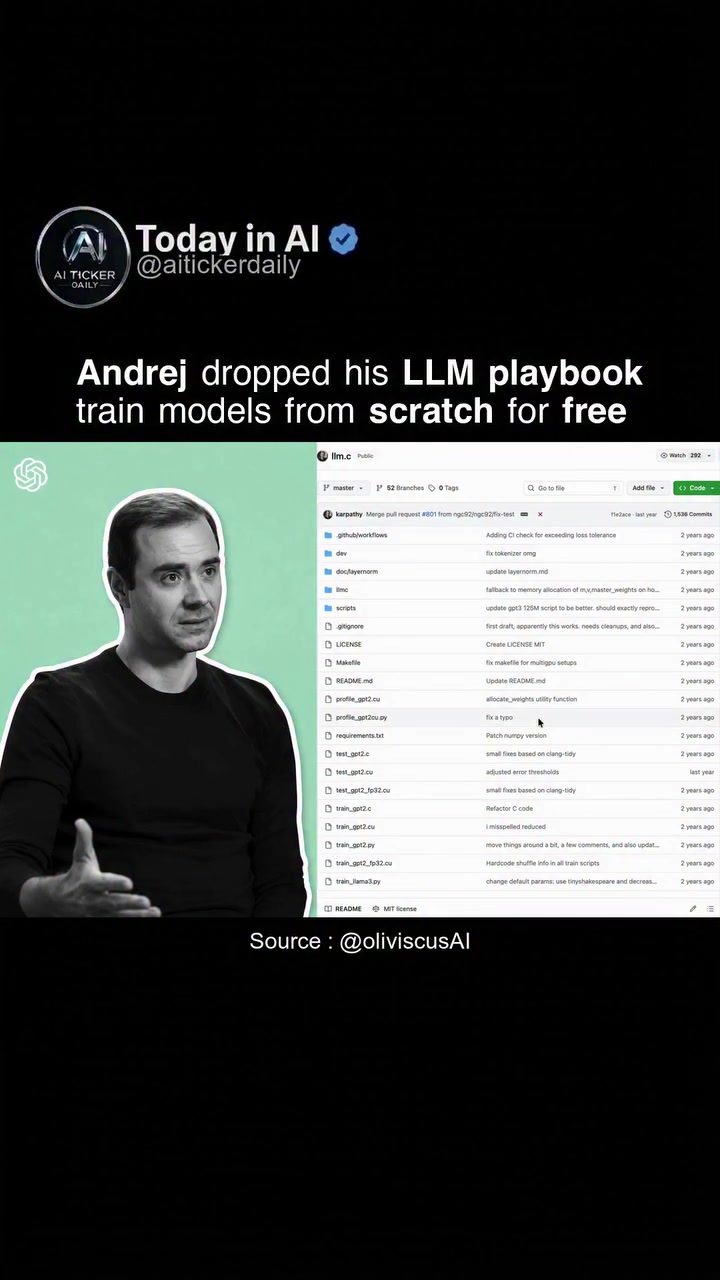
Training Large Language Models (LLMs) from Scratch
Andrej Karpathy, the former Director of AI at Tesla, has recently released a personal guide to training Large Language Models (LLMs) from scratch. This resource, dubbed llm.c, stands out for its accessibility and efficiency, offering a streamlined approach that requires no heavy setup and can run on a regular CPU, a MacBook, or a GPU. The guide boasts a 7% improvement in speed over standard methods and avoids the use of heavy frameworks, instead providing raw code to give users a deeper understanding.
This comprehensive training guide is more than just a set of instructions; it's designed to demystify the complex process of LLM training, making it accessible to a broader audience. By eschewing heavy setups and frameworks, it enables users to run the models on everyday devices, reducing the barriers to entry. The implications of this release are significant, both for those new to the field and for experienced practitioners looking to optimize their workflow.
Why This Matters
The release of llm.c by Andrej Karpathy is a game-changer for several reasons. Firstly, it lowers the barrier to entry for anyone interested in training LLMs. Traditional methods often require extensive computational resources and complex setups, which can be prohibitive for many individuals and small teams. By offering a guide that can run on everyday devices, Karpathy makes the technology more accessible.
Additionally, the efficiency gains highlighted in the guide are significant. A 7% improvement in speed might not sound like much, but in the context of training large models, it can translate into substantial time and resource savings. This efficiency is achieved through raw code and a minimalistic approach, which also offers a deeper understanding of the underlying processes.
Understanding the Guide
The Basics of Training LLMs
Training LLMs from scratch involves several key steps. These models are fundamentally complex neural networks that require vast amounts of data and computational power to train effectively. The process involves feeding the model large datasets, allowing it to learn patterns and relationships within the data. Over time, the model adjusts its internal parameters to improve its predictions.
Key Features of llm.c
-
Accessibility: One of the standout features of
llm.cis its accessibility. By avoiding heavy setups and frameworks, it allows users to run the training process on everyday devices. This democratizes access to LLM training, making it available to a wider audience, including hobbyists, students, and small teams. -
Efficiency: The guide boasts a 7% improvement in speed over standard methods. This might not seem like a massive leap, but in the context of training large models, every percentage point counts. This efficiency is achieved through raw code, which cuts out the overhead of heavy frameworks.
-
Learning Opportunities: The raw code approach also provides a deeper understanding of the underlying processes. By working with the code directly, users can gain a more intuitive grasp of how LLMs are trained, which can be invaluable for learning and innovation.
Practical Tips
Setting Up Your Environment
Before diving into the guide, it's important to set up your environment correctly. While llm.c is designed to run on a variety of devices, including regular CPUs, MacBooks, and GPUs, ensuring that your setup is optimized can help you get the most out of the guide.
-
Choose Your Device: Depending on your resources, choose a device that best fits your needs. For basic training, a regular CPU or a MacBook should suffice. For more intensive tasks, a GPU can significantly speed up the process.
-
Install Necessary Software: Ensure that you have all the necessary software and libraries installed. While
llm.cavoids heavy frameworks, you might still need some basic libraries for data handling and processing. -
Prepare Your Data: Gather and preprocess your data before starting the training process. High-quality, well-preprocessed data can significantly enhance the model's performance.
Following the Guide
-
Understand the Code: The guide provides raw code, which means you'll need to spend some time understanding how it works. This can be a steep learning curve for beginners, but it's also an opportunity to deepen your understanding.
-
Experiment with Parameters: Once you're comfortable with the code, start experimenting with different parameters. Small tweaks can lead to significant improvements in performance.
-
Monitor Performance: Keep an eye on the model's performance as it trains. Monitoring metrics such as loss, accuracy, and speed can help you identify areas for improvement.
Important Takeaways
- Accessibility: The guide makes LLM training accessible to a wider audience, including those with limited computational resources.
- Efficiency: The 7% speed improvement over standard methods can translate into significant resource savings.
- Learning Opportunities: The raw code approach offers a deeper understanding of the underlying processes, making it a valuable learning tool.
Conclusion
Andrej Karpathy's llm.c guide is a significant contribution to the field of LLM training. Its accessibility, efficiency, and learning opportunities make it a valuable resource for both beginners and experienced practitioners. By lowering the barriers to entry and providing a deeper understanding of the training process, it has the potential to drive innovation and advancement in the field. Whether you're new to LLM training or looking to optimize your existing workflow, llm.c offers a streamlined, efficient approach that can help you achieve your goals.
Questions readers ask
Who is Andrej Karpathy and what is his `llm.c` guide?
Andrej Karpathy is a prominent figure in the field of AI, formerly the Director of AI at Tesla. His `llm.c` guide is a comprehensive resource for training Large Language Models (LLMs) from scratch, designed to be accessible and efficient, allowing users to train models on everyday devices without needing heavy frameworks.
What makes Andrej Karpathy's LLM training guide different from other resources?
Andrej Karpathy's guide stands out by offering a streamlined, efficient method that can run on regular CPUs, MacBooks, or GPUs. It avoids heavy setups and frameworks, providing raw code to enhance understanding of the underlying processes and achieving a 7% speed improvement over standard methods.
Can I train LLMs on my personal devices using this guide?
Yes, one of the key benefits of Andrej Karpathy's `llm.c` guide is its accessibility. It is designed to run on everyday devices, including regular CPUs, MacBooks, and GPUs, making it possible to train LLMs without needing specialized or high-end hardware.
Why does the guide avoid using heavy frameworks?
By avoiding heavy frameworks, Andrej Karpathy's guide provides users with a deeper understanding of the LLM training process. The use of raw code allows users to see the underlying mechanics more clearly, which can be beneficial for both learning and customization purposes.
What kind of speed improvements can I expect from using this guide?
Andrej Karpathy's `llm.c` guide boasts a 7% improvement in training speed compared to standard methods. This is achieved through a streamlined and efficient approach, making the training process not only more accessible but also faster.
Is the guide suitable for beginners in LLM training?
Yes, the guide is designed to demystify the complex process of LLM training, making it accessible to a broader audience. By providing a clear, step-by-step approach and using raw code, it helps beginners understand the process better and get started with LLM training more easily.
What are the benefits of training LLMs from scratch?
Training LLMs from scratch allows for a deeper understanding of the model's architecture and behavior. It also provides the flexibility to customize the training process to specific needs and can lead to better performance and efficiency gains, as demonstrated by Andrej Karpathy's `llm.c` guide.
Related deep dives
Similar reads based on topic and creator.




Recent articles
Fresh deep dives from the latest Reels we unpacked.




Comments
Be the first to comment.