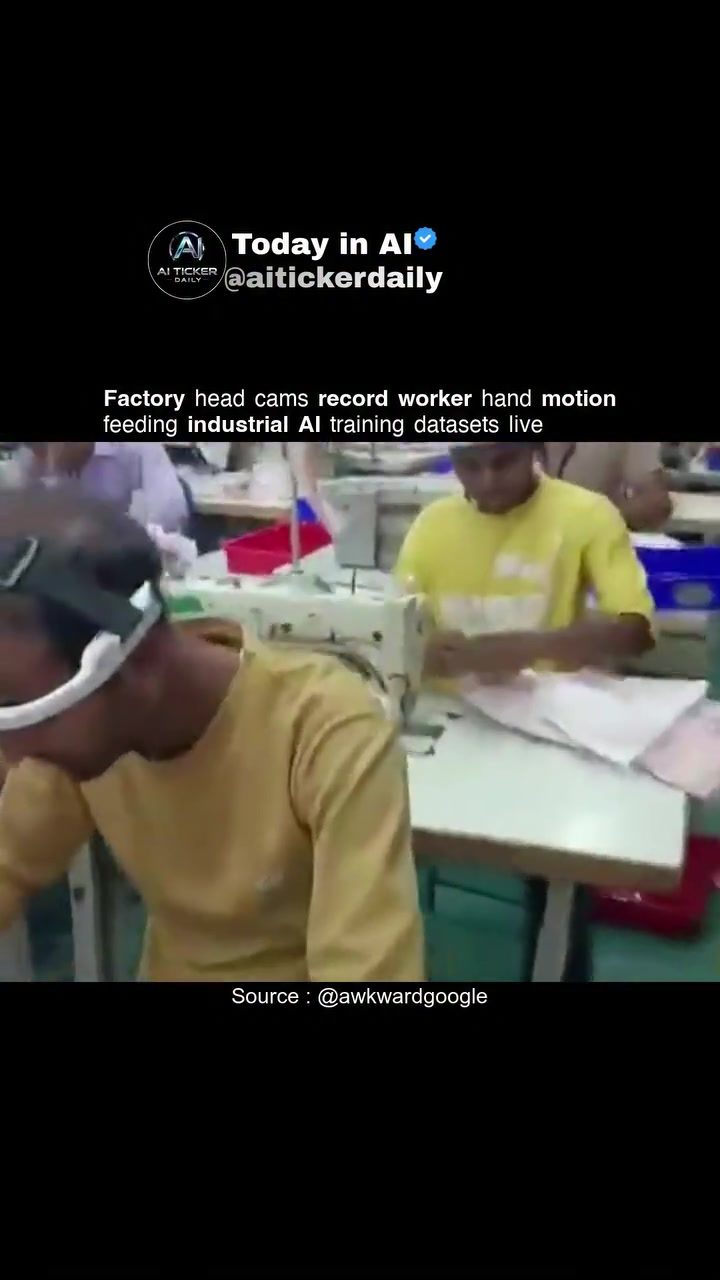
Industrial Automation in Action: How Factory Workers' Hand Movements Feed AI Training
Factory workers in India are playing a pivotal role in the development of AI systems. The direct use of head-mounted cameras to record hand movements on factory machinery provides valuable insights into the training of AI models. In this article, we’ll explore what happens in these factories, why this process is crucial, and the practical applications of head-mounted cameras in industrial AI training.
Context / Why This Matters
As industries continue to automate, the need for highly accurate and efficient AI models is paramount. These models depend on vast datasets that capture a wide range of motions and scenarios. By directly recording the hand movements of factory workers as they operate machinery, companies can gather precise data that reflects real-world operations. This data is essential for training AI systems that can perform tasks with the same level of accuracy and efficiency as human workers.
How Industrial AI Training Works
The Use of Head-Mounted Cameras
The use of head-mounted cameras to record the hand movements of factory workers is a direct and effective way to gather training data. Head-mounted cameras provide a first-person perspective, capturing all the minute details of how workers interact with factory machinery. This detailed data is crucial for training AI models to understand and replicate these actions accurately.
Capturing Real-World Scenarios
Real-time recording of worker hand motions ensures that the data collected is as close to real-world scenarios as possible. The video provides a view of workers feeding materials into machines, showcasing the exact movements required for efficient operation.
The Role of AI in Industrial Operations
AI models trained on this data can be used to optimize factory operations, reduce errors, and improve overall efficiency. By understanding the precise movements required to operate machinery, AI systems can assist in training new workers, optimizing workflows, and even detecting potential issues before they become critical.
Practical Tips for Implementing AI Training in Factories
Choosing the Right Equipment
Selecting the right head-mounted cameras is crucial. These cameras need to be lightweight, comfortable for workers to use for extended periods, and capable of capturing high-quality video.
Ensuring Data Accuracy
It’s important to calibrate the cameras correctly and ensure they are securely fastened to the worker's head. This will help in capturing accurate data without any disruptions.
Integrating AI Models
Once the data is collected, it needs to be integrated into AI models. This involves extensive processing, annotation, and training. The goal is to create a model that can accurately replicate the movements and actions of workers, thus enhancing the efficiency of the factory operations.
Maintaining Worker Comfort
While the use of head-mounted cameras is effective, it’s essential to ensure that workers are comfortable and that the equipment does not interfere with their daily tasks. Regular breaks and proper ergonomic considerations should be taken into account.
Important Takeaways
- Real-World Data Collection: The use of head-mounted cameras to record worker hand movements provides a direct and accurate way to gather training data for AI models.
- Optimized Operations: AI models trained on this data can significantly improve factory operations by reducing errors and enhancing efficiency.
- Comfort and Accuracy: Ensuring the comfort of workers and the accuracy of the data collected are crucial for the success of this approach.
- Future Applications: This method of data collection can be applied to various industries and scenarios, making it a versatile tool for AI training.
Conclusion
Industrial AI training, especially through the use of head-mounted cameras to record worker hand movements, is a revolutionary approach to data collection. It not only enhances the accuracy and efficiency of AI models but also provides valuable insights into real-world operations. By adopting this method, industries can achieve new levels of precision and productivity, setting a new standard for automation.
Questions readers ask
How do Indian factory workers contribute to AI training through their hand movements?
Indian factory workers contribute to AI training by performing their tasks while wearing head-mounted cameras. These cameras capture detailed data of their hand movements, which is then used to train AI models. This helps AI systems learn how to replicate human tasks more accurately, enhancing the efficiency of industrial automation.
Why are head-mounted cameras used in capturing hand movement data?
Head-mounted cameras are used because they provide a first-person perspective, ensuring that the capture of hand movements is precise and comprehensive. They are non-disruptive and allow workers to perform their tasks naturally, making the data collected more authentic and useful for AI training.
What role does hand movement data play in industrial automation?
Hand movement data is crucial in industrial automation as it helps AI models understand and replicate human tasks. By analyzing this data, AI systems can learn to operate machinery with high accuracy, improve operational efficiency, and reduce the need for human intervention in repetitive tasks.
What are the benefits of using hand-mounted cameras for workers and the industry?
For workers, head-mounted cameras are non-invasive and allow them to continue their work without disruption. For the industry, this method provides high-quality data that enhances AI model accuracy, leading to better automation and operational improvements. This ultimately contributes to increased productivity and cost savings.
What are the practical applications of using AI to replicate human tasks in industrial settings?
Replicating human tasks with AI can significantly reduce the workload on human workers, particularly in repetitive and potentially hazardous tasks. It can also lead to more consistent and efficient operations. For instance, an AI model could handle tasks including packaging, assembly, or quality control, ensuring high standards and reducing errors.
How is the data from the head-mounted cameras used in the development of AI models in India?
The data from head-mounted cameras is processed to create detailed datasets of human movements. These datasets are then used to train AI models, enabling them to understand and replicate complex human tasks. The AI models can then be implemented in various industrial applications, from robotics to automated quality control.
What advancements has India seen in industrial AI due to capturing worker's hand movements?
Capturing hand movements has led to significant advancements in AI training in India. This includes the development of more accurate and efficient AI models for industrial applications. These models can perform tasks with high precision, improving overall operational efficiency and contributing to the growth of industrial automation in India.
Related deep dives
Similar reads based on topic and creator.




Recent articles
Fresh deep dives from the latest Reels we unpacked.




Comments
Be the first to comment.