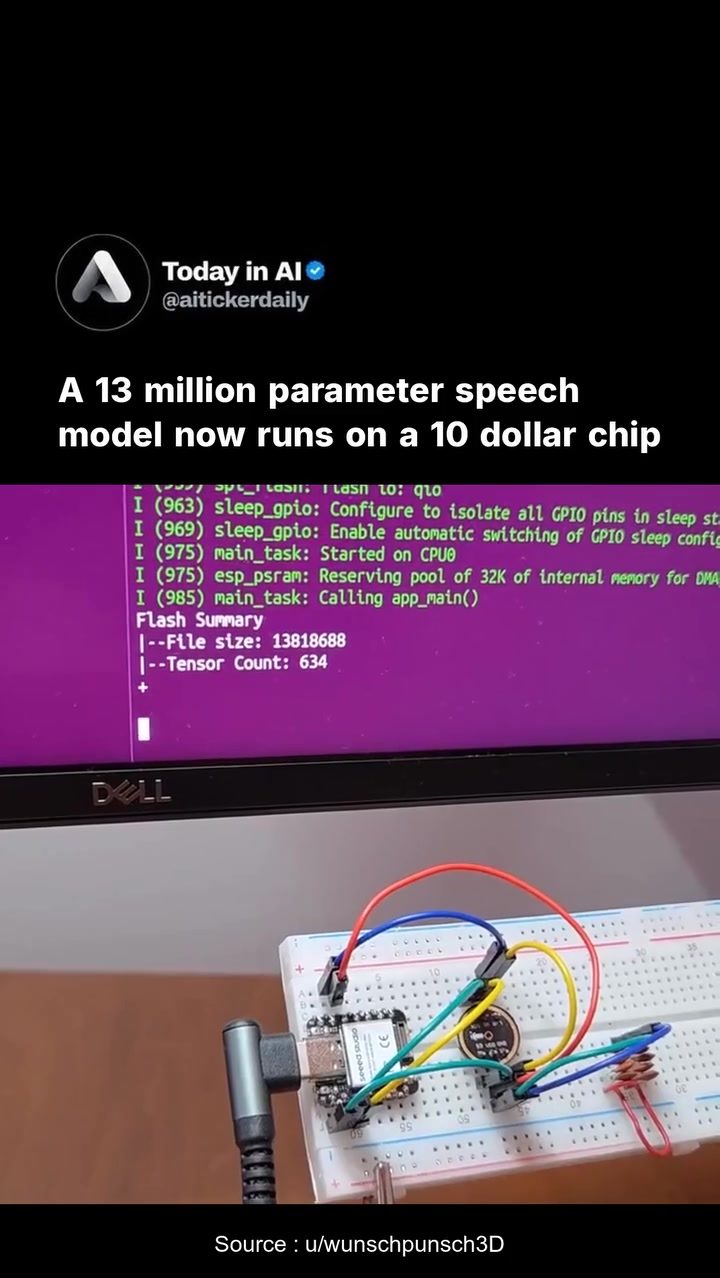
AI Speech Models on Microcontrollers
AI speech models are revolutionizing the way microcontrollers interact with the world. The impressive capabilities of these models, once the domain of powerful computers, are now being harnessed by inexpensive microcontrollers. Specifically, a distilled and quantized version of Nvidia's small conformer speech model, with 13.1 million parameters, is now capable of running on an ESP32-S3 microcontroller, a device that costs less than $10.
Why this Matters
The ability to run complex AI models on low-cost hardware opens up a world of possibilities for real-time speech recognition and natural language processing. This advancement is particularly significant for developers and hobbyists working on projects that require voice control, voice assistants, or automated transcription.
Microcontrollers like the ESP32-S3 are ubiquitous in modern devices, from smart home gadgets to wearable technology. Equipping these devices with advanced speech models can enhance their functionality, making them more intuitive and interactive. Imagine a smart speaker that can transcribe conversations in real-time, or a wearable device that can take notes or send messages based on voice commands.
Main Discussion
The ESP32-S3 Microcontroller
The ESP32-S3 is a low-cost, high-performance microcontroller with built-in wireless capabilities. It features a dual-core processor, 256KB of SRAM, and 16MB of flash memory, making it a versatile choice for a variety of applications. Its affordability and compact size make it an ideal platform for experimenting with AI speech models.
The Speech Model
The speech model in question is a distilled and quantized version of Nvidia's small conformer speech model. Quantization is a technique used to reduce the size and computational requirements of a model by approximating the weights with lower-precision numbers. This process can significantly speed up inference and reduce memory usage, making it feasible to run on a microcontroller.
The model has 13.1 million parameters, which is a compromise between accuracy and efficiency. While it may not be as accurate as larger models, it strikes a balance that allows it to run in real-time on a microcontroller, transcribing 8 seconds of audio in a fraction of a second. The first attempt to run the model took 10 minutes to transcribe 5 seconds of audio, but this version is dramatically faster.
Real-Time Speech Transcription
One of the most impressive demonstrations of this technology is real-time speech transcription. The microcontroller can listen to spoken words, process them, and transcribe them into text with remarkable speed. For example, it can transcribe the phrase "Put cheese on my shopping list" in just 3799 milliseconds (3.8 seconds). This capability opens up a range of applications, from voice-controlled devices to automated transcription services.
Accuracy and Performance
The accuracy of the speech model is an important consideration. The caption mentions an accuracy hit of only about 3% across standard ASR (Automatic Speech Recognition) benchmarks. This means that while there is a slight reduction in accuracy compared to larger models, the performance is still highly impressive for a device of this size and cost.
Hardware and Software Integration
Integrating an AI speech model into a microcontroller requires careful consideration of both hardware and software. The microcontroller must have sufficient processing power and memory to run the model efficiently. Additionally, the software must be optimized to take full advantage of the hardware capabilities.
The ESP32-S3, with its dual-core processor and ample memory, is well-suited to this task. The model fits into 14MB of flash and about 256KB of SRAM, leaving enough room for other applications and peripherals. The software, likely written in a language like MicroPython or C++, must be optimized for speed and efficiency to ensure real-time performance.
Practical Tips
Choosing the Right Microcontroller
When selecting a microcontroller for AI applications, consider factors like processing power, memory, and connectivity options. The ESP32-S3 is a great choice for many projects, but depending on your specific needs, you might opt for a different model. Some other popular options include the Arduino Nano 33 BLE Sense, which features a low-power ARM Cortex-M0+ microcontroller, and the Raspberry Pi Pico, which offers a dual-core Arm Cortex-M0+ design.
Optimizing the Model
To make the most of your microcontroller, you may need to optimize the AI model. Techniques like quantization and pruning can reduce the model's size and computational requirements, making it more efficient to run on low-cost hardware. You can experiment with different quantization levels and pruning strategies to find the best balance between performance and accuracy.
Handling Real-Time Audio
Real-time audio processing requires careful management of audio buffers and processing pipelines. Ensure that your software can handle audio data efficiently, with minimal latency. You may need to implement buffering, audio filtering, and other signal processing techniques to achieve the best results.
Power Management
Microcontrollers often run on battery power, so efficient power management is crucial. Optimize your code to minimize power consumption, and consider using power-saving features like deep sleep or low-power modes when the device is not in use. Additionally, choose a microcontroller with efficient power management capabilities.
Important Takeaways
- AI speech models can now run on low-cost microcontrollers, making advanced voice recognition and transcription capabilities accessible to a wide range of devices.
- The ESP32-S3 microcontroller, with its dual-core processor and ample memory, is an excellent platform for running AI speech models.
- Real-time speech transcription is a powerful application of this technology, with potential uses ranging from voice-controlled devices to automated transcription services.
- While there is a slight accuracy trade-off, the performance and efficiency gains make this technology highly practical for many applications.
Conclusion
The integration of AI speech models into microcontrollers represents a significant leap forward in the capabilities of low-cost, embedded systems. The ESP32-S3, with its ability to run a 13.1 million parameter speech model, demonstrates the potential for real-time speech recognition and natural language processing at a fraction of the cost of traditional solutions. As this technology continues to advance, we can expect to see a wide range of new applications and devices that leverage the power of AI speech models.
Questions readers ask
What is the ESP32-S3 microcontroller and why is it significant in the context of AI speech models?
The ESP32-S3 is a low-cost microcontroller, priced under $10, that has gained significance due to its ability to run AI speech models. This capability allows for real-time speech recognition and natural language processing in affordable, compact devices, making advanced AI features accessible to a wider range of applications, such as smart home gadgets and wearable technology.
How does running AI speech models on microcontrollers enhance device functionality?
By running AI speech models, microcontrollers can enable real-time speech recognition and natural language processing. This allows devices to respond to voice commands, transcribe speech, and engage in conversational interactions, greatly enhancing their interactivity and usability.
What specific AI speech model can run on the ESP32-S3 microcontroller?
A distilled and quantized version of Nvidia's small conformer speech model, with approximately 13.1 million parameters, is capable of running on the ESP32-S3 microcontroller. This model has been optimized to fit within the constraints of low-cost hardware, allowing for efficient speech recognition and processing.
What are some practical applications of AI speech models on microcontrollers?
AI speech models on microcontrollers can be used in a variety of applications, including smart home devices for voice control, wearable technology for hands-free operation, and even in hobbyist projects that require voice assistants or speech transcription features. The affordability and compact size of these microcontrollers make them ideal for innovative and cost-effective designs.
How does the cost of the ESP32-S3 microcontroller impact the accessibility of AI speech models?
The low cost of the ESP32-S3 microcontroller, which is less than $10, makes AI speech models more accessible to a broader range of developers and hobbyists. This affordability encourages experimentation and innovation, as it allows for the integration of advanced speech recognition capabilities into a wide array of devices without significant financial barriers.
What benefits do developers gain from using AI speech models on affordable microcontrollers?
Developers benefit from the ability to create more interactive and functional devices by integrating AI speech models into affordable microcontrollers. This opens up new possibilities for voice-controlled applications, smart devices, and wearable technology, providing a competitive edge in the market and fostering creativity in project development.
Can AI speech models on microcontrollers be used for real-time speech transcription?
Yes, AI speech models on microcontrollers, such as the ESP32-S3, are capable of real-time speech transcription. This functionality enables devices to convert spoken language into text in real-time, making it useful for applications like voice-to-text input, live captioning, and interactive voice-controlled interfaces.
Related deep dives
Similar reads based on topic and creator.




Recent articles
Fresh deep dives from the latest Reels we unpacked.




Comments
Be the first to comment.