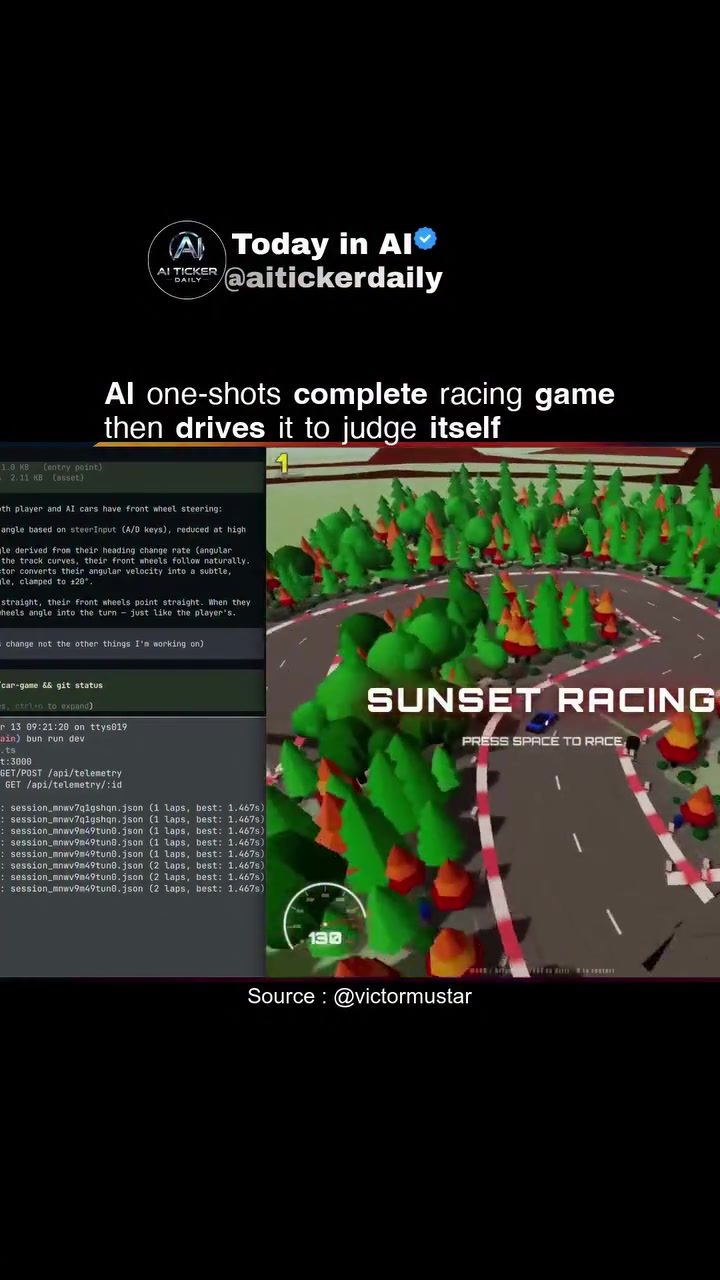
AI-Powered Racing Simulation
Racing simulations are continually evolving with advancements in AI technology. One of the latest breakthroughs showcased a workflow where the GLM-5.1 AI model, facilitated by Claude Code-style tooling, completes laps in a Three.js racing game with drift-style car physics. What sets this demo apart is the AI's ability to self-evaluate its performance, iterating against the running build for continuous improvement. The game, entitled "SUNSET RACING," offers a glimpse into the future of racing simulations and AI integration.
Why This Matters
The integration of AI in racing games is not just about enhancing the gaming experience; it's about pushing the boundaries of what's possible in game development. The ability of AI to one-shot a game, complete a lap, and then self-evaluate its performance opens up new avenues for game testing, optimization, and even player experience. This technology can help developers identify bugs, optimize performance, and create more realistic and immersive gameplay experiences.
Understanding the Workflow
AI and Game Integration
The workflow begins with the AI, specifically the GLM-5.1 model, which is a large language model designed to understand and generate code. In this case, Claude Code-style tooling is utilized to facilitate the AI's interaction with the game. This tooling is crucial as it allows the AI to understand and manipulate the game environment effectively.
Drift-Style Car Physics
The game, built with Three.js, a popular JavaScript library for 3D graphics, features drift-style car physics. This adds a layer of complexity to the AI's tasks, as it must not only navigate the track but also handle the unique physics of drift-style racing. This type of physics requires precise control and timing, making it a challenging task for any AI.
Self-Evaluation and Iteration
The AI doesn't just complete the lap; it also evaluates its performance. This self-evaluation is a significant step forward in AI capabilities. By judging its own performance, the AI can identify areas for improvement and iterate on its strategies. This continuous self-improvement is what makes this workflow so powerful. It allows the AI to learn from its mistakes and enhance its performance over time.
Practical Tips for Developers
Leveraging AI in Game Development
For developers looking to integrate AI into their games, understanding the capabilities of large language models like GLM-5.1 is crucial. These models can be used to automate various tasks, from bug identification to performance optimization. By leveraging AI, developers can focus more on the creative aspects of game development.
Using Claude Code-Style Tooling
Claude Code-style tooling provides a way for AI to interact with game environments effectively. For developers, understanding how to use this tooling can open up new possibilities. It can help in automating repetitive tasks, identifying bugs, and even creating more immersive gameplay experiences.
Implementing Drift-Style Car Physics
Drift-style car physics adds a layer of complexity to any racing game. However, it can also make the game more engaging and challenging. Developers should consider incorporating this type of physics into their games to offer a more realistic and immersive experience.
Important Takeaways
- AI and Game Development: The integration of AI in game development can significantly enhance the gaming experience and optimize performance.
- Self-Evaluating AI: The ability of AI to self-evaluate and iterate on its performance is a significant step forward in AI capabilities.
- Drift-Style Car Physics: Implementing drift-style car physics can make racing games more engaging and challenging.
Conclusion
The demo showcased a fascinating glimpse into the future of racing simulations and AI integration. With the AI's ability to complete laps and self-evaluate its performance, the possibilities for game development are endless. As AI technology continues to advance, we can expect to see more innovative and immersive gaming experiences. For developers, understanding and leveraging these technologies can provide a competitive edge in the rapidly evolving gaming industry.
Questions readers ask
What is the GLM-5.1 model and how does it function in the 'SUNSET RACING' game?
The GLM-5.1 model is an AI designed to navigate drift-style car physics in the racing game 'SUNSET RACING' It utilizes Claude Code-style tooling to complete laps in a Three.js racing game and continuously improves through self-evaluation during gameplay.
How does AI integration enhance the future of racing games?
Integration of AI in racing games, like the GLM-5.1 model in 'SUNSET RACING', allows for continuous improvement of the game through self-evaluation and iteration. This helps in fine-tuning the game's physics, enhancing the overall gaming experience, and pushing the boundaries of game design.
What is the significance of the 'Sunset Racing' game demo?
The 'Sunset Racing' game demo demonstrates how AI can be integrated into racing games to test and improve game designs, and the importance of AI self-evaluation in continuously improving the game design.
How does the AI in 'Sunset Racing' handle drift-style car physics?
The AI in 'Sunset Racing' uses the GLM-5.1 model to navigate drift-style car physics, allowing it to complete laps and self-evaluate its performance, enhancing car physics gameplay.
What are the benefits of AI-powered racing simulations for game development?
AI-powered racing simulations, like 'Sunset Racing', offer benefits such as continuous self-improvement, enhanced testing, and pushing the boundaries of game design and car physics.
Related deep dives
Similar reads based on topic and creator.




Recent articles
Fresh deep dives from the latest Reels we unpacked.




Comments
Be the first to comment.