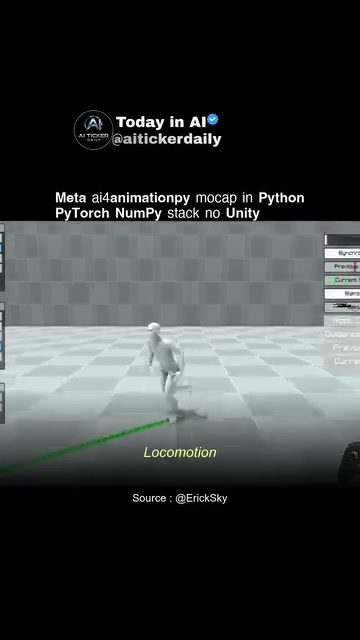
AI-Powered Animation: Full-Body Characters with Motion Capture and Python
Animation software has seen remarkable advancements with the integration of artificial intelligence. One of the most exciting developments in this field is the use of AI to animate full-body characters, including humans and quadrupeds, through motion capture. This approach leverages the power of Python, PyTorch, and NumPy to create stunning, lifelike animations.
Context: Why AI Animation Matters
AI animation is more than just a technological marvel; it's a game-changer in various industries. From film and gaming to virtual reality and robotics, the ability to animate characters with high fidelity and efficiency is crucial. Traditional animation methods, while effective, often require extensive manual labor and significant time investments. AI-powered animation significantly reduces these burdens, allowing for faster production cycles and more dynamic content.
The Basics of AI Animation with ai4animationpy
Full-Body Characters and Motion Capture
One of the key features of AI animation is the ability to animate full-body characters. This includes not just humans but also quadrupeds and other animals. The process involves motion capture, where real-world movements are recorded and translated into digital animations. This ensures that the movements are natural and believable, adding a layer of realism to the animations.
The ai4animationpy system, linked to Meta, exemplifies this capability. It uses motion capture technology to record the movements of actors, which are then translated into animations using AI. This approach ensures that the animations are not only accurate but also highly detailed, capturing every nuance of the movement.
Training and Inference in Python
The ai4animationpy software runs entirely in Python, utilizing PyTorch and NumPy for training and inference. This choice of technology stack is significant for several reasons. Python is a widely-used programming language known for its simplicity and versatility. PyTorch, a deep learning framework, is renowned for its flexibility and ease of use, making it an ideal choice for developing complex AI models. NumPy, a library for numerical computing, provides the mathematical foundations needed for training and inference.
By leveraging these technologies, the ai4animationpy system can handle the intricate details of motion capture data. The training process involves feeding the AI model with large datasets of motion capture data, allowing it to learn the patterns and nuances of human and animal movements. Once trained, the model can then infer new animations from different inputs, creating a seamless and efficient workflow.
No Unity in the Loop
One of the standout features of the ai4animationpy system is that it does not run within Unity. Unity is a popular game engine known for its versatility and ease of use. However, it is also a resource-intensive platform that can slow down the animation process. By avoiding Unity, the ai4animationpy system can operate more efficiently, reducing the computational load and speeding up the animation pipeline.
Visualizations and Technical Aspects
The demo showcases several key visualizations that highlight the capabilities of the AI animation software. These include:
Locomotion
Locomotion refers to the movement of characters from one point to another. In the demo, locomotion is demonstrated through various scenarios, showing how the AI can generate natural and realistic walking, running, and jumping motions. This is crucial for creating believable characters in any animation project.
Entity-Component-System
The Entity-Component-System (ECS) is a design pattern used in game development and animation. It breaks down entities (such as characters) into components that can be managed independently. This modular approach allows for greater flexibility and efficiency in the animation process. The demo highlights how the AI can handle complex interactions between different components, ensuring smooth and cohesive animations.
Motion Module
The Motion Module is a key component of the animation software. It is responsible for generating and managing the movements of characters. In the demo, the Motion Module is shown in action, demonstrating how it can create dynamic and lifelike animations. This is achieved through a combination of motion capture data and AI algorithms that generate new movements based on learned patterns.
Inverse Kinematics
Inverse Kinematics (IK) is a technique used to determine the joint parameters needed to achieve a desired end-effector position. In the context of animation, IK is used to control the movements of character limbs and joints. The demo showcases the FABRIK (Fast Approximate-Batched Inverse Kinematics) algorithm, which is used to compute IK solutions efficiently. This ensures that the animations are not only accurate but also computationally efficient.
Data Visualization - Joint Trajectories
Joint trajectories are the paths that character joints follow during movement. In the demo, these trajectories are visualized, providing a clear view of how the AI generates smooth and natural movements. This visualization is essential for understanding the intricacies of the animation process and ensuring that the animations meet the desired quality standards.
Practical Tips for Using AI Animation
While the ai4animationpy system is powerful, using it effectively requires some practical tips. Here are a few key points to keep in mind:
Start with High-Quality Data
The quality of the motion capture data is crucial for generating high-quality animations. Ensure that the data is clean, accurate, and comprehensive. This will provide the AI with the necessary information to create lifelike movements.
Optimize Your Workflow
Efficiency is key in any animation project. By optimizing your workflow, you can reduce the time and resources required to generate animations. This includes using the right tools and technologies, as well as streamlining your processes.
Experiment with Different Techniques
AI animation opens up new possibilities for creating dynamic and engaging content. Don't be afraid to experiment with different techniques and approaches. This will help you discover new ways to enhance your animations and push the boundaries of what's possible.
Important Takeaways
AI-powered animation software, such as ai4animationpy, offers a range of benefits for animators and developers. By using motion capture, training, and inference in Python, it allows for the creation of highly detailed and realistic animations. The use of PyTorch and NumPy ensures that the software is efficient and flexible, while avoiding Unity keeps the process streamlined.
Visualizations such as locomotion, entity-component-system, motion module, and inverse kinematics provide a clear view of the software's capabilities, showcasing how it can generate smooth and natural movements. By following practical tips and experimenting with different techniques, animators can make the most of this powerful tool.
Conclusion
AI animation is revolutionizing the way characters are brought to life in various media. The use of motion capture, Python, PyTorch, and NumPy in ai4animationpy demonstrates the potential of this technology. By understanding the different components and visualizations, animators can create stunning, lifelike animations that push the boundaries of what's possible. Whether you're working in film, gaming, or virtual reality, AI animation offers a powerful and efficient way to bring your characters to life.
Questions readers ask
What is motion capture and how does it relate to AI-powered animation?
Motion capture is a technology that records the movements of actors or subjects and translates them into digital data. In AI-powered animation, motion capture data is used to train AI models, enabling them to generate natural, full-body movements for animated characters. This results in more realistic and efficient animations.
Why is Python commonly used in AI animation?
Python is widely used in AI animation due to its simplicity and the vast array of libraries available for machine learning and data manipulation. Libraries like PyTorch and NumPy are particularly useful for creating and training AI models for animation, as well as processing and analyzing motion capture data.
What are the benefits of using AI for full-body character animation?
AI can significantly speed up the animation process by generating realistic movements autonomously. This reduces the need for manual keyframing and allows animators to focus on other creative aspects. Additionally, AI can create consistent and natural movements for both humans and animals, enhancing the overall quality of the animation.
How does inverse kinematics contribute to AI animation?
Inverse kinematics is a technique used to determine the necessary joint angles to achieve a desired position of an object or character. In AI animation, inverse kinematics helps in generating realistic limb movements by solving the complex mathematical equations involved. This ensures that the character's movements are both physically plausible and visually convincing.
Can AI animation be used for both humans and animals?
Yes, AI animation can be applied to both humans and animals, known as bipeds and quadrupeds, respectively. By training AI models on motion capture data from various subjects, it is possible to create natural and believable movements for a wide range of characters. This versatility makes AI animation a powerful tool in industries like film, gaming, and virtual reality.
What is the role of PyTorch in AI animation?
PyTorch is a popular deep learning framework used in AI animation for developing and training neural networks. It enables the creation of complex models that can learn from motion capture data, generate realistic animations, and even predict future movements. PyTorch's flexibility and performance make it an ideal choice for AI animation projects.
How can I get started with AI animation using Python?
To begin with AI animation using Python, you should familiarize yourself with libraries like PyTorch and NumPy. There are numerous tutorials and Python animation demos available online that can guide you through the basics of creating and training AI models for animation. Additionally, exploring motion capture data and understanding how to preprocess it will be beneficial for your projects.
Related deep dives
Similar reads based on topic and creator.




Recent articles
Fresh deep dives from the latest Reels we unpacked.




Comments
Be the first to comment.