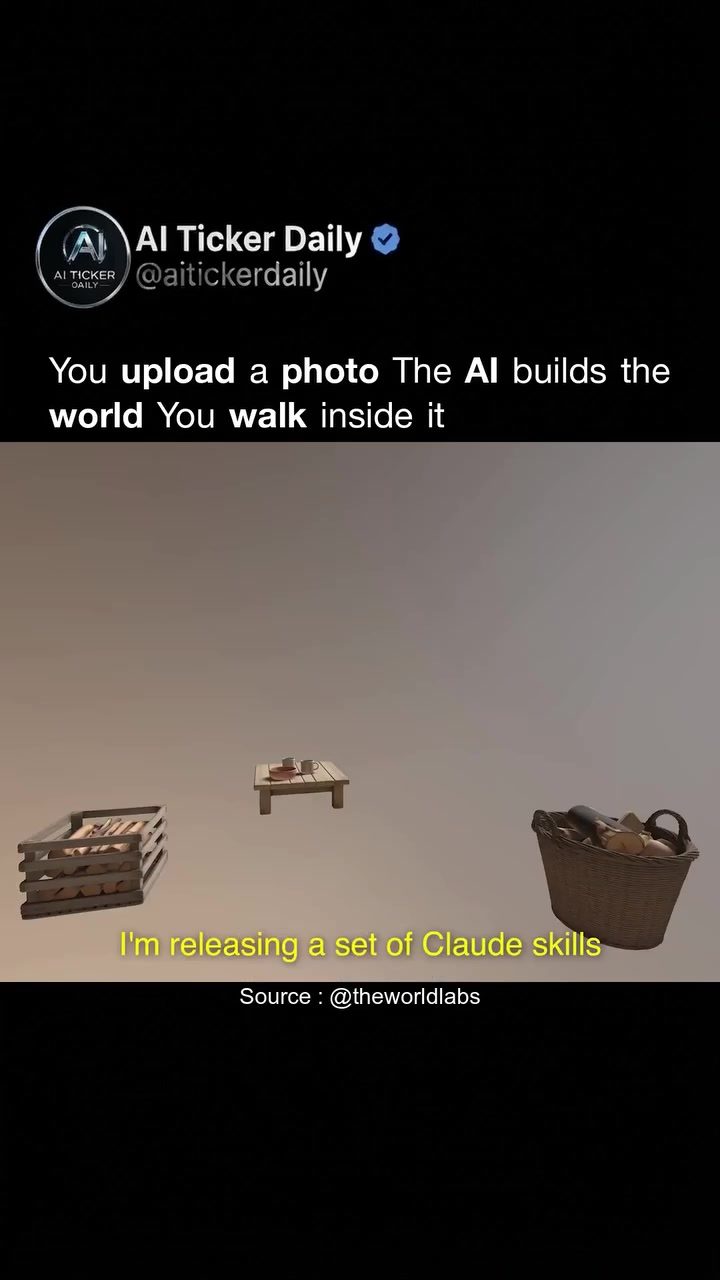
Photo to 3D Worlds: AI-Powered Image Generation
AI image generation technology has evolved to a point where it can transform a single photo into a fully meshed 3D environment. This breakthrough, demonstrated by AI Ticker Daily, leverages sophisticated AI tools to create immersive environments with interactive physics, sound effects, and explorable terrain.
Why This Matters
Traditional 3D world-building often requires specialized software like Blender or Unity and a deep understanding of 3D modeling. However, the advancements in AI technology now allow anyone to generate a fully meshed 3D environment from a single photo. This democratizes the process, making it accessible to a broader audience.
How AI Generates 3D Environments
The Reference Image
The process begins with a single reference image, which acts as a framework. The AI agent analyzes this image, generating individual objects and a static environment. The environment includes colliders for objects that need to stay in place and additional elements like lighting and sound effects.
Object and Scene Generation
Claude, an AI model, starts by recommending objects from the original source image. Once the list of desired objects is confirmed, Claude creates an image for each object. These images are then sent to a 3D generation model, which produces GLB files and PBR materials. The GLB files are a standardized format for 3D models, while PBR (Physically Based Rendering) materials ensure accurate lighting and texture rendering. The original image can then be edited or manipulated as needed.
Environment and Sound Effects
The generated environment is further enriched with static Gaussian splats, a panoramic environment map, and a mesh collider. These elements enhance the realism and interactivity of the scene. Additionally, there are object sound effects and ambient sound effects that play in the background, adding to the immersive experience.
Integration and Customization
The project is designed to be used with various 3D authoring tools, including Blender, Unreal, and Unity. This makes it versatile for different game design, AR, and AI filmmaking projects. The generated scenes can be duplicated, edited, and manipulated, allowing for extensive customization.
Practical Tips
Using Image Blaster
Image Blaster, the tool showcased by AI Ticker Daily, is built using Marble, Claude skills, and fal. It's designed to be user-friendly, requiring no prior 3D modeling skills. Here's how to get started:
- Upload a Photo: Start by uploading a single reference image.
- Generate the Environment: The AI will build the 3D environment, including objects, sound effects, and terrain.
- Explore and Customize: Walk inside the generated world, duplicate, edit, and manipulate the scene as needed.
Real vs. Fake Images
The system works with both real and fake images, providing flexibility in what you can create. Detailed interior scenes tend to yield the best results, but the flexibility allows for creativity in various settings.
Open Source and Extendable
The project is fully open source, available on GitHub under the name Image Blaster. This means you can extend the pipeline, connect it to other tools, and even build scenes with it. Currently, the focus is on generation, but future developments could include more advanced scene-building features.
Important Takeaways
AI image generation is revolutionizing the way 3D environments are created. This technology makes it possible to generate fully meshed 3D environments with interactive physics, sound effects, and explorable terrain from a single photo. The tools used, such as Claude and WorldLab, are powerful and versatile, allowing for extensive customization and integration with popular 3D authoring tools. As this technology continues to evolve, it will become an indispensable part of game design, AR, and AI filmmaking.
Conclusion
AI-powered image generation is transforming the landscape of 3D world-building. With tools like Image Blaster, anyone can create immersive 3D environments from a single photo, eliminating the need for specialized skills or software. This democratization of technology opens up new possibilities for game design, AR, and AI filmmaking, making it easier than ever to bring complex worlds to life.
Questions readers ask
What kind of software do I need to create a 3D world from a photo using AI?
You don't need any specialized 3D modeling software to create a 3D world from a photo using AI. The process leverages advanced AI tools that handle the complex tasks, making it accessible to users without technical expertise.
Can I interact with the 3D world generated from a single photo?
Yes, the AI-generated 3D worlds are fully interactive. They include physics simulations, sound effects, and explorable terrain, allowing users to engage with the environment in a dynamic way.
What are the benefits of using AI for 3D world creation compared to traditional methods?
Using AI for 3D world creation eliminates the need for extensive 3D modeling skills and specialized software. It democratizes the process, making it easier and more efficient for users to generate immersive 3D environments from a single photo.
How does the AI understand the structure and details of the photo to create a 3D world?
The AI uses sophisticated algorithms to analyze the photo, identifying key elements and structures. It then generates a 3D mesh that accurately represents the scene, adding interactive features and details to create a cohesive 3D environment.
Can I use any photo to create a 3D world, or are there specific requirements?
Most photos can be used to create a 3D world, but the quality and detail of the resulting environment may vary. Clear, well-lit photos with distinct features tend to yield the best results. Photos with complex or ambiguous details may require additional adjustments.
What are some practical applications of transforming a photo into an interactive 3D environment?
This technology can be used in various fields such as gaming, virtual tours, real estate, and architecture. It allows for the creation of immersive experiences, virtual walkthroughs, and detailed 3D models without the need for manual modeling.
Is there a limit to the size or complexity of the 3D world that can be generated from a photo?
The size and complexity of the 3D world generated from a photo can vary based on the AI tools and computational resources used. Generally, smaller and less complex environments are easier to generate and maintain, but advancements in AI are continually pushing the boundaries of what is possible.
Related deep dives
Similar reads based on topic and creator.



Recent articles
Fresh deep dives from the latest Reels we unpacked.




Comments
Be the first to comment.