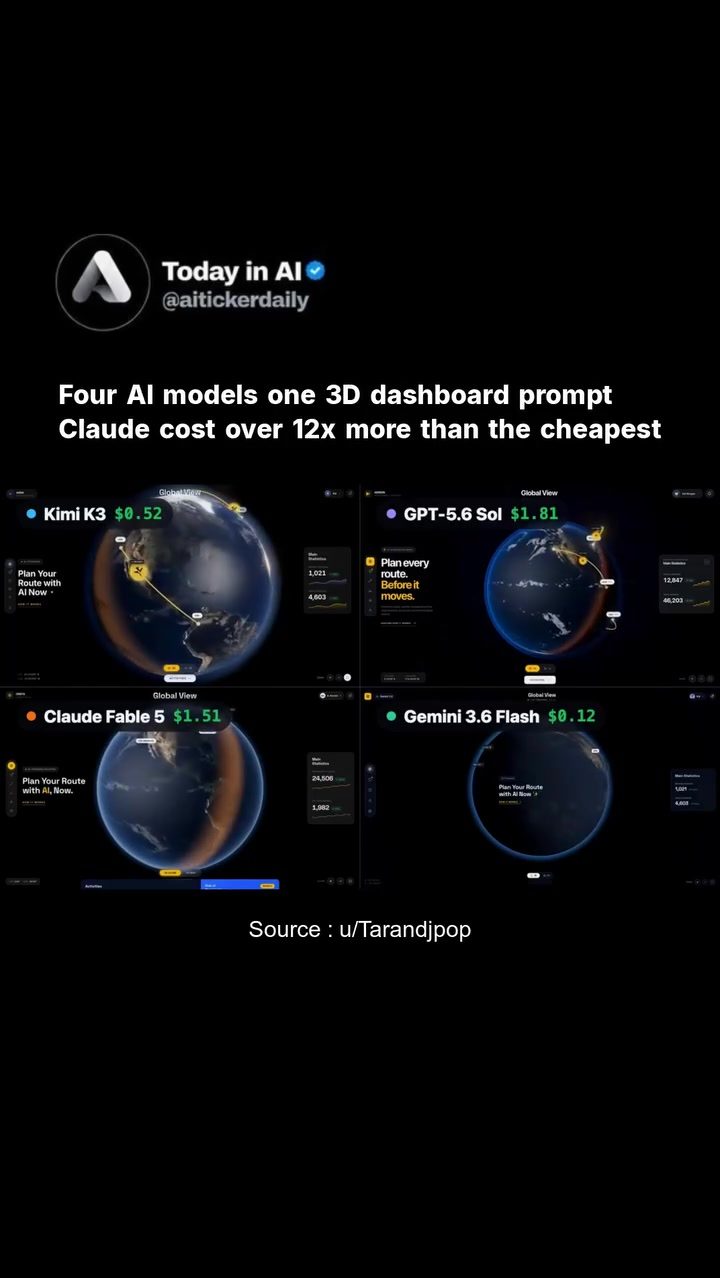
AI Model Comparison: Comparing Four AI Models for Building a 3D Global Logistics Dashboard
Artificial intelligence (AI) models are transforming various industries, and one of the most compelling applications is in logistics. Building a 3D global logistics dashboard is a complex task that requires significant computational power and sophisticated algorithms. Four AI models—Kimi K3, GPT-5.6 Sol, Claude Fable, and Gemini 3.6 Flash—were tasked with creating this dashboard, each delivering unique results with varying costs and efficiencies.
Why This Matters
The choice of AI model can significantly impact the cost and effectiveness of a project. Understanding the performance and pricing of different models is crucial for businesses looking to optimize their logistics operations. By comparing these four models, we can gain insights into which models offer the best value for specific tasks, helping businesses make informed decisions.
Main Discussion
The Models in Action
Each AI model was given the same prompt: to build a 3D global logistics dashboard. The results varied in terms of cost, visual appeal, and overall functionality. Kimi K3 completed the task for $0.52, while GPT-5.6 Sol did it for $1.81. Claude Fable, on the other hand, completed the task for $1.51, which is significantly more expensive, especially when compared to the cheapest option, Gemini 3.6 Flash, which cost only $0.12. Despite Claude Fable's higher cost, its output was described as solid, featuring a big globe, real stats, and route visuals. However, it landed in a strange middle spot—neither the cheapest nor the most polished.
Pricing and Performance
The cost disparity among the models is striking. Claude Fable cost over 12 times more than Gemini 3.6 Flash, the cheapest option. This raises questions about the value proposition of each model. While Claude Fable's output was described as solid, the significant price difference may not justify its use for this specific task. On the other hand, Gemini 3.6 Flash, being the most cost-effective, offers a compelling case for businesses looking to minimize expenses without sacrificing functionality. Kimi K3 and GPT-5.6 Sol fall in between, each with its own cost and performance characteristics.
The AIHubMix Unified API
AIHubMix offers a Unified API with over 800 models, providing a comprehensive solution for businesses looking to leverage AI. This API allows for seamless integration of multiple AI models, enabling businesses to choose the best model for each specific task. This flexibility is crucial in an evolving landscape where different tasks may require different AI capabilities.
Practical Tips
When choosing an AI model for a specific task, consider the following:
- Budget: Evaluate your budget constraints and choose a model that offers the best value for your investment.
- Performance: Assess the performance of each model in relation to the specific task at hand. Some models may excel in certain areas while falling short in others.
- Flexibility: Opt for a platform like AIHubMix that offers a Unified API with multiple models. This allows you to choose the best model for each task, providing flexibility and optimization.
Important Takeaways
- Cost Variability: There is a significant cost difference among AI models, and understanding this variability is crucial for making informed decisions.
- Performance: While cost is important, the performance and functionality of the model should also be considered. Claude Fable, for example, offered a visually appealing output but at a significantly higher cost.
- Flexibility: Platforms like AIHubMix, with their Unified API, offer the flexibility to choose the best model for each task, providing a comprehensive solution.
Conclusion
Comparing AI models for building a 3D global logistics dashboard reveals significant differences in cost and performance. While some models offer better value for money, others may provide superior functionality at a higher cost. Understanding these differences is essential for businesses looking to optimize their logistics operations. By leveraging platforms like AIHubMix, businesses can choose the best model for each task, ensuring optimal performance and cost-efficiency.
Questions readers ask
Which AI model is the most cost-effective for building a 3D global logistics dashboard?
The cost-effectiveness of an AI model depends on the specific requirements of your logistics dashboard. However, Kimi K3 is known for its affordability, making it a strong contender for budget-conscious businesses. For precise pricing, it's best to consult the latest available data on Kimi K3's costs.
How does the performance of GPT-5.6 Sol compare to other models in this context?
GPT-5.6 Sol offers robust performance with a balance of cost and functionality. It excels in processing complex data sets, which is beneficial for a 3D logistics dashboard. However, the exact performance metrics can vary based on the specific features you need, so comparing it to your particular needs is essential.
What are the key features of Claude Fable that make it suitable for logistics dashboard optimization?
Claude Fable stands out for its advanced natural language processing capabilities, which can be particularly useful for interpreting and presenting logistics data in a user-friendly format. Its ability to handle intricate data sets and provide actionable insights makes it a strong candidate for optimizing 3D logistics dashboards.
Why might a business consider using the Gemini 3.6 Flash model for their 3D logistics dashboard?
Gemini 3.6 Flash is known for its speed and efficiency in processing large volumes of data, which is crucial for real-time updates in a logistics dashboard. It offers a high level of accuracy and can handle complex calculations, making it a reliable choice for businesses focused on performance and precision.
What factors should be considered when choosing the best AI model for a logistics dashboard?
When selecting an AI model, consider factors such as cost, processing speed, data handling capabilities, and the specific features your dashboard requires. Additionally, evaluate the model's compatibility with your existing systems and its ability to scale with your business needs. Each model—Kimi K3, GPT-5.6 Sol, Claude Fable, and Gemini 3.6 Flash—has unique advantages, so aligning these with your business goals is crucial.
Is there a significant difference in pricing between these four AI models?
Yes, there is a notable difference in pricing among Kimi K3, GPT-5.6 Sol, Claude Fable, and Gemini 3.6 Flash. The costs can vary based on the level of functionality, processing power, and the scale of the logistics operations. For the most accurate and up-to-date pricing, it is recommended to review the latest cost comparisons and possibly consult with representatives from the respective AI model providers.
Related deep dives
Similar reads based on topic and creator.




Recent articles
Fresh deep dives from the latest Reels we unpacked.




Comments
Be the first to comment.