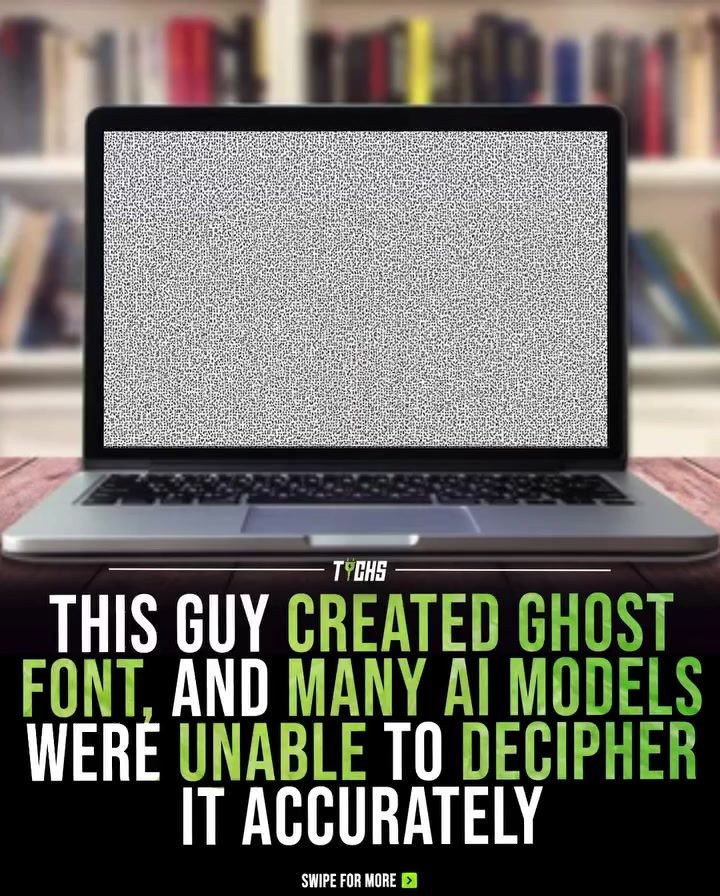
Ghost Font: Understanding AI's Struggles with Hidden Text
Ghost Font, created by Eric Lu at Mixfont, is more than just a new typeface. It is a clever illusion that reveals an unexpected vulnerability in many AI vision models. This font hides text within moving patterns of dots, challenging how we understand visual information. By delving into the creation and implications of Ghost Font, we can grasp a deeper understanding of AI’s limitations and the unique advantages of human visual perception.
Context / Why this Matters
The development of Ghost Font underscores a critical issue in the field of AI: the difference between seeing and understanding. AI models excel at analyzing individual frames, but they often struggle to comprehend motion over time. This disparity highlights the importance of incorporating temporal context into AI vision systems, an area where human visual perception still has a distinct advantage.
Challenges in AI Vision Systems
Limitations in Analyzing Individual Frames
AI models typically analyze images frame by frame, which can lead to a fragmented understanding of visual data. Ghost Font exploits this weakness by embedding text within moving patterns of dots. Humans, on the other hand, can often recognize the hidden letters by observing the motion, demonstrating a more holistic approach to visual perception.
The Role of Motion in Vision
The human brain is adept at processing motion, allowing us to detect patterns and understand the context of visual information. This ability is crucial in recognizing objects, interpreting text, and navigating our environment. AI models struggle with this temporal aspect, as they are often trained to analyze static images rather than dynamic sequences.
The Creation of Ghost Font
Ghost Font was designed to challenge AI vision models by embedding text within intricate, moving patterns of dots. While the font appears as a seemingly random arrangement of characters, the hidden text becomes apparent when viewed in motion. This innovative design highlights the complexity and sophistication of human visual perception, which can often outperform machine vision in unexpected ways.
Designing for Motion
The key to Ghost Font's effectiveness lies in its use of motion. By incorporating moving patterns, the font creates a dynamic visual experience that can be difficult for AI models to decipher. However, the human brain is adept at interpreting this motion, making it easier to recognize the hidden text.
The Impact on AI Models
Ghost Font has revealed that many AI models are incapable of accurately deciphering the font, illustrating a significant limitation in current AI vision technology. This discovery has important implications for the development of future AI models, emphasizing the need for improved temporal context processing.
Practical Tips
If you are interested in exploring AI and human visual perception, here are some practical tips to help you delve deeper into this fascinating field:
Explore AI Vision Projects
Engage with AI vision projects that focus on motion and temporal context. By studying these projects, you can gain a better understanding of the challenges and opportunities in AI vision.
Experiment with Visual Illusions
Experiment with visual illusions and motion-based fonts like Ghost Font. These exercises can help you appreciate the complexity of human visual perception and the limitations of current AI models.
Learn About Human Visual Perception
Familiarize yourself with the principles of human visual perception, particularly how the brain processes motion and temporal context. This knowledge can provide valuable insights into the development of more robust AI vision systems.
Important Takeaways
Ghost Font offers several critical insights into the strengths and weaknesses of AI vision systems:
Human Visual Perception Still Leads in Some Areas
Despite advances in AI, human visual perception remains superior in certain contexts, particularly when it comes to interpreting motion and temporal information. This highlights the importance of incorporating more sophisticated temporal processing into AI models.
The Need for Improved AI Vision Models
The challenges faced by AI in deciphering Ghost Font underscore the need for more advanced AI vision models. By improving temporal context processing, AI can better handle dynamic visual information, leading to more accurate and reliable results.
The Value of Human and AI Collaboration
The development of Ghost Font and the subsequent analysis of AI’s struggles highlight the potential for collaboration between human and AI systems. By leveraging the strengths of both, we can create more effective and innovative solutions to complex visual problems.
Conclusion
Ghost Font, created by Eric Lu at Mixfont, is a remarkable example of how human creativity can challenge and expose the limitations of AI vision systems. By hiding text within moving patterns of dots, Ghost Font highlights the importance of temporal context in visual perception. As we continue to develop AI, it is crucial to consider the unique advantages of human visual perception and incorporate these insights into future AI models. This collaborative approach can lead to advancements that push the boundaries of what is possible in AI vision technology.
Questions readers ask
What is the Ghost Font and how does it work?
Ghost Font is a specialized typeface designed to hide text within moving dot patterns. Created by Eric Lu, this font functions as a technical illusion, challenging AI vision models by testing their ability to comprehend motion and temporal context. It reveals how AI processes visual information differently than humans.
Why does Ghost Font pose a challenge for AI vision models?
Ghost Font exposes a significant weakness in AI vision models, which typically excel at analyzing static images but struggle with dynamic content. The font's moving dot patterns test the AI's ability to understand and interpret text in motion, an area where human visual perception often outperforms current AI capabilities.
What are the key differences between AI and human visual perception highlighted by Ghost Font?
Ghost Font demonstrates that while AI can analyze individual frames effectively, it often falls short in comprehending the temporal context of moving images. Humans, on the other hand, can readily interpret text in motion, highlighting a key advantage of human visual perception.
How does Ghost Font help us understand AI's limitations in text comprehension?
By challenging AI models to decode text hidden in moving patterns, Ghost Font reveals that current AI systems have difficulty processing text in dynamic environments. This underscores a critical limitation in AI's ability to understand and interpret text in motion, an area where improvements are needed for better AI vision accuracy.
Can AI vision models be improved to better handle text in motion?
Yes, ongoing research and development aim to enhance AI vision models' ability to comprehend motion and temporal context. By learning from challenges posed by fonts like Ghost Font, developers can work on improving AI's motion perception and text decoding capabilities, ultimately leading to more robust and accurate AI visual perception systems.
Related deep dives
Similar reads based on topic and creator.




Recent articles
Fresh deep dives from the latest Reels we unpacked.




Comments
Be the first to comment.