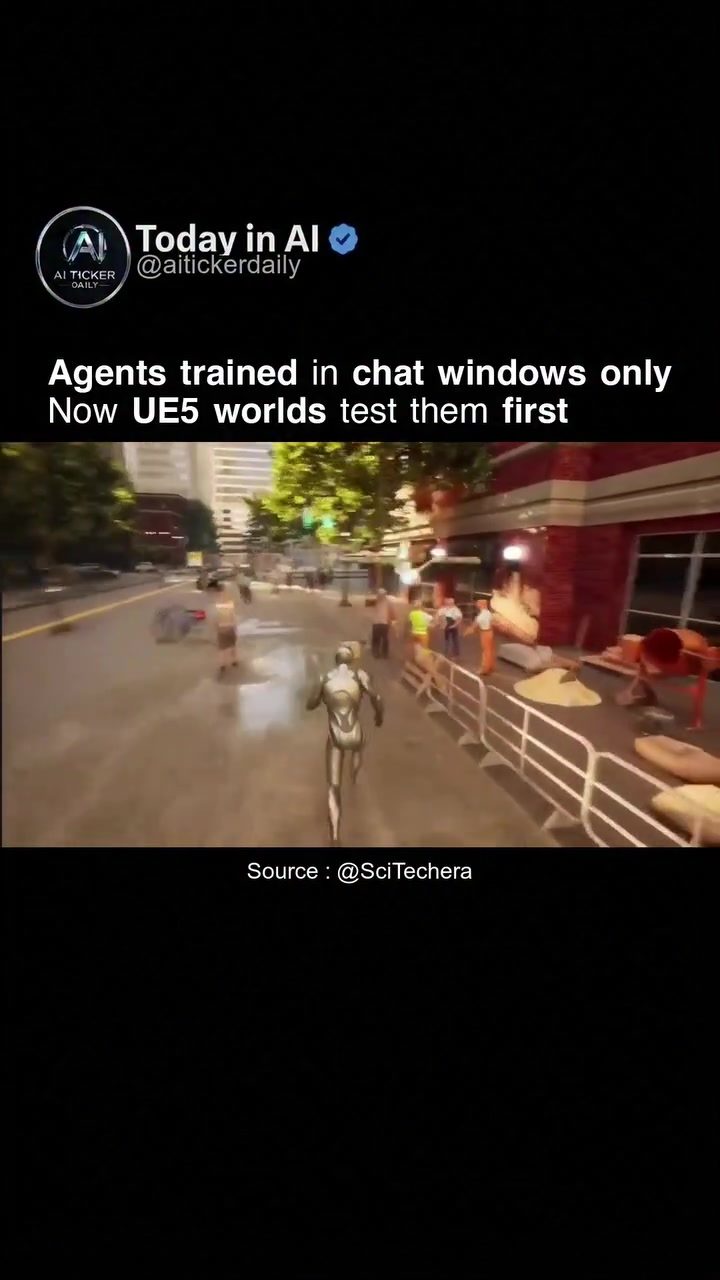
AI World Generation
AI agents, traditionally trained in chat windows and benchmark suites, are now being tested in realistic 3D cities. This advancement, backed by the open-source release of SimWorld, an Unreal Engine 5 (UE5) simulator, allows AI agents to perceive, reason, and act within virtual environments before interacting with the real world. Here’s an in-depth look at how these AI agents are being trained and tested, and what this means for the future of embodied AI.
Context / Why This Matters
AI agents are becoming increasingly sophisticated, and the ability to train and test them in realistic 3D environments is a significant leap forward. This technology can have far-reaching applications, from autonomous vehicles and robotics to virtual assistants and immersive gaming experiences. By leveraging the capabilities of Unreal Engine 5, researchers are pushing the boundaries of what AI can achieve, making it more adaptable and versatile in real-world scenarios.
Main Discussion
AI Training in Unreal Engine 5
The integration of AI agents with Unreal Engine 5 (UE5) has opened up new possibilities for training and testing AI in virtual worlds. UE5, known for its high-fidelity graphics and robust development tools, provides an ideal platform for creating immersive and detailed environments. This allows AI agents to navigate and interact with virtual worlds that closely resemble real-life settings, enhancing their ability to generalize and apply learned behaviors in practical situations.
The Role of SimWorld
SimWorld, the open-source simulator developed for this purpose, is built on Unreal Engine 5. It offers a comprehensive training and testing ground for AI agents, featuring a gym-like Python API, RGB + depth + segmentation sensors, and a variety of environmental elements like navigation, vehicles, pedestrians, and robots. This simulator also supports procedural city generation, allowing for the creation of diverse and dynamic urban landscapes.
Language-Controllable Scene Generation
One of the standout features of this technology is the ability to generate and manipulate scenes using language. This means that researchers and developers can describe the desired environment using natural language, and the AI will create a corresponding virtual world. This capability not only streamlines the training process but also makes it more accessible, as it doesn’t require extensive programming knowledge to set up and modify training scenarios.
AI Agents in 3D Environments
Traditionally, AI agents have been trained in chat windows, where they learn to understand and respond to textual inputs. However, this method has its limitations, as it doesn't prepare the agents for the complexities of real-world interactions. By training in 3D environments, agents can learn to navigate, interact with objects, and make decisions in a more realistic context. This prepares them better for tasks that require physical interaction and situational awareness.
Practical Tips
Getting Started with SimWorld
For developers and researchers interested in exploring SimWorld, here are some practical tips:
- Familiarize Yourself with Unreal Engine 5: Ensure you have a good understanding of UE5, as SimWorld is built on this platform. UE5 has extensive documentation and tutorials to help you get up to speed.
- Experiment with Language-Controllable Scenes: Start by experimenting with the language- controllable scene generation feature. This will give you a hands-on understanding of how to create and modify virtual environments using natural language.
- Leverage the Gym-Like API: The Python API in SimWorld is designed to be intuitive and user-friendly. Use it to set up and run experiments efficiently.
- Test with Different Scenarios: Take advantage of the procedural city generation to test your AI agents in a variety of scenarios. This will help you understand how well they generalize and adapt to different situations.
Important Takeaways
- Advanced AI Training: The use of UE5 for training AI agents represents a significant advancement in AI capabilities, allowing agents to perceive, reason, and act in realistic 3D environments.
- Open-Source Simulator: SimWorld provides a robust and accessible platform for researchers and developers, with features like a Python API and language-controllable scene generation.
- Real-World Applications: This technology has wide-ranging applications, from autonomous vehicles to robotics and beyond, making it a valuable tool for advancing AI research.
Conclusion
The integration of AI agents with Unreal Engine 5 and the development of SimWorld mark a pivotal moment in AI technology. By providing a realistic and dynamic training ground, this technology prepares AI agents for a wide range of real-world applications. Whether you're a researcher, developer, or enthusiast, exploring this new frontier of AI world generation offers exciting possibilities.
Questions readers ask
What is SimWorld and how does it benefit AI training?
SimWorld is an AI simulator built using Unreal Engine 5 that allows AI agents to train in 3D cities. This platform provides a more realistic and dynamic environment than traditional setups, enabling AI to better understand and navigate complex scenarios, which is crucial for improving their real-world performance.
How does training in 3D cities enhance AI's real-world applicability?
Training in 3D cities allows AI to learn and adapt to a wide range of real-world conditions, including varied landscapes, traffic patterns, and environmental challenges. This exposure helps AI to develop more refined decision-making skills and better handle unpredictability in real-world situations, such as navigating urban areas or interacting with people in various settings.
What are the key advantages of using Unreal Engine 5 for AI training?
Unreal Engine 5 offers high-fidelity graphics and robust physics simulations, creating a more immersive and accurate 3D environment. This engine also provides advanced tools for customization and scalability, making it ideal for developing complex and detailed training scenarios. The open-source release of SimWorld, powered by Unreal Engine 5, enables researchers and developers to contribute and enhance the platform.
How does SimWorld facilitate the development of autonomous vehicles and robotics?
SimWorld allows autonomous vehicles and robotics to hone their navigation, perception, and decision-making skills in a safe and controlled 3D environment. By simulating various driving conditions, traffic scenarios, and environmental challenges, AI can learn to operate more safely and effectively in the real world, reducing the need for extensive physical testing and accelerating development timelines.
What types of AI tasks can benefit from training in 3D city environments?
AI tasks that require navigation, interaction, and decision-making in complex environments can significantly benefit from 3D city training. This includes autonomous vehicles, robotics, and virtual assistants, which need to understand and respond to their surroundings in real-time. Virtual assistants, for example, can improve their ability to assist users in a variety of settings, such as providing directions or performing tasks in a simulated city environment.
How does SimWorld differ from traditional AI training methods?
Unlike traditional methods, which often involve simplified 2D or benchmark scenarios, SimWorld offers a three-dimensional, interactive environment. This allows AI to practice in a setting that closely mirrors real-world conditions, complete with dynamic elements like weather, crowds, and unpredictable events. As a result, AI can develop more robust and adaptable skills, better preparing them for practical applications.
Related deep dives
Similar reads based on topic and creator.




Recent articles
Fresh deep dives from the latest Reels we unpacked.




Comments
Be the first to comment.