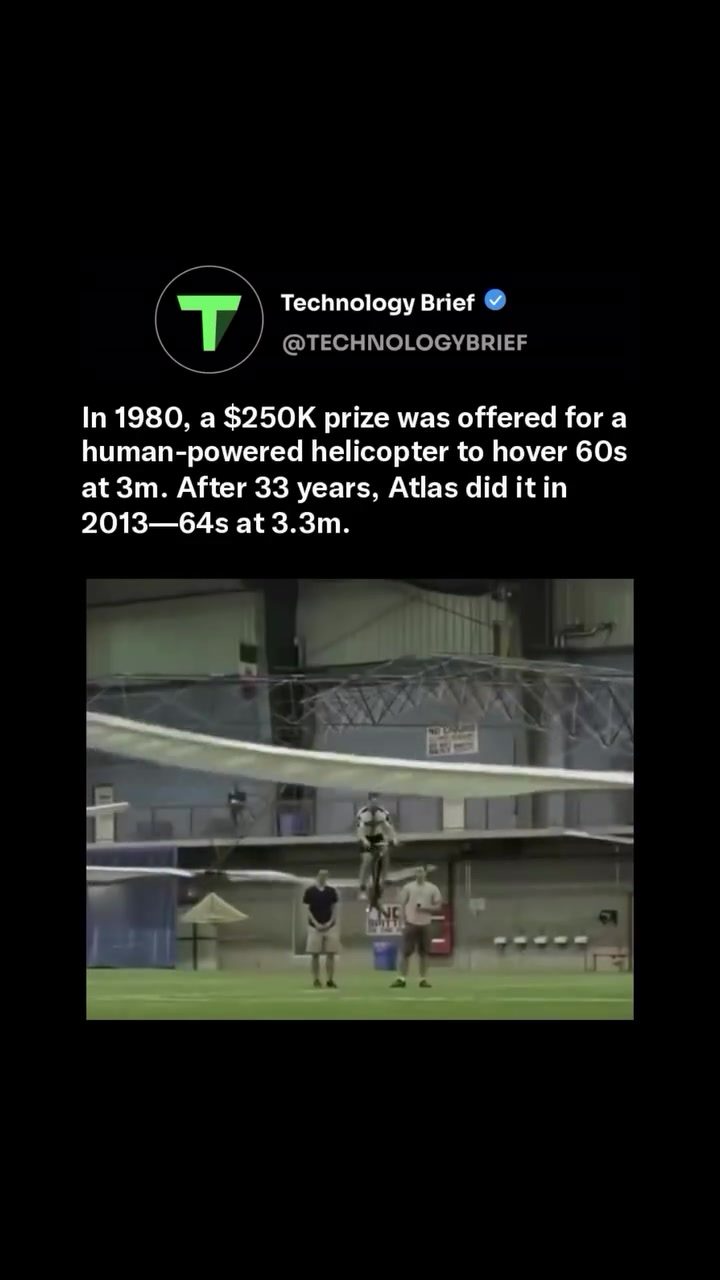
Human-Powered Helicopter Development
The American Helicopter Society (AHS) issued a daunting challenge in 1980: design a human-powered helicopter capable of hovering for at least 60 seconds at an altitude of 3 meters, all while staying within a 10-by-10-meter square. This challenge, known as the Igor I. Sikorsky Human-Powered Helicopter Prize, began with a $25,000 incentive, which was later raised to $250,000 in 2009 due to the immense complexity of the task.
Why this Matters
The AHS challenge highlighted the immense difficulties in human-powered flight. It required not only advanced engineering but also exceptional physical endurance from the pilot. This accomplishment showcases the limits of human capability and the ingenuity of engineers, underlining the potential for future innovations in sustainable flight.
The Journey to the Achievement
For over three decades, teams worldwide tackled this challenge, with each attempt pushing the boundaries of human-powered flight. The challenge's long-standing status underscored its difficulty, as teams struggled with engineering constraints and the physical demands of powering the craft.
The Ultimate Success
In 2013, AeroVelo, a Canadian team consisting of students and graduates from the University of Toronto, finally achieved the feat. The Atlas helicopter, developed by AeroVelo, successfully hovered for 64.1 seconds and reached a height of 3.3 meters, surpassing all requirements and ending a 33-year quest. The achievement not only secured the $250,000 prize but also marked a significant milestone in the realm of human-powered aviation. The Atlas' success demonstrated that human-powered flight was not just a theoretical possibility but a practical reality, albeit under specific conditions.
The Design and Engineering of the Atlas
The Atlas helicopter's design was a testament to innovative engineering. The craft had to be lightweight yet robust enough to withstand the physical forces exerted by the pilot. The team meticulously designed the rotor blades to optimize lift and reduce drag, ensuring efficiency. The pilot's position and the mechanical system for transferring energy from the pilot's muscles to the rotor blades were crucial for achieving the necessary lift and stability.
Rotor System
The Atlas featured four rotor blades arranged in a quad-copter configuration, which provided stability and lift. This design choice was essential for the helicopter to hover within the confined 10-by-10-meter square. Each rotor system was carefully balanced to ensure smooth and controlled flight.
Pilot Interface
The pilot's position and the mechanical system for transferring energy from the pilot's muscles to the rotor blades were crucial for achieving the necessary lift and stability. The pilot had to maintain a high level of physical exertion for the duration of the hover, requiring exceptional endurance and strength.
Materials and Construction
The materials used in the Atlas were critical to its success. Lightweight and durable composites were chosen to minimize weight while ensuring structural integrity. The rotor blades and the frame were engineered to withstand the stresses of high-speed rotation and the forces exerted by the pilot.
The Significance of the Achievement
The AeroVelo team's success with the Atlas helicopter marked a significant breakthrough in human-powered flight. It proved that a human-powered helicopter could hover for the required duration and reach the specified altitude, overcoming one of the hardest unsolved problems in aviation. This achievement opened new avenues for research and development in sustainable and human-powered flight technologies.
Practical Tips for Aspiring Engineers
For those interested in pursuing similar challenges, several practical tips can be gleaned from the AeroVelo team's experience:
Focus on Efficiency
Optimize the design for maximum efficiency. Reducing weight and drag are critical for human-powered flight, as every gram and every watt of power saved can significantly improve performance.
Iterative Testing
Conduct iterative testing and refinement. Small adjustments can lead to significant improvements in performance. Pay attention to feedback from each test flight and make incremental changes to enhance the helicopter's capabilities.
Collaboration and Expertise
Leverage collaboration and expertise from diverse fields. The AeroVelo team included individuals with background in engineering, materials science, and physiology, all of which contributed to the success of the Atlas.
Physical Training
Never underestimate the importance of physical training. The pilot must be in peak physical condition to sustain the high level of exertion required for the hover. Incorporate strength and endurance training into the project from the outset.
Important Takeaways
The AeroVelo team’s achievement demonstrates the potential for significant advancements in human-powered flight. The Atlas helicopter's success highlights the importance of innovative engineering, meticulous design, and exceptional physical endurance. The lessons learned from this project can inspire future developments in sustainable and human-powered aviation technologies.
Conclusion
The Atlas helicopter's achievement in 2013 was a groundbreaking milestone in human-powered flight. It showcased the culmination of three decades of engineering innovation and physical endurance, successfully overcoming one of aviation's most formidable challenges. The legacy of this accomplishment continues to inspire researchers and engineers to explore the boundaries of human-powered flight and sustainable aviation technologies.
Questions readers ask
What was the significance of the 64.1-second flight by AeroVelo's Atlas helicopter?
The 64.1-second flight was a milestone in human-powered aviation. It was the first time a human-powered helicopter achieved a sustained flight duration of over 60 seconds, surpassing the requirements of the AHS challenge. This flight marked the culmination of 33 years of engineering efforts and demonstrated the potential of human-powered, sustainable flight technology.
Who set the challenge that AeroVelo's Atlas helicopter achieved?
The challenge was set by the American Helicopter Society (AHS) in 1980. Known as the Igor I. Sikorsky Human-Powered Helicopter Prize, it tasked engineers and pilots with creating a human-powered helicopter that could hover for at least 60 seconds at 3 meters altitude, within a 10-by-10-meter area.
What were the key requirements of the AHS challenge?
The challenge required a human-powered helicopter to hover for a minimum of 60 seconds, reach an altitude of at least 3 meters, and stay within a 10-by-10-meter square. This combination of duration, altitude, and precision was a significant barrier to overcome.
How did AeroVelo's Atlas helicopter achieve its record-breaking flight?
AeroVelo's Atlas helicopter achieved its record-breaking flight through a combination of advanced engineering and exceptional physical endurance from the pilot. The helicopter was designed with lightweight materials and an efficient drive system to maximize the pilot's power output, allowing for sustained flight.
What does the success of AeroVelo's Atlas helicopter mean for the future of sustainable flight?
The success of AeroVelo's Atlas helicopter highlights the potential for human-powered, sustainable flight technology. It demonstrates that with innovative engineering and a deep understanding of human capabilities, it is possible to achieve remarkable feats in aviation with minimal environmental impact.
What was the original prize for the human-powered helicopter challenge?
The original prize for the human-powered helicopter challenge was $25,000. However, due to the immense complexity and the 33-year duration of the challenge, the prize was later raised to $250,000 in 2009 to reflect the increasing difficulty and the advancements required to meet the requirements.
How did the Atlas helicopter showcase human capability and innovation?
The Atlas helicopter showcased human capability and innovation by achieving a 64.1-second flight, surpassing the 60-second duration required by the AHS. This accomplishment was the result of a 33-year engineering challenge, requiring innovative design, precise construction, and exceptional physical endurance from the pilot.
Recent articles
Fresh deep dives from the latest Reels we unpacked.




Comments
Be the first to comment.