3D Printed Robotic Lamp: Exploring the Watti's Precision
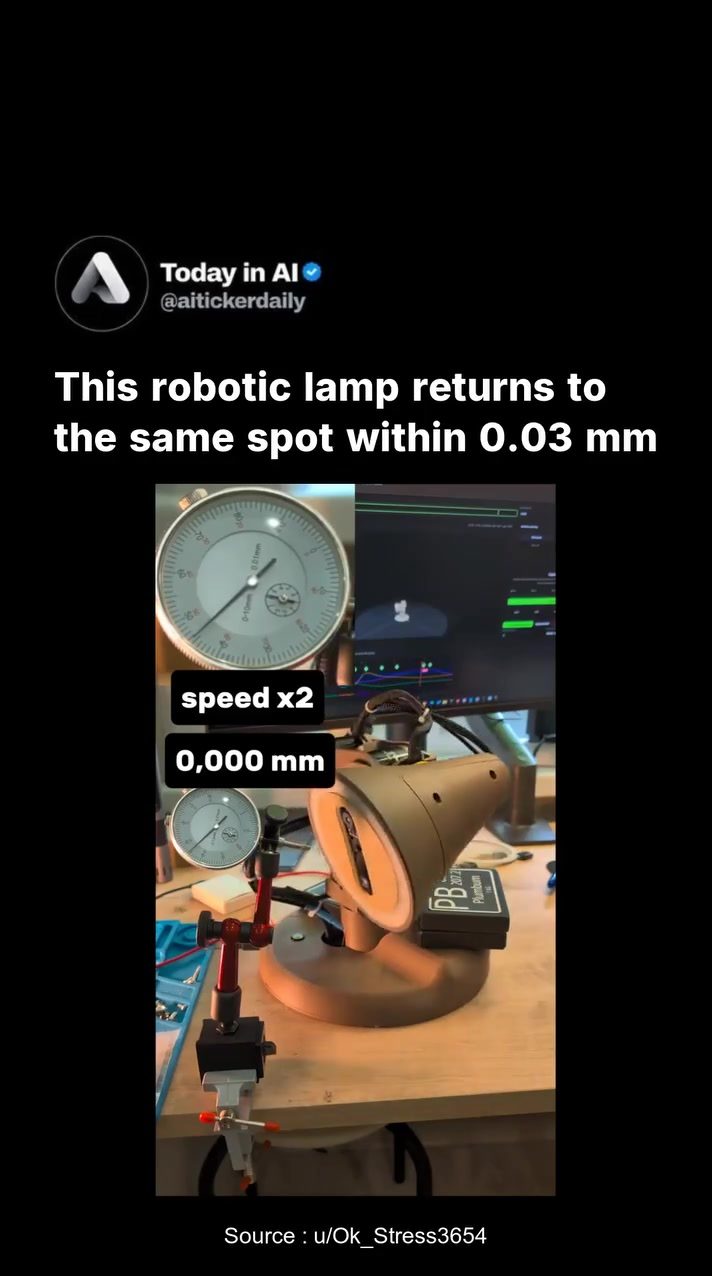
In the world of 3D printing, innovative projects continuously push the boundaries of what is possible. One such project is a 3D printed robotic lamp named Watti. This lamp showcases remarkable precision, returning to the same position with an average deviation of just 0.03 mm across ten repetitions. The precision of this robotic lamp is measured using a simple dial indicator, and the video shows the arm repeating the same movement seamlessly.
Context: The Intersection of 3D Printing and Robotics
The convergence of 3D printing and robotics has opened up new possibilities for creating functional and precise objects. While 3D printing allows for the creation of complex structures, robotics adds functionality and precision. The robotic lamp, Watti, exemplifies this intersection by combining a 3D printed design with mechanical precision.
Main Discussion
The Precision of Watti
The robotic lamp, Watti, demonstrates exceptional precision, returning to the same spot within a margin of 0.03 mm. The accuracy was tested using a dial indicator, which displayed the deviation in millimeters. The gauge initially showed 0.000 mm, indicating perfect alignment, and then measured 0.035 mm and 0.032 mm at different speeds. This level of accuracy is crucial for applications requiring high precision, such as manufacturing and quality control.
The Role of 3D Printing
The 3D printed design of the robotic lamp offers several advantages. First, 3D printing allows for the creation of complex geometries that would be difficult or impossible to achieve with traditional manufacturing methods. Second, 3D printing enables rapid prototyping, allowing makers to quickly iterate and improve their designs. The design of Watti showcases the potential of 3D printing to create functional and precise objects.
Future Goals: 3D Scanning
The next goal for the robotic lamp is to use its depth camera to scan objects in 3D. This capability would expand the practical applications of the lamp, making it a valuable tool for 3D modeling, prototyping, and quality control. By integrating a depth camera, the lamp could scan objects and create digital models, which could then be used for further analysis or manufacturing.
Practical Tips
Measuring Precision
To achieve the level of precision demonstrated by Watti, it is essential to use accurate measurement tools. A dial indicator is a simple yet effective tool for measuring small deviations. For makers interested in replicating this level of precision, investing in a high-quality dial indicator is a good starting point.
Testing and Iteration
Testing and iteration are crucial steps in the development of any precision device. The maker of Watti conducted ten repetitions to ensure the lamp's accuracy. This rigorous testing process is essential for identifying and addressing any inconsistencies in the design.
Integrating a Depth Camera
For those interested in expanding the functionality of their 3D printed robots, integrating a depth camera is a valuable addition. Depth cameras use infrared sensors to create detailed 3D maps of objects. By integrating a depth camera, the robotic lamp can scan objects and generate precise 3D models.
Important Takeaways
The robotic lamp, Watti, showcases the potential of 3D printing and robotics to create precise and functional objects. The lamp's ability to return to the same spot with an average deviation of 0.03 mm demonstrates the high level of precision achievable with 3D printed robots. The next step for this project is to integrate a depth camera, expanding its functionality and practical applications.
Conclusion
The robotic lamp, Watti, is a testament to the intersection of 3D printing and robotics. By demonstrating exceptional precision and the potential for future 3D scanning capabilities, Watti opens up new possibilities for makers and enthusiasts. Whether you are a seasoned maker or just starting, exploring the world of 3D printed robots can be a rewarding and exciting endeavor.
Questions readers ask
What makes the Watti lamp's precision so remarkable?
The Watti lamp's precision is notable because it can return to the same position with an average deviation of just 0.03 mm. This level of accuracy is achieved through a combination of complex 3D printed structures and mechanical precision, making it a standout in the field of 3D printed robotics.
How is the precision of the Watti lamp measured?
The precision of the Watti lamp is measured using a simple dial indicator. This tool allows for precise measurements of the lamp's movements, demonstrating its ability to repeat the same action seamlessly.
What are the key components that contribute to the Watti lamp's high precision?
The high precision of the Watti lamp is a result of its 3D printed structures, which allow for the creation of complex and intricate designs, combined with mechanical precision that ensures accurate and consistent movements.
Why is the Watti lamp considered an example of the intersection of 3D printing and robotics?
The Watti lamp is an example of the intersection of 3D printing and robotics because it utilizes 3D printing to create complex structures and robotics to add functionality and precision. This combination allows for the creation of functional and precise objects.
What applications could benefit from the precision of the Watti lamp?
The precision of the Watti lamp makes it ideal for applications that require high levels of accuracy, such as manufacturing, scientific research and prototyping. Its ability to repeat movements with such precision opens up new possibilities for these fields.
How does the Watti lamp demonstrate the capabilities of 3D printing?
The Watti lamp demonstrates the capabilities of 3D printing by showcasing the ability to create complex structures with high precision. Its creation highlights the potential of 3D printing in producing functional and precise objects, pushing the boundaries of what is possible in this field.
Related deep dives
Similar reads based on topic and creator.




Recent articles
Fresh deep dives from the latest Reels we unpacked.




Comments
Be the first to comment.