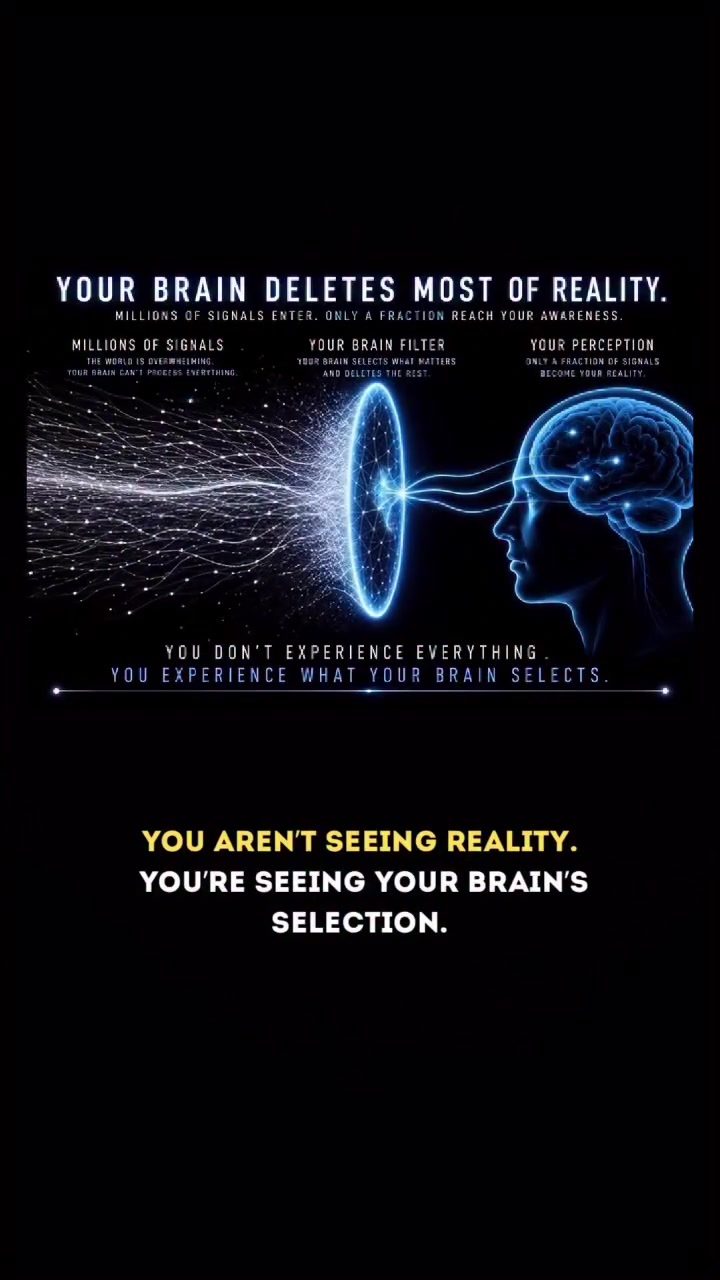
Brain Perception: How Your Brain Selects and Filters Your Reality
Every second, millions of signals flood your brain. These signals can be sights, sounds, sensations, and even possibilities. However, your brain doesn’t process all of them. Instead, it filters and selects only a fraction, presenting you with a highly curated version of reality. Understanding this process is crucial because it shapes your perception, influences your decisions, and affects your overall experience of the world.
Context: Why This Matters
The brain's filtering mechanism is a double-edged sword. On one hand, it helps manage the overwhelming amount of information we receive daily, making it possible to function without being paralyzed by sensory overload. On the other hand, it can limit our experiences, keeping us in familiar but limiting patterns. Understanding how this process works can help you break free from these patterns and start experiencing more of what life has to offer.
Main Discussion
The Brain as a Search Engine
Imagine your brain as a sophisticated search engine. It constantly processes vast amounts of data and presents you with results based on what it perceives as relevant to your current search terms. If, for instance, you’ve been searching for fear, you’ll likely find fear in various situations. The same applies to rejection or the belief that you can’t achieve something. Your brain filters out anything that doesn’t match your current search parameters, even if it could be beneficial for you.
The Selection Process: How Your Brain Filters Information
Your brain doesn’t show you everything; it shows you what you’ve been searching for. This means that your reality is a product of your brain's selection process. Millions of signals enter your brain, but only a fraction reach your awareness. This selection is influenced by your past experiences, beliefs, and current mental state. It’s like having a personalized filter that decides what you see, hear, and experience.
The Implications of Brain Filtering
So, what does this mean for you? Your brain doesn’t prioritize your happiness; it prioritizes consistency. This means that if you’ve been focusing on negative thoughts, you’ll likely continue to experience negativity. Conversely, if you’ve been focusing on positive thoughts and experiences, you’ll likely continue to encounter more of the same. This filtering mechanism can explain why you keep missing opportunities, attracting the same people, and feeling stuck in repetitive loops.
The Power of Changing Your Search Terms
The good news is that you can change your brain's search terms. It’s not about “thinking positive,” but rather about installing new filters and feeding your brain new data. By repeating new patterns, you can train your brain to search for different things. For example, if you’ve been focusing on fear, you can start practicing gratitude and focusing on what you’re thankful for. Gradually, your brain will begin to filter and select more positive experiences.
Practical Tips
Practice Mindfulness and Awareness
Start by practicing mindfulness and awareness. Pay attention to your thoughts and emotions. Notice when you’re stuck in negative patterns and consciously choose to shift your focus to more positive or neutral thoughts. This simple practice can help you become more aware of your brain's filtering mechanism and give you the power to change it.
Feed Your Brain New Data
To change your brain's search terms, you need to feed it new data. This can be done through reading, listening to new perspectives, and engaging in activities that challenge your current beliefs. For instance, if you’ve been focusing on fear, read books about courage and resilience. Listen to people who have overcome their fears and start practicing small acts of bravery.
Install New Filters
Installing new filters is about creating new neural pathways. This can be done through repetition and practice. For example, if you want to break free from the fear of rejection, repeat affirmations such as “I am worthy of love and acceptance.” Practice self-compassion and self-encouragement. Over time, your brain will begin to filter and select more positive experiences.
Important Takeaways
Consistency: The Key to Changing Your Perception
Remember, your brain values consistency. This means that small, consistent changes can lead to significant shifts in your perception. Start with small, manageable steps and be patient with yourself. It takes time to rewire your brain, but with consistency, you can achieve it.
The Role of Past Experiences
Your past experiences play a significant role in shaping your brain's search terms. If you’ve had negative experiences in the past, your brain may be more inclined to focus on potential threats and dangers. Recognize this and work on re-framing those experiences in a more positive light.
The Power of Positive Change
Changing your brain's search terms can have a profound impact on your life. It can help you break free from limiting beliefs, attract more positive experiences, and live a more fulfilling life. It’s about harnessing the power of your brain to shape your reality in a way that aligns with your desires and aspirations.
The Importance of Self-Compassion
Finally, remember to be compassionate towards yourself. Changing your brain’s search terms is a journey, and it’s okay to have setbacks. Be kind to yourself, acknowledge your efforts, and celebrate your progress, no matter how small.
Conclusion
Your brain is a powerful tool that shapes your perception of reality. By understanding how it filters and selects information, you can gain control over your experiences. You can change your brain's search terms, feed it new data, and install new filters. With consistency and self-compassion, you can transform your life and start experiencing more of what you desire.
Questions readers ask
How does the brain decide which signals to process and which to ignore?
Your brain prioritizes signals based on relevance, novelty, and emotional significance. Past experiences and beliefs also play a crucial role in this decision-making process. For instance, if you're in a familiar environment, your brain might filter out routine signals to focus on new or important ones, curating your experience of that environment.
Can the brain's filtering process change over time?
Yes, the brain's filtering process is not static. As you gain new experiences and update your beliefs, your brain adapts and recalibrates what it focuses on and ignores. This adaptability is key to personal growth and learning, as it allows your perception of reality to evolve.
How do past experiences influence the brain's filtering process?
Past experiences shape your brain's filtering process by creating neural pathways that prioritize certain signals. For example, if you've had a traumatic experience, your brain may be more attuned to similar threatening stimuli in the future, filtering out other less relevant information in favor of potentially risky stimuli.
What role do beliefs play in how the brain filters information?
Beliefs act as a lens through which your brain interprets and filters information. They help prioritize signals that align with your existing beliefs and may downplay or ignore contradictory information. This is why two people can experience the same event but perceive it differently based on their beliefs.
How does the brain's filtering process affect decision-making?
The brain's filtering process influences decision-making by shaping the information you have to work with. Since your brain presents you with a curated version of reality, your decisions are based on a subset of available signals. This can lead to both insightful choices and cognitive biases, which might limit your options.
What happens when the brain's filtering process is impaired?
When the brain's filtering process is impaired, such as in cases of sensory overload or certain neurological conditions, it can lead to difficulties in focusing and making decisions. You might experience heightened sensitivity to stimuli, making it challenging to navigate daily life. Understanding this process can help in managing such situations more effectively.
Can individuals influence or train their brain's filtering process?
While the brain's filtering process is largely automatic, there are techniques that can help influence it. Mindfulness and meditation, for instance, encourage present-moment awareness and can help you become more attuned to the signals you might otherwise ignore. Cognitive-behavioral therapy (CBT) can also help reshape beliefs and thought patterns, thereby altering how the brain filters information.
Related deep dives
Similar reads based on topic and creator.




Recent articles
Fresh deep dives from the latest Reels we unpacked.




Comments
Be the first to comment.