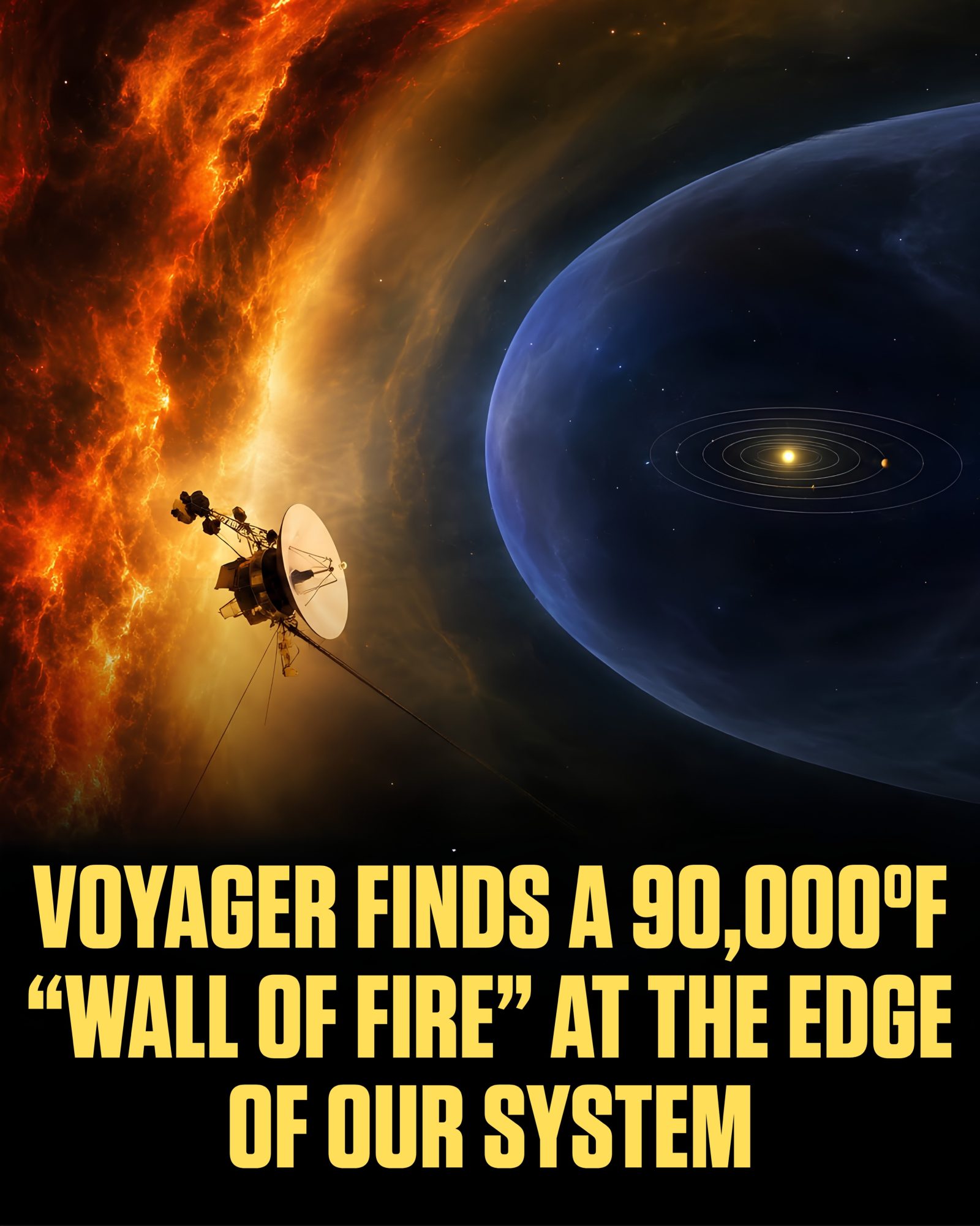
Space Exploration – The “Wall of Fire” at the Edge of Our Solar System
A "wall of fire" hotter than almost anything on Earth surrounds our entire solar system. This isn't a scene from a science fiction movie but a real phenomenon encountered by the Voyager spacecraft. As these twin probes crossed the heliopause, the boundary where the Sun’s influence gives way to interstellar space, their instruments recorded plasma temperatures between 30,000 and 50,000 Kelvin, roughly 54,000 to 90,000 degrees Fahrenheit.
This discovery, while not new, remains fascinating. Voyager 1 crossed this boundary back in August 2012, becoming the first human-made object to reach interstellar space. Voyager 2 confirmed the finding from a different location in 2018. The temperature data from these crossings were published in the years following both events. Despite the extreme temperatures, neither spacecraft melted. Understanding why involves delving into the peculiarities of physics.
The Heliosphere and the Heliospause
The heliosphere is the vast, bubble-like region of space dominated by the Sun's solar wind. This wind, a stream of charged particles, creates a protective boundary around our solar system. The heliopause is the outer boundary of this region, where the solar wind's influence wanes, and interstellar space begins.
Voyager 1 and 2
Voyager 1 and 2 are identical spacecraft launched in 1977. Their primary mission was to explore the outer planets, but their journey didn't stop there. Both probes continued onward, eventually crossing the heliopause and entering interstellar space. This feats provided unprecedented data about the edge of our solar system and the transition to interstellar space.
The “Wall of Fire”
The "wall of fire" is a region of intense plasma heating where the solar wind collides with interstellar particles. This collision compresses and heats the particles to extreme temperatures, creating a plasma with temperatures ranging from 30,000 to 50,000 Kelvin. However, the particles in this region are incredibly sparse, far more spread out than the best vacuums created in laboratories on Earth. This sparsity means there aren't enough particles to transfer significant heat to the spacecraft.
Why the Spacecraft Didn't Melt
The key to understanding why the Voyager spacecraft didn't melt lies in the difference between temperature and heat. Temperature is a measure of the average energy of the particles in a system, while heat is the transfer of that energy from one body to another. In the case of the "wall of fire," the temperature is extremely high, but the heat transfer is minimal due to the low particle density.
Particle Density and Heat Transfer
The plasma in the "wall of fire" is incredibly thin. Despite the high temperature, the particles are so far apart that they rarely collide with the spacecraft. This lack of collisions means there isn't enough energy transfer to heat up the spacecraft significantly. It's a bit like standing in a room with a single candle—while the candle's flame is hot, it doesn't heat the room much because the heat disperses quickly.
The Dynamics of the Heliosphere
The heliopause isn't a fixed line; it expands and contracts based on solar activity. This dynamic nature means that Voyager 1 and Voyager 2 crossed the heliopause at different distances from the Sun, even though they followed similar paths outward. Understanding this dynamic boundary and the processes that shape it is crucial for understanding our place in the cosmos.
Solar Activity and the Heliosphere
The Sun's activity, particularly the solar wind, plays a significant role in shaping the heliosphere. During periods of high solar activity, the solar wind is stronger, pushing the heliopause outward. Conversely, during periods of low solar activity, the heliopause contracts inward. This dynamic nature means that the heliopause's position can vary over time, influenced by the Sun's 11-year solar cycle.
Practical Tips for Understanding Space Exploration
Understanding the complexities of space exploration requires delving into the fundamentals of physics and the dynamics of the solar system. Here are some practical tips for deepening your knowledge:
Stay Updated with Scientific Literature
Reading scientific journals and papers can provide a wealth of information. Publications from institutions like NASA and the European Space Agency (ESA) often detail the latest findings and discoveries from space missions.
Explore Online Resources
Websites and online databases offer a wealth of information. Platforms like NASA's official site, the European Space Agency (ESA), and various astronomical societies provide detailed reports, images, and data from spacecraft missions.
Engage with the Scientific Community
Joining forums, attending conferences, and participating in online discussions can provide valuable insights and perspectives. Engaging with professionals and enthusiasts can enrich your understanding and provide access to the latest developments in space exploration.
Important Takeaways
The "wall of fire" at the edge of our solar system is a remarkable phenomenon that showcases the complexities of the cosmos. Key takeaways include:
- The heliopause is a dynamic boundary where the solar wind's influence gives way to interstellar space.
- The "wall of fire" is a region of intense plasma heating, but the low particle density means minimal heat transfer to spacecraft.
- Understanding the difference between temperature and heat is crucial for comprehending this phenomenon.
Conclusion
The "wall of fire" discovered by the Voyager spacecraft at the heliopause is a testament to the mysteries and wonders of our solar system. This phenomenon underscores the importance of continued exploration and research, pushing the boundaries of human knowledge and understanding.
Questions readers ask
What is the 'wall of fire' at the edge of our solar system?
The 'wall of fire' is a region of incredibly hot plasma at the outer boundary of our solar system, where temperatures can exceed 50,000 degrees Fahrenheit. This area marks the transition from the solar system, dominated by the Sun, to interstellar space.
Why is this phenomenon called a 'wall of fire'?
The term 'wall of fire' is used due to the extremely high temperatures of the plasma in this region. These temperatures are far hotter than anything naturally found on Earth's surface, making the boundary seem like an intense, fiery barrier.
Which spacecraft first detected this 'wall of fire'?
The Voyager spacecraft, specifically Voyager 1 in 2012 and Voyager 2 in 2018, both detected this 'wall of fire' as they crossed the heliopause, the boundary where the solar system's influence ends and interstellar space begins.
What is the heliopause, and why is it significant?
The heliopause is the boundary where the solar wind's influence ends and interstellar space begins. It is significant because it marks the edge of our solar system, making it a crucial region for understanding the interaction between our solar system and the interstellar medium.
How does the 'wall of fire' affect the Voyager probes?
The 'wall of fire' does not pose a direct physical threat to the Voyager probes, but it represents a significant boundary that the probes must cross to enter interstellar space. The probes are equipped with instruments to measure the properties of this region, providing valuable data about the boundary and beyond.
What did the Voyager probes measure as they crossed the heliopause?
As the Voyager probes crossed the heliopause, they measured plasma temperatures ranging from 30,000 to 50,000 Kelvin (54,000 to 90,000 degrees Fahrenheit). These measurements confirmed the presence of the 'wall of fire' and provided insights into the conditions at the boundary of our solar system.
What does the discovery of the 'wall of fire' tell us about interstellar space?
The discovery of the 'wall of fire' highlights the dramatic difference in conditions between our solar system and interstellar space. It shows that the boundary between these two regions is not gradual but marked by a sharp increase in plasma temperature, offering a clearer picture of the transition from the solar system to the vast expanse of interstellar space.
Recent articles
Fresh deep dives from the latest Reels we unpacked.




Comments
Be the first to comment.