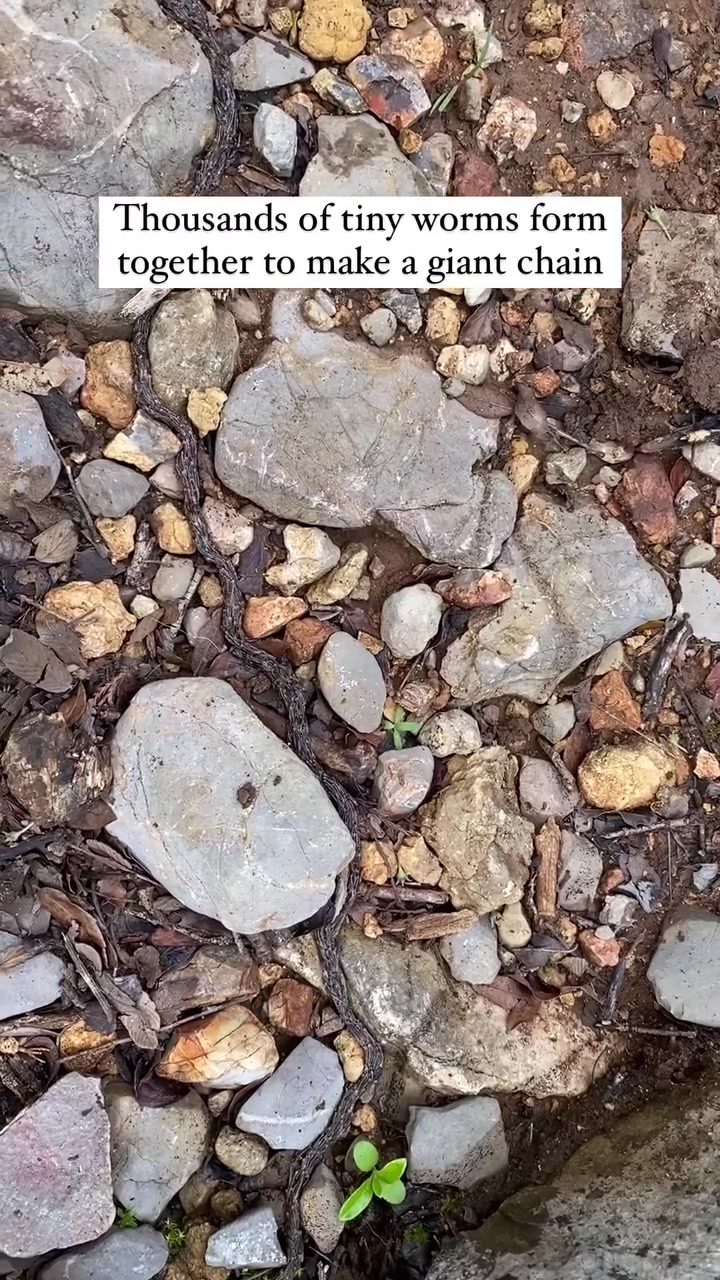
Worm Chain Formation
Worm chain formations, where thousands of tiny worms come together to create an elongated, chain-like structure, are a fascinating and intriguing natural phenomenon. This behavior, often observed outdoors near bodies of water, raises questions about the mechanisms behind such collective movements and their significance in the worm's ecosystem.
Why this matters
Understanding the behavior of worm chain formations is more than just a curiosity. It reveals insights into the complex social structures and survival strategies of earthworms, which are crucial for soil health and nutrient cycling. By learning about this behavior, we can better appreciate the intricate web of life and the critical roles that even the smallest organisms play in our environment.
Worm Chain Formation: A Closer Look
The Dynamics of Worm Chain Formation
Worm chain formations are a striking example of collective behavior in invertebrates. These formations can be found in various habitats, particularly near bodies of water and in moist soil. The worms, often too small to be noticed individually, form elongated chains that can stretch for several inches or even feet. This behavior is not just a visual spectacle but also a testament to the worms' ability to coordinate and move in unison.
Potential Mechanisms
The exact mechanisms behind worm chain formation are not fully understood, but several theories exist. One hypothesis suggests that the worms use chemical signals to communicate and coordinate their movements. Another theory posits that physical contact and touch sensitivity play a crucial role. These worms may be responding to environmental cues such as moisture levels, temperature, or the presence of predators.
Chemical Communication
Earthworms are known to release various chemical compounds that can influence their behavior. These compounds, often released through their mucus, can serve as signals to other worms. In the context of chain formation, these chemical signals might help worms align and move in a coordinated manner. This hypothesis is supported by the observation that worms often form chains in response to specific environmental triggers, such as changes in moisture or temperature.
Physical Contact and Tactile Sensitivity
Physical contact and tactile sensitivity are also likely to play a role in worm chain formation. Earthworms have sensitive receptors on their bodies that allow them to detect touch and movement. This sensitivity may enable them to respond to the movements of neighboring worms, leading to the formation of chains. The worms may use their bodies to "feel" the direction and speed of their neighbors, allowing them to move in unison.
The Significance of Worm Chain Formation
Ecosystem Roles
Earthworms, including those that form chains, are essential for soil health. They play a crucial role in nutrient cycling by breaking down organic matter and enhancing soil structure. The formation of chains might be a strategy to enhance their efficiency in nutrient cycling. By moving collectively, they can cover more ground and process more organic material, contributing to soil fertility and productivity.
Survival Strategies
Chain formation might also serve as a survival strategy. Worms are vulnerable to predators, and forming chains could be a way to confuse or deter predators. Additionally, the coordinated movement might help worms navigate through complex environments, such as dense vegetation or rocky terrain, more efficiently.
Research and Conservation
Understanding worm chain formation can inform conservation efforts. By appreciating the ecological importance of earthworms and their collective behaviors, conservationists can develop strategies to protect these essential organisms and their habitats. This knowledge can also guide land management practices, ensuring that soil health is maintained and ecosystems are preserved.
Practical Tips for Observing Worm Chain Formation
Observing worm chain formation can be a rewarding experience, offering a glimpse into the intricate world of these tiny creatures. Here are some tips for spotting and studying worm chain formations:
Where to Look
Worm chain formations are most commonly observed in moist, outdoor environments near bodies of water, such as streams, ponds, or marshes. They can also be found in damp soil, especially after rain. Look for them in areas with rich organic matter, such as compost piles, leaf litter, or garden beds.
When to Look
Worm chain formation can occur at any time, but it is often more visible in the early morning or after rainfall. During these times, the soil is moist, and the worms are more active. It is essential to move slowly and observe quietly to avoid disturbing the worms.
How to Observe
Use a magnifying glass or a pair of binoculars to get a closer look at the worms. You can also use a camera with a macro lens to capture detailed images. Be gentle and avoid touching the worms, as they are sensitive to disturbance. Observe from a distance and take notes on the behavior and movement patterns.
Important Takeaways
Worm chain formation is a remarkable example of collective behavior in nature, highlighting the complex and coordinated movements of earthworms. Understanding this behavior provides valuable insights into the ecological roles of earthworms and their significance in maintaining healthy ecosystems.
By observing and studying worm chain formations, we can deepen our appreciation for the intricate web of life and the critical roles that even the smallest organisms play. This knowledge can inform conservation efforts and land management practices, ensuring that these essential creatures and their habitats are protected.
Conclusion
Worm chain formations are a fascinating and intriguing natural phenomenon that offer a glimpse into the complex world of earthworms. By understanding the mechanisms behind this behavior and its ecological significance, we can better appreciate the intricate web of life and the critical roles that these tiny creatures play in our environment.
Questions readers ask
What triggers worm chain formations to occur?
Worm chain formations typically occur in response to environmental cues such as moisture, temperature changes, or disturbances in their habitat. These tiny worms in chains move together as a survival strategy to find more favorable conditions or to escape potential threats.
Why do worms form chains specifically?
Worms form chains to increase their collective mobility and efficiency. By linking together, they can move faster and cover more ground, which is beneficial for finding food, escaping predators, or relocating to better soil conditions.
How do worm chain formations benefit soil health and nutrient cycling?
Worm chain formations contribute to soil health by enhancing aeration and mixing of soil layers as the worms move through the earth. This activity facilitates the breakdown of organic matter and improves nutrient cycling, making essential minerals more accessible to plants.
What can observing these formations tell us about earthworm social behavior?
Observing worm chain formations provides insights into the social behaviors of earthworms, revealing their ability to communicate and coordinate movements. This collective behavior suggests a level of sophistication in their interactions, which can be further studied to understand their environmental adaptations and survival mechanisms.
Are worm chain formations common, and where are they usually seen?
While not always common, worm chain formations are often observed in moist environments, such as near bodies of water or after heavy rainfall. These conditions seem to stimulate the worms to form chains, making it a natural occurrence that can be noticed in various outdoor settings.
Why have worm chain videos gained popularity on social media platforms like Instagram?
Worm chain videos have gained traction on social media due to their visually striking and unusual nature. People are often amazed by the sight of thousands of tiny worms forming such intricate structures, leading to viral worm videos that spark curiosity and fascination.
Related deep dives
Similar reads based on topic and creator.




Recent articles
Fresh deep dives from the latest Reels we unpacked.




Comments
Be the first to comment.