The Hermes Sensei Loop: Autonomous AI Self-Improvement
The Hermes Sensei Loop is a sophisticated process designed to enable autonomous self-improvement in AI models. By employing a champion-challenger framework with holdout validation, feedback sweep, and a meticulous testing process, this loop ensures significant and sustainable enhancements. This method meticulously logs, verifies, scores, and tests each change, ultimately leading to improved model performance over time.
Context / Why This Matters
In the rapidly evolving world of AI, model improvement is crucial. The Hermes Sensei Loop addresses a critical need: how to continuously enhance AI models without succumbing to overfitting. Overfitting occurs when a model performs exceptionally well on training data but fails to generalize to new, unseen data. This is particularly problematic in AI, where the goal is to create models that can adapt and improve over time.
Main Discussion
The Hermes Sensei Loop operates through a series of well-defined steps, each serving a specific purpose in the model improvement process.
The Champion-Challenger Process
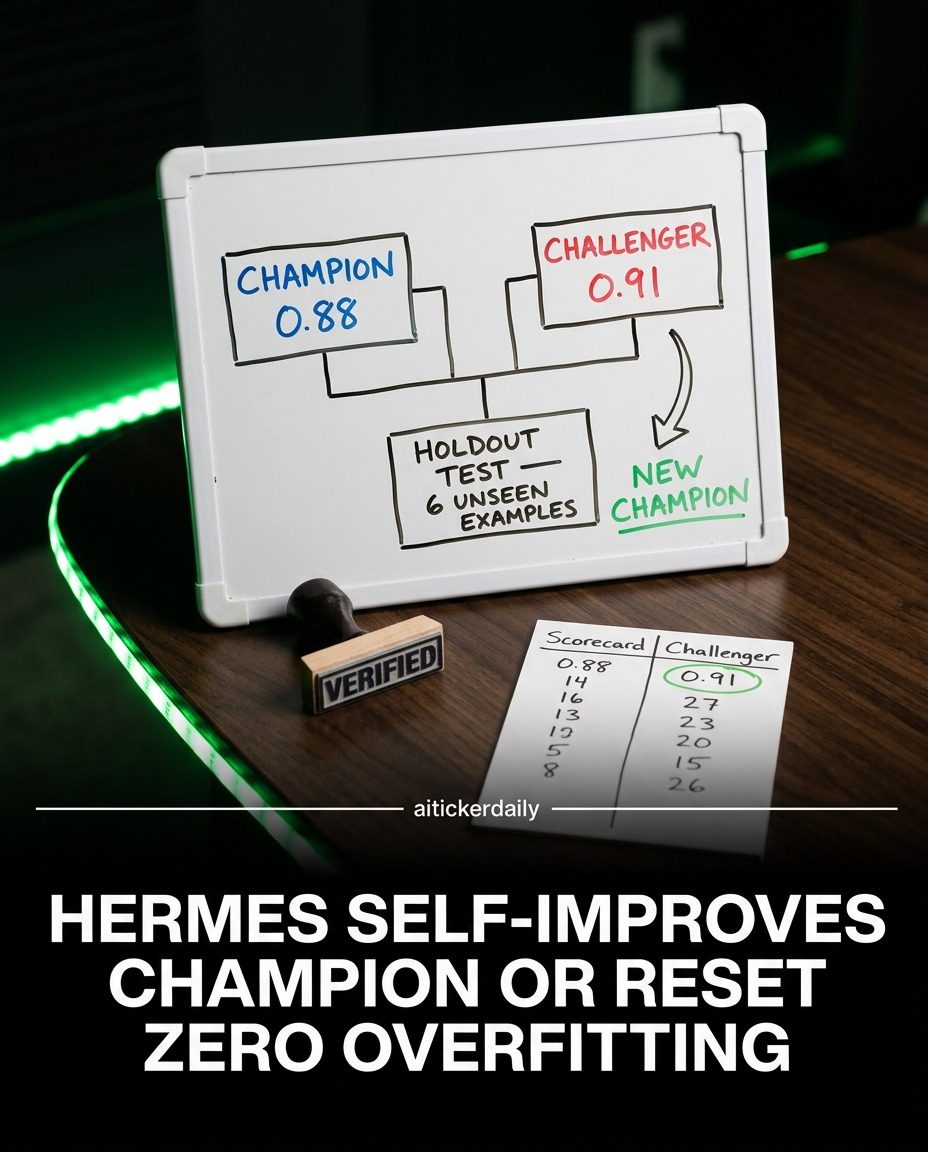
One of the core components of the Hermes Sensei Loop is the champion-challenger process. In this framework, the current best-performing model is designated as the "champion," while a new, improved model is the "challenger." The champion's performance is continuously evaluated against the challenger. This process ensures that only genuine improvements are accepted, preventing overfitting and ensuring that the model remains robust and adaptable.
Holdout Validation
Holdout validation is another essential aspect of the loop. This involves setting aside a portion of the data, known as the holdout set, which is not used during the training phase. The holdout set serves as an untested benchmark, allowing the model to be evaluated on unseen data. This rigorous testing helps identify whether the model is actually improving or simply memorizing the training data. By focusing on unseen examples, the holdout validation step ensures that the model's performance is genuinely enhanced.
Feedback Sweep and Continuous Improvement
The feedback sweep is a critical step in the Hermes Sensei Loop. It involves logging, verifying, scoring, and testing each change in the model. This systematic approach ensures that every modification is carefully scrutinized for its impact on performance. The feedback mechanism provides a detailed analysis of what works and what doesn't, allowing for continuous refinement and improvement. This iterative process helps in identifying and addressing specific issues, leading to a more robust and reliable model.
Avoiding Overfitting
Overfitting is a common pitfall in AI model training, where the model becomes too closely tailored to the training data and fails to generalize to new data. The Hermes Sensei Loop addresses this by emphasizing the importance of avoiding overfitting. The loop includes steps to freeze the baseline model and make incremental improvements, ensuring that the model does not become overly specialized to the training data. This approach helps in maintaining the model's ability to generalize and adapt to new, unseen data.
Practical Tips
Implementing the Hermes Sensei Loop in your AI projects can significantly enhance model performance. Here are some practical tips to help you get started:
Identify Key Metrics
Begin by identifying the key metrics that define success for your AI model. These metrics will serve as the basis for evaluating the performance of both the champion and challenger models. Ensure that these metrics are comprehensive and cover all relevant aspects of the model's performance.
Use a Holdout Set
Always set aside a portion of your data as a holdout set. This set should be separate from the training and validation data and should not be used during the training phase. Use the holdout set to evaluate the model's performance on unseen data, ensuring that the model is genuinely improving.
Gradual Improvements
Make incremental changes to the model and test them thoroughly. Focus on fixing one issue at a time and use the feedback sweep to evaluate the impact of each change. This gradual approach helps in maintaining the model's robustness and adaptability.
Monitor for Overfitting
Continuously monitor the model for signs of overfitting. If the model's performance on the training data is significantly better than on the holdout set, it may indicate overfitting. Take corrective measures by freezing the baseline model and making incremental improvements.
Important Takeaways
The Hermes Sensei Loop offers a structured and systematic approach to AI model improvement. By employing a champion-challenger process, holdout validation, and a feedback sweep, this loop ensures that models are continually refined and enhanced. This method not only prevents overfitting but also guarantees that the model's performance is genuinely improved. Implementing the Hermes Sensei Loop can significantly enhance the performance and reliability of AI models, making it an invaluable tool for anyone working in the field of AI.
Conclusion
The Hermes Sensei Loop represents a significant advancement in AI model training. By emphasizing continuous improvement, rigorous testing, and the prevention of overfitting, this method ensures that AI models remain robust, adaptable, and effective. Whether you're working on a small-scale project or a large-scale AI initiative, the Hermes Sensei Loop can help you achieve better results and stay ahead of the curve in the fast-moving world of AI.
Questions readers ask
How does the Hermes Sensei Loop prevent overfitting in AI models?
The Hermes Sensei Loop uses holdout validation to prevent overfitting. This technique involves setting aside a portion of the training data to test the model's performance independently. By doing so, it ensures that the model generalizes well to new, unseen data and doesn't just memorize the training set.
What is the role of the champion-challenger framework in the Hermes Sensei Loop?
The champion-challenger framework is a core component of the Hermes Sensei Loop. It involves having a current best-performing model (the champion) and a new model (the challenger) that competes to replace it. The challenger must outperform the champion in a series of rigorous tests before it can take its place, ensuring that only truly improved models are deployed.
What are the key steps involved in the Hermes Sensei Loop process?
The Hermes Sensei Loop consists of ten steps, including logging and verifying changes, scoring model performance, and conducting thorough testing. It starts with a baseline assessment, and proceeds through a structured feedback sweep, ensuring that each change is carefully evaluated and validated before any improvements are implemented in the AI model.
How does the Hermes Sensei Loop ensure continuous improvement in AI models?
The loop ensures continuous AI improvement by iterating through a structured process of testing and validating changes. Instead of making single, isolated improvements, it focuses on incremental enhancements that are proven to work before they are integrated into the model. This gradual, methodical approach leads to sustainable, long-term improvements.
What is the significance of the feedback sweep in the Hermes Sensei Loop?
The feedback sweep is a crucial part of the Hermes Sensei Loop, facilitating a rigorous evaluation of the new model (the challenger). It involves collecting and analyzing feedback from various sources, including performance metrics and user interactions. This process helps in identifying areas for improvement and ensures that only the most effective changes are implemented.
How is the performance of the AI model measured in the Hermes Sensei Loop?
The performance of an AI model in the Hermes Sensei Loop is measured through a combination of metrics and tests. The loop employs holdout validation to gauge the model's performance on unseen data, ensuring it generalizes well. Additionally, it uses a scoring mechanism to quantify improvements, making it clear whether the challenger outperforms the champion.
What happens if the challenger does not outperform the champion in the Loop?
If the challenger does not outperform the champion, it is discarded, and the champion remains in place. The loop then starts the process over, generating a new challenger to compete against the current champion. This ensures that only meaningful improvements are accepted, and the model continues to evolve effectively.
Recent articles
Fresh deep dives from the latest Reels we unpacked.




Comments
Be the first to comment.