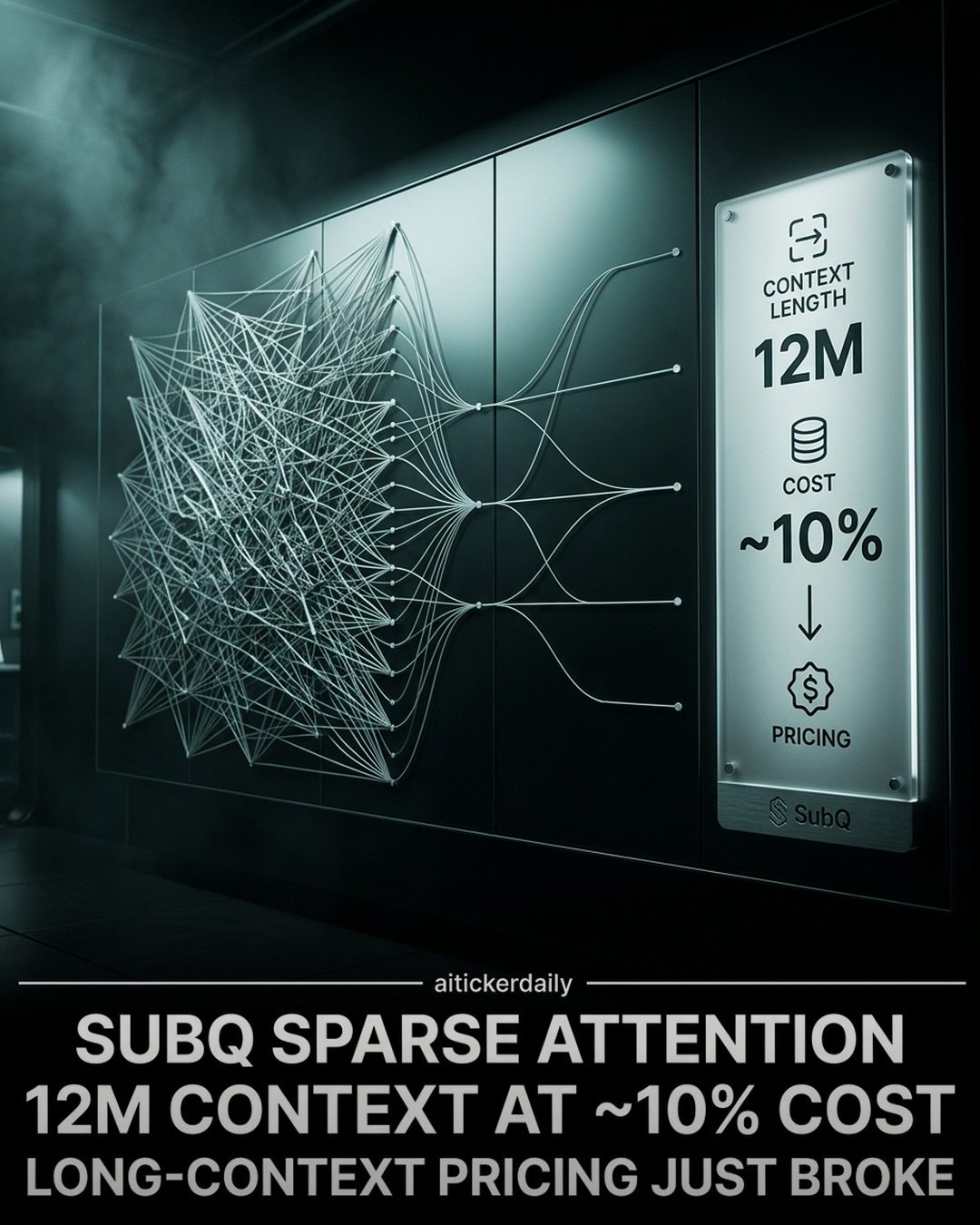
SubQ's Sparse Attention: Transforming AI Model Pricing and Context Length
Imagine an AI model that can process vast amounts of information with unprecedented efficiency and at a lower cost. This is precisely what SubQ, an innovative AI model, promises with its sparse attention mechanism. By reimagining how AI models handle long-context data, SubQ is set to redefine the economics of AI, making larger, more efficient models more accessible and cost-effective.
Why This Matters
The advent of AI models with sparse attention mechanisms signify a pivotal shift in how we approach long-context data. For years, AI models have relied on quadratic attention mechanisms, which compare each token with every other token in the sequence. This approach, while effective, has significant computational and cost implications, especially for long contexts. SubQ's sparse attention mechanism, however, scales attention based on relevant relationships rather than full pairwise token comparisons. This not only enhances throughput but also drastically reduces costs, marking a significant breakthrough in AI economics.
SubQ's Sparse Attention: A Paradigm Shift
Sub-Quadratic and Near Full-Length Retention
SubQ's claim to fame is its sub-quadratic and near full-length retention capabilities. Traditional AI models often struggle with long-context data due to the quadratic attention mechanism, which leads to high computational costs and latency. SubQ addresses this by focusing on relevant relationships within the data, effectively retaining near full-length information at a fraction of the cost. This shift allows for larger, more usable windows of context, enabling more efficient and accurate processing of extensive data sets.
Relevant Relationships vs. Full Pairwise Token Comparisons
At the core of SubQ's innovation is its approach to attention compute. Instead of comparing every token with every other token (full pairwise token comparisons), SubQ's sparse attention mechanism scales attention based on relevant relationships. This change in approach significantly alters the economics of long-context throughput. By focusing on what matters most, SubQ can process information more efficiently, reducing both computational load and cost.
Performance and Pricing Implications
If SubQ's performance holds up in independent tests, the implications for long-window inference pricing are profound. The cost of processing long-context data could see a massive reduction, potentially re-rating the pricing for long-window inference quickly. This shift could have ripple effects across various AI applications, making long-context data more accessible and affordable for a wider range of users and industries.
Architectural Implications and Broader Impact
Years of Vector Truth
The broader architectural argument is that many existing workflows, particularly those involving heavy retrieval and chunking, were designed to patch the limitations of quadratic attention mechanisms. Accuracy at full window, latency, and summarization loops were often necessary to work around these limits. SubQ's sparse attention mechanism could change this by providing a more direct and efficient way to handle long-context data, potentially rendering these patches obsolete.
Rebalancing Agent Design
The lower cost of long-context processing can rebalance agent design, shifting the focus from heavy retrieval orchestration back toward direct-context reasoning. This change could simplify many workflows, making them more efficient and cost-effective. While SubQ's sparse attention mechanism may not eliminate the need for Retrieval-Augmented Generation (RAG) entirely, it can significantly reduce the premium labs charge for window size alone, making long-context data more accessible.
Practical Implications for Builders and Users
Benchmarking Real-Dollar Cost
For builders and developers, the immediate question is how to benchmark real-dollar cost per completed task. As SubQ's sparse attention mechanism becomes more widely adopted, the pricing power around long context will weaken. This shift could move product differentiation up-stack to reliability and workflow fit, making it essential for developers to focus on these aspects to stay competitive.
Watching the Space Closely
The AI landscape is rapidly evolving, and it's crucial to stay updated on the latest developments. SubQ's sparse attention mechanism is a game-changer, and its impact on long-context pricing could be significant. Before committing to expensive long-context assumptions, it's wise to watch this space closely and stay informed about the latest advancements.
Important Takeaways
SubQ's sparse attention mechanism is a groundbreaking development in AI, offering a more efficient and cost-effective way to handle long-context data. This innovation could significantly alter the economics of AI, making long-context data more accessible and affordable. For builders and users, staying updated on these developments and focusing on reliability and workflow fit will be crucial for success in the evolving AI landscape.
Concluding Thoughts
As AI continues to evolve, innovations like SubQ's sparse attention mechanism will play a pivotal role in shaping the future of AI economics. By focusing on relevant relationships and scaling attention compute accordingly, SubQ offers a more efficient and cost-effective way to handle long-context data. The implications for various AI applications are profound, and staying informed about these developments will be essential for builders, developers, and users alike. Keep an eye on this rapidly evolving space, as it holds the key to the future of AI.
Questions readers ask
What is the SubQ AI Model and how does it differ from traditional AI models?
The SubQ AI Model is an innovative AI model that utilizes a sparse attention mechanism, unlike traditional models that use quadratic attention. This allows SubQ to process long-context data more efficiently, reducing costs and making it a more accessible option for users.
How does the sparse attention mechanism in the SubQ AI Model work?
The sparse attention mechanism in the SubQ AI Model reimagines how AI models handle long-context data. Instead of comparing each token with every other token, it selectively attends to relevant parts, enabling it to process large amounts of information more efficiently and at a lower cost.
What are the benefits of using the SubQ AI Model for processing long-context data?
The SubQ AI Model offers several benefits for processing long-context data, including reduced costs, increased efficiency, and the ability to handle vast amounts of information. This makes it a cost-effective solution for users who require large, powerful AI models.
How does the SubQ AI Model impact AI model pricing?
The SubQ AI Model's sparse attention mechanism significantly impacts AI model pricing by lowering costs. By reducing the need for extensive computational resources, the model offers a more affordable alternative, making powerful AI models more accessible to a broader range of users.
Can the SubQ AI Model handle the same context length as traditional models?
The SubQ AI Model can handle a full window of context, allowing it to process extensive data. The sparse attention mechanism enables it to manage this without the high computational costs typically associated with quadratic attention.
What are the implications of the SubQ AI Model for the economics of AI?
The SubQ AI Model represents a pivotal shift in AI model economics. Its efficiency and cost-effectiveness make it a game-changer, allowing for the development and deployment of more powerful AI models without the traditional financial barriers.
How does the SubQ AI Model's pricing compare to traditional AI models?
The SubQ AI Model's pricing is significantly lower than traditional AI models due to its sparse attention mechanism. This innovative approach reduces the computational resources needed, resulting in lower costs and making it a more attractive option for users.
Recent articles
Fresh deep dives from the latest Reels we unpacked.




Comments
Be the first to comment.