Nearly 30% of U.S. Workers Earn Less Than $20 per Hour
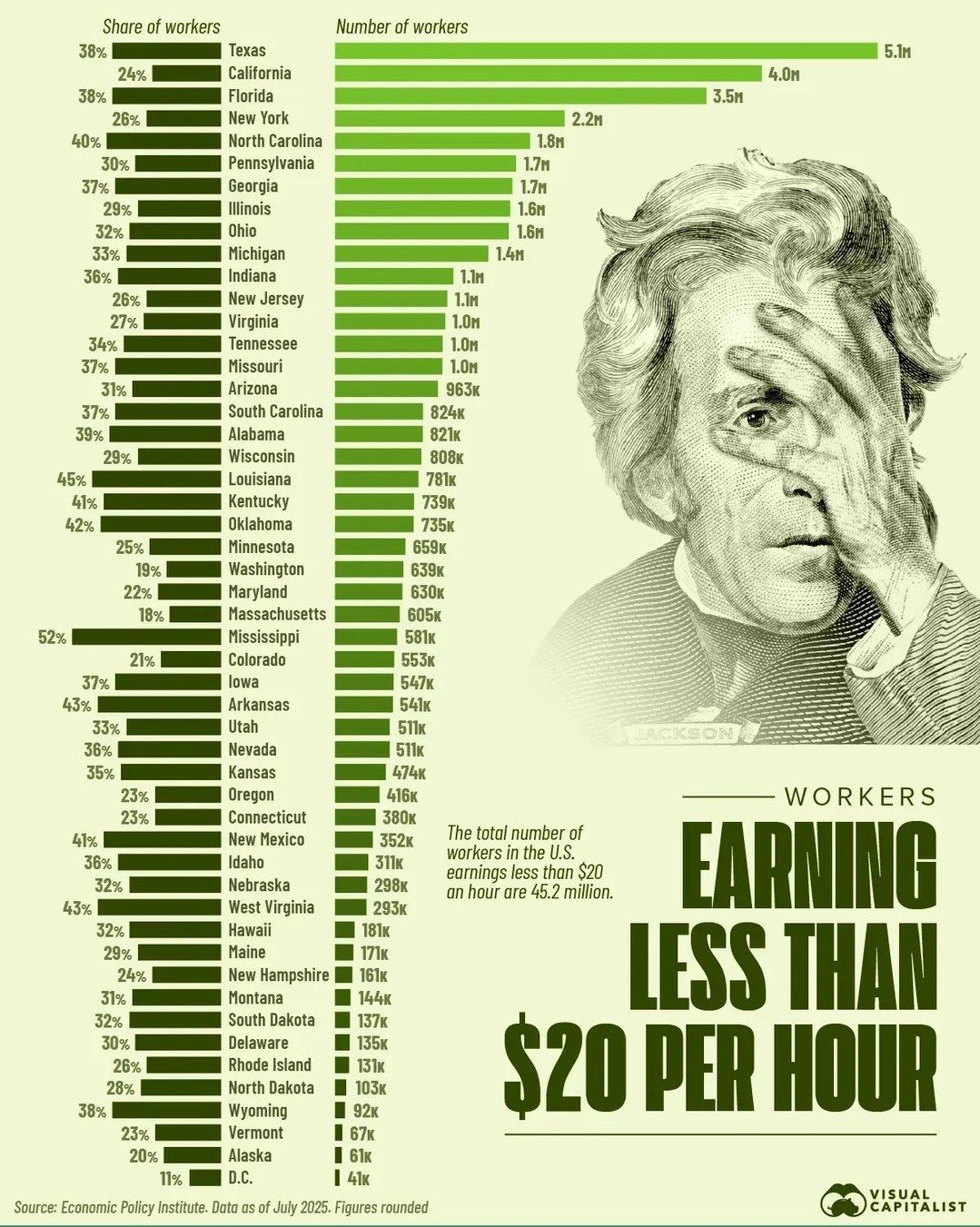
The landscape of hourly wages in the United States reveals a significant portion of workers earning less than $20 per hour. This wage threshold is a critical benchmark for understanding economic disparity and labor market conditions across different states. Notably, the data highlights that nearly 30% of U.S. workers fall below this hourly wage, with some states showing particularly high concentrations of low-wage earners.
Why This Matters
Understanding the distribution of low-wage workers is crucial for several reasons. It provides insights into the economic well-being of a significant segment of the population, influences policy discussions around minimum wage and labor regulations, and highlights areas where economic development and job creation efforts may be most needed.
State-by-State Breakdown
The data from the Economic Policy Institute as of July 2025 offers a detailed breakdown of the share of workers earning less than $20 per hour in each state. Here are some key observations:
Highest and Lowest Percentages
- Louisiana leads the nation with 45% of its workers earning less than $20 per hour. This is followed closely by Arkansas at 43%, Oklahoma at 42%, and Kentucky at 41%. These states have the highest percentages of workers in this wage bracket.
- New Hampshire has the lowest percentage, with only 17% of its workers earning less than $20 per hour. This is closely followed by Montana at 14%, Wyoming at 11%, and Hawaii at 11%.
Major Populous States
- Texas has the largest number of low-wage workers, with 5.1 million earning less than $20 per hour. This is significant given Texas's large population and economy.
- California, despite being one of the wealthiest states, has 24% of its workers earning less than $20 per hour. This highlights the economic disparities even within high-income states.
- New York and Pennsylvania each have 38% and 30% of their workers, respectively, earning less than $20 per hour.
Mid-Range States
- North Carolina and South Carolina both have high percentages of low-wage workers, with 40% and 39% respectively.
- Georgia, Oklahoma, Iowa and Connecticut each have between 37% and 39% of their workers earning less than $20 per hour.
- Mississippi has the highest share of low-wage workers, with 52% of its workers earning under $20 an hour. This is a stark indicator of the economic challenges faced by the state.
Regional Trends
The data also reveals regional trends:
- Southeastern States: States like Louisiana, Mississippi, and Arkansas tend to have higher percentages of low-wage workers. This region has historically had lower wages and higher poverty rates.
- Western and Northeastern States: States like New Hampshire, Wyoming, and Montana have some of the lowest percentages of low-wage workers. These states often have higher costs of living but also higher average wages.
- Midwestern States: States like Wisconsin and Minnesota have moderate percentages, indicating a mix of economic conditions. The data suggests that while some Midwestern states have higher wages, others still struggle with significant low-wage populations.
Total Number of Low-Wage Workers
The total number of workers in the U.S. earning less than $20 an hour is approximately 45.2 million. This figure underscores the prevalence of low-wage work and the need for policies and initiatives aimed at improving economic conditions for these workers.
Practical Tips for Understanding and Addressing Low-Wage Work
For policymakers, economists, and advocates seeking to address low-wage work, several practical steps can be taken:
Policy Interventions
- Minimum Wage Increases: Implementing and advocating for higher minimum wages can directly impact the earnings of low-wage workers. This is a contentious issue, but many studies show that modest increases can boost wages without significantly affecting employment.
- Earned Income Tax Credits (EITC): Expanding EITC programs can provide additional financial support to low-wage workers, helping to mitigate the impact of low wages.
- Access to Affordable Healthcare and Education: Improving access to healthcare and education can empower low-wage workers to pursue better-paying jobs and improve their long-term economic prospects.
Industry and Employer Initiatives
- Wage Transparency: Encouraging employers to be transparent about their wage structures can help workers negotiate better salaries and understand their worth in the job market.
- Skill Development Programs: Offering training and skill development programs can help low-wage workers acquire the skills needed to secure higher-paying jobs.
- Fair Scheduling and Benefits: Ensuring that low-wage workers have access to fair scheduling and benefits can improve their overall job satisfaction and economic stability.
Important Takeaways
- Diverse Economic Conditions: The data highlights the diverse economic conditions across different states, with some having a much higher percentage of low-wage workers than others.
- Policy and Industry Role: Policymakers and industry leaders play a crucial role in addressing low-wage work through policy interventions and industry initiatives.
- Regional Trends: Regional trends show that certain areas, particularly the Southeastern United States, have higher concentrations of low-wage workers.
Conclusion
The information on workers earning less than $20 per hour provides a snapshot of the economic realities faced by a significant portion of the U.S. workforce. It underscores the need for targeted interventions and policies aimed at improving wages and economic conditions for low-wage workers. By understanding the distribution and prevalence of low-wage work, we can better address the economic disparities that exist and work towards a more equitable labor market.
Questions readers ask
Which state has the highest percentage of workers earning less than $20 per hour?
Louisiana has the highest percentage of workers earning less than $20 per hour, with approximately 45% of its workforce in this wage bracket. This makes it a significant outlier compared to other states in the analysis.
What is the percentage of workers earning less than $20 per hour in New Hampshire?
New Hampshire has the lowest percentage of workers earning less than $20 per hour, at 17%. This indicates a relatively higher wage distribution in the state compared to the national average of 30%.
How does the percentage of low-wage workers in Mississippi compare to the national average?
Mississippi is among the states with the highest percentage of workers earning less than $20 per hour. While the exact figure is not provided, it is known that the national average is 30%, and Mississippi is notably higher.
Which state has the lowest percentage of workers earning less than $20 per hour in the United States?
New Hampshire has the lowest percentage of workers earning less than $20 per hour, at 17%. This means that 83% of workers in the state earn $20 per hour or more, making it one of the states with the highest wage distribution.
Are there significant disparities in hourly wages across different states in the U.S.?
Yes, there are significant disparities in hourly wages across different states. For instance, while 45% of workers in Louisiana earn less than $20 per hour, only 17% of workers in New Hampshire do. This highlights the varying economic conditions and labor market dynamics across the country.
How does North Carolina's wage data compare to the national average of workers earning less than $20 per hour?
North Carolina has a higher percentage of workers earning less than $20 per hour. While the exact figure is not specified, it is clear that the state is above the national average of 30%, indicating a notable presence of low-wage workers in its labor market.
What insights can be gained from the hourly wage statistics across different states?
Hourly wage statistics across different states provide valuable insights into economic disparities and labor market conditions. They can influence policy discussions around minimum wage and labor regulations, helping policymakers to address the needs of low-wage workers and improve overall economic conditions in various regions.
Recent articles
Fresh deep dives from the latest Reels we unpacked.




Comments
Be the first to comment.