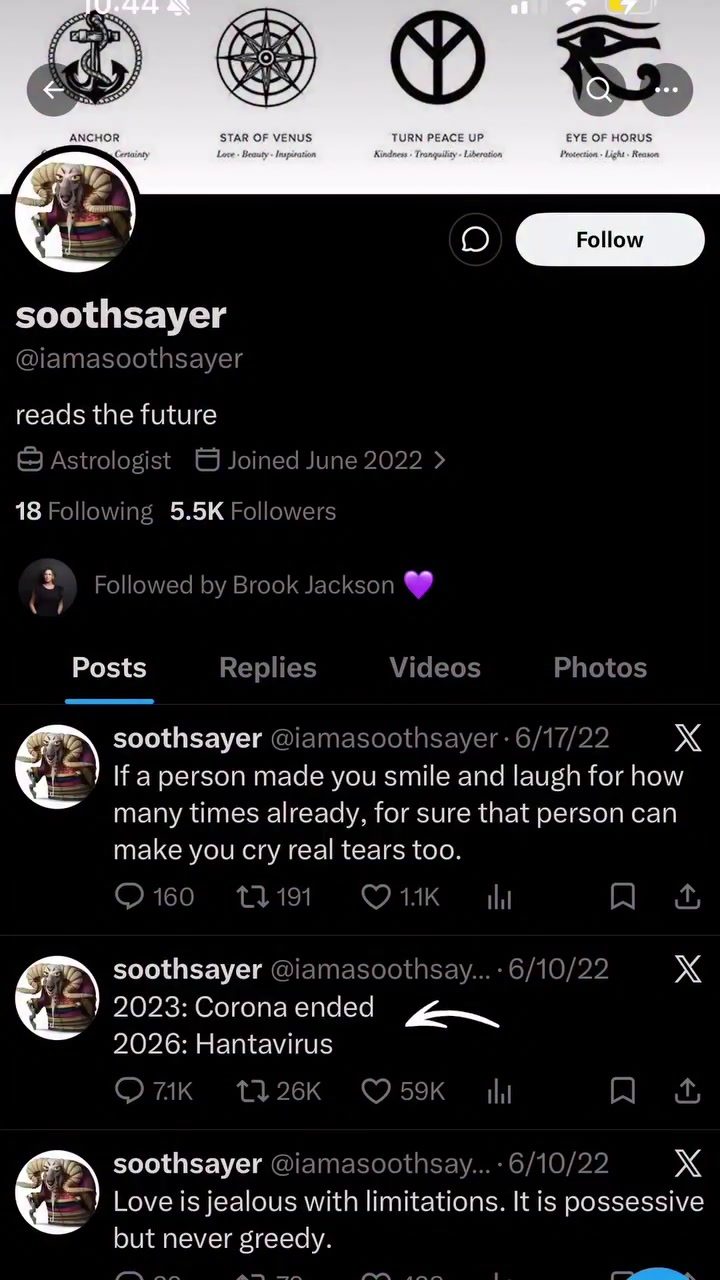
The Soothsayer Profile: Predictions, Hantavirus and Simulations
The mysterious Instagram profile 'soothsayer' has recently gained attention. The account, which identifies as an astrologist, has drawn significant interest for its accurate predictions about future events. The profile, under the username @iamasmoothsayer, has made striking claims about the end of the Corona virus and the emergence of Hantavirus.
Why This Matters
The rise of the 'soothsayer' profile underscores broader questions about predictive programming, government involvement in public perception, and the complex interplay between social media and societal narratives. The account's predictions—such as the end of the Corona pandemic and the emergence of Hantavirus—have gained traction for their perceived accuracy, sparking discussions about the nature of predicted events and their potential origins.
Decoding the Predictions
The End of Corona
One of the most attention-grabbing predictions made by the soothsayer is the end of the Corona virus. Predicted for 2023, this forecast has gained significant attention. The accuracy of this prediction, if it comes to pass, could raise important questions about how such knowledge is obtained and who might benefit from public knowledge of such events.
The Emergence of Hantavirus
Another notable prediction from the soothsayer account is the emergence of the Hantavirus in 2026. The mention of a specific virus, especially one that has historically been less prevalent in public discourse, adds a layer of intrigue. The idea that future viral outbreaks could be predicted years in advance raises critical questions about public health preparedness and the potential for predictive programming.
Theories and Speculations
Predictive Programming
The concept of predictive programming suggests that information about future events is deliberately seeded into the public consciousness. This idea is central to the debate around the soothsayer account. The theory posits that certain narratives are planted in media to condition the public to accept future events without surprise or resistance.
Government-Sponsored Psyops
The theory that these predictions are part of a government-sponsored psyop adds another layer of complexity. Proponents of this theory suggest that governments or powerful entities may use such accounts to manage public perception, creating new fears or distractions as needed. This notion implies a high level of coordination and control over narrative, much like a Hollywood script.
Simulation Theory
While the simulation theory is not explicitly mentioned in the post, it is worth considering in the context of these predictions. This theory suggests that our reality is a simulated construct, and that future events are pre-programmed. The soothsayer account, whether intentional or not, plays into this narrative by suggesting that events are part of a larger, pre-scripted narrative.
Practical Tips
Critical Thinking
When encountering predictions like those from the 'soothsayer' account, it's crucial to approach them with a critical eye. Assess the sources and motives behind the predictions. Consider whether the information is coming from a credible source or if it aligns with verified data.
Fact-Checking
Always verify information from multiple sources. Look for corroborating evidence and cross-reference predictions with reputable scientific and public health organizations. This practice can help distinguish between genuine predictions and potential manipulations.
Staying Informed
Staying informed about current events and public health issues is essential. Educate yourself on the latest research and developments related to viruses and pandemics. This knowledge can help you navigate predictions and public narratives more effectively.
Important Takeaways
Understanding Predictive Narratives
Recognize that predictive narratives can influence public perception and behavior. Understanding the mechanisms behind these narratives can help you make more informed decisions. Be aware of the potential for manipulation and stay vigilant about the sources of your information.
The Role of Social Media
Social media platforms play a significant role in shaping public narratives. They can amplify certain messages and create viral trends that influence public opinion. Be mindful of the information you consume and share on these platforms.
Questioning Authority
The real question, as raised by the original post, is why certain individuals or entities are allowed to hold such influence over public narratives. This question extends beyond the 'soothsayer' account and touches on broader issues of transparency and accountability in public communication.
Conclusion
The 'soothsayer' account and its predictions about the end of the Corona virus and the emergence of Hantavirus present a fascinating case study. This account is a conversation starter about predictive programming, government involvement, and the nature of reality. Whether you view these predictions as genuine foresight, government manipulation, or part of a larger simulation, it is clear that they have sparked important discussions.
Questions readers ask
What are the key predictions made by the 'soothsayer' Instagram account?
The 'soothsayer' account, run by an astrologist, has made several notable predictions, including the end of the Corona virus pandemic and the emergence of Hantavirus. These predictions have garnered significant attention due to their perceived accuracy and timing.
How has the 'soothsayer' account influenced public discussions?
The 'soothsayer' profile has sparked conversations about predictive programming, the role of governments in shaping public narratives, and the impact of social media on societal perceptions. The account's followers often discuss the potential implications of these predictions on future events.
What is predictive programming, and how does it relate to the 'soothsayer' predictions?
Predictive programming refers to the subtle embedding of ideas or expectations about future events in media and cultural narratives. The 'soothsayer' account's predictions have been analyzed through this lens, with some viewers speculating about the broader societal influences at play.
How can I stay updated on the new predictions from the 'soothsayer' account?
To stay updated on the latest predictions from the 'soothsayer' account, follow @iamasmoothsayer on Instagram. The account regularly posts new predictions and insights, often accompanied by detailed explanations and astrological analyses.
What is Hantavirus, and why has it been mentioned in the 'soothsayer's predictions?
Hantavirus is a family of viruses that can cause serious diseases in humans, including Hantavirus Pulmonary Syndrome (HPS). It is typically transmitted through rodent droppings or urine. The 'soothsayer' account has predicted the emergence of Hantavirus, linking it to broader discussions about health and safety.
How do the 'soothsayer's predictions relate to government involvement in public perception?
The 'soothsayer' account has raised questions about whether government agencies or other influential entities might be using predictive programming to shape public perception and prepare society for future events, such as the emergence of new viral threats.
What methods does the 'soothsayer' use to predict future events?
The 'soothsayer' uses astrology as the primary method for predicting future events. By analyzing planetary movements and celestial patterns, the account claims to gain insights into upcoming trends and significant occurrences, which are then shared with followers on Instagram.
Recent articles
Fresh deep dives from the latest Reels we unpacked.




Comments
Be the first to comment.