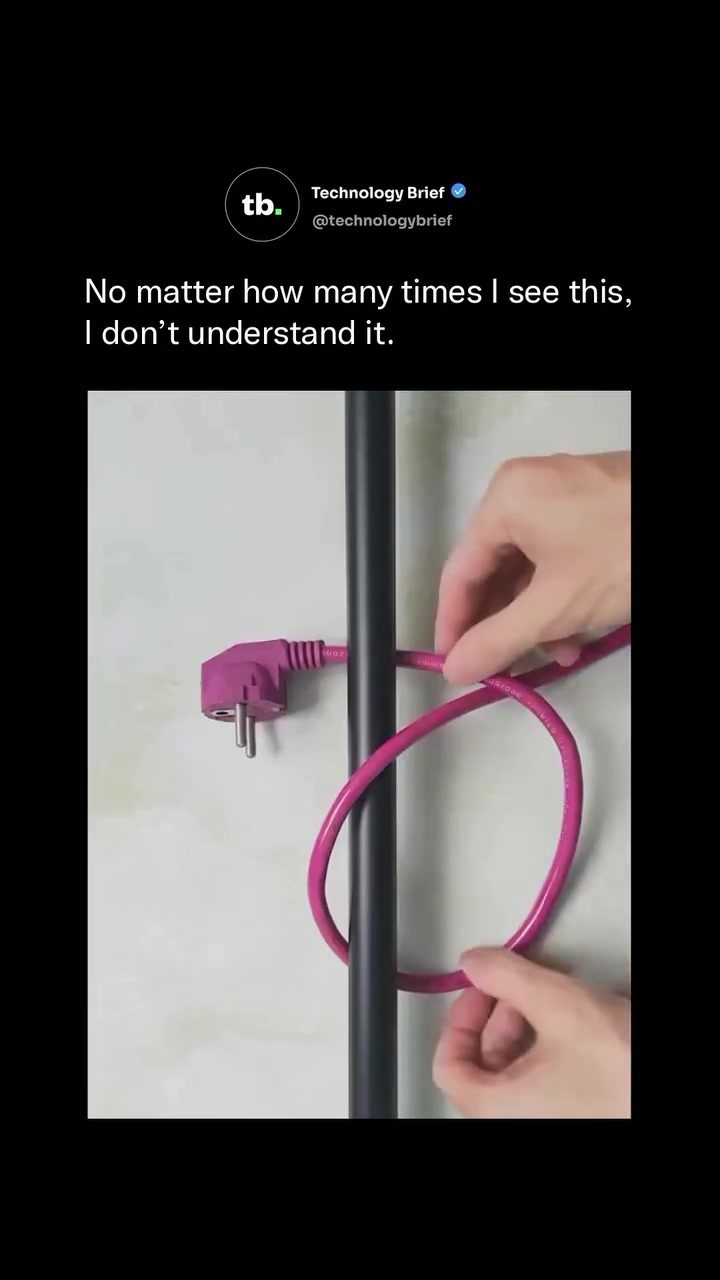
Optical Illusions with Power Cords
Optical illusions have a way of bending our perception and challenging our understanding of reality. One such captivating illusion involves a power cord and a metal pole, creating a scenario that seems to defy the laws of physics. This illusion is more than just a visual trick; it's rooted in the fascinating field of knot theory, a branch of mathematics that delves into the complexities of tangling and untangling loops.
Context / Why This Matters
Understanding this optical illusion is not just about marveling at a visual trick, but about grasping deeper concepts in knot theory and our own cognitive biases.
Cognitive Biases and Illusions
Our brains are wired to interpret what we see in a certain way, but the power cord and pole illusion showcases how easily we can be tricked. The human intuition often treats any complex tangle as a genuine knot, which can lead to misunderstandings and misinterpretations. But this illusion demonstrates that complex tangles can be simple to undo.
Everyday Application
This concept is more than just a curiosity; it applies to everyday scenarios. Imagine untangling headphones, cables, or any other twisted loops. The same principles used to untangle the power cord can make your daily tasks easier. But that’s not all: the principles behind knot theory also extend to fields like biology, computer science, and even DNA research.
Main Discussion
The Intriguing Visual Trick
The illusion begins with a power cord looping around a metal pole in a way that appears impossible to unravel. On first glance, it looks like the cord is solidly locked in place. But the secret lies in the arrangement of the loops. By pulling them through in a specific sequence, the entire tangle unravels effortlessly. The scissors sitting nearby are a deliberate red herring, reinforcing the idea that cutting is unnecessary.
The Mathematical Foundation
The concept at the heart of this trick is what mathematicians refer to as an "unknot." An unknotted loop has no true topological knot structure and can be freed without cutting. This is a fundamental concept in knot theory, a field that studies how closed loops can be tangled, deformed, and untangled.
To systematically determine if a messy-looking loop is actually free, mathematicians use a set of moves called Reidemeister moves. These moves help in understanding the topology of knots, revealing whether a complex tangle is truly locked or merely an unknot in disguise.
Human Intuition vs. Mathematical Reality
The brain's struggle with such illusions highlights a deeper issue: our intuition often treats any complex tangle as a genuine knot. In reality, the number of crossings in a loop tells you very little about whether it is actually locked. A cord with dozens of twists can dissolve instantly with the right handling, while a simple-looking two-crossing knot can hold firm under serious force.
The Illusion Unveiled
The beauty of this illusion lies in its simplicity. The power cord and pole setup is a visual demonstration of a mathematical concept that defies our intuition. By manipulating the loops in the correct sequence, the illusion is exposed as a clever arrangement rather than a genuine knot.
Practical Tips
Untangling in Real Life
Understanding this illusion can make untangling everyday items like headphones or cables much easier. Here are some practical tips:
- Observe the Tangles: Before attempting to untangle, take a moment to observe the arrangement of the loops. Identify key points where the loops intersect and start from there.
- Use Systematic Moves: Apply the principles of Reidemeister moves to simplify the tangle. This involves carefully pulling and twisting the loops in a specific sequence.
- Avoid Cutting: Remember, cutting is often unnecessary. The key is to find the correct sequence and method to unravel the loops.
Teaching the Concept
When teaching this concept, be patient. The human brain naturally finds it difficult to grasp the idea that a seemingly complex tangle can be simple. Use visual aids and demonstrations to illustrate the unraveling process. Encourage hands-on practice to reinforce the idea that the loops are not truly locked.
Engaging with the Audience
When sharing this concept, encourage others to try it out themselves. Seeing the illusion firsthand can be a powerful learning experience. Provide visual aids and walk through the process step-by-step, allowing others to follow along and experiment with the untangling process.
Important Takeaways
- Perception vs. Reality: The illusion shows that our perception of tangles does not always align with reality. What seems impossible can often be easily untangled with the right approach.
- Mathematical Foundations: The concept is rooted in knot theory, which helps understand the topology of knots and untangled loops.
- Practical Applications: The principles can be applied to everyday tasks, making untangling cables and other loops more manageable.
Conclusion
Optical illusions like the power cord and pole trick offer more than just visual entertainment; they provide a gateway into complex mathematical concepts and cognitive biases. By exploring the principles behind this illusion, we gain a deeper appreciation for the intricacies of knot theory and our own perceptual limitations.
The power cord and pole illusion is a testament to the ingenuity of human thought and the beauty of mathematical principles. Whether you're a math enthusiast or just someone who enjoys a good puzzle, this illusion offers a fascinating journey into the world of knots and perception.
Questions readers ask
What is the power cord illusion and how does it work?
The power cord illusion involves looping a power cord around a pole in a specific way to create a visual trick. It looks incredibly tangled, but this illusion is based on knot theory, which shows that sometimes what appears complicated is actually quite simple.
How do I perform the power cord illusion with a pole?
To perform this illusion, start by looping the power cord around the pole in a specific pattern. Make sure the cord is looped in a way that creates a visual confusion. When done correctly, it will appear as though the cord is deeply tangled, even though it can be easily untangled.
What is knot theory and how does it relate to power cords?
Knot theory is a branch of mathematics that deals with equations that cannot be untangled. In the case of power cords, knot theory helps explain how a seemingly complex tangle can often be untangled with minimal effort.
Why do power cords appear more tangled than they are?
Power cords often appear more tangled due to the way our brains process visual information. This optical illusion leverages our cognitive biases, making us perceive a simple loop as a complex tangle. By understanding the pattern, it can be easily untangled.
Can anyone perform the power cord illusion?
Yes, this trick can be performed by anyone with a power cord and a pole. However, it does require a bit of practice to loop the cord in the correct sequence. It's a great way to visualize and understand the concepts of knot theory in a practical way.
How do mathematicians use optical illusions with power cords?
Mathematicians use these optical illusions as a practical demonstration of knot theory. The way the power cord tangles and untangles provides a real-world application of complex mathematical concepts, making it easier to grasp the fundamental principles.
What can the power cord illusion teach us about our perception?
The power cord illusion demonstrates how our brains can be tricked by visual cues. It highlights the gap between what we see and the reality of the situation, providing insight into our cognitive biases and how they can affect our understanding of the world.
Related deep dives
Similar reads based on topic and creator.




Recent articles
Fresh deep dives from the latest Reels we unpacked.




Comments
Be the first to comment.