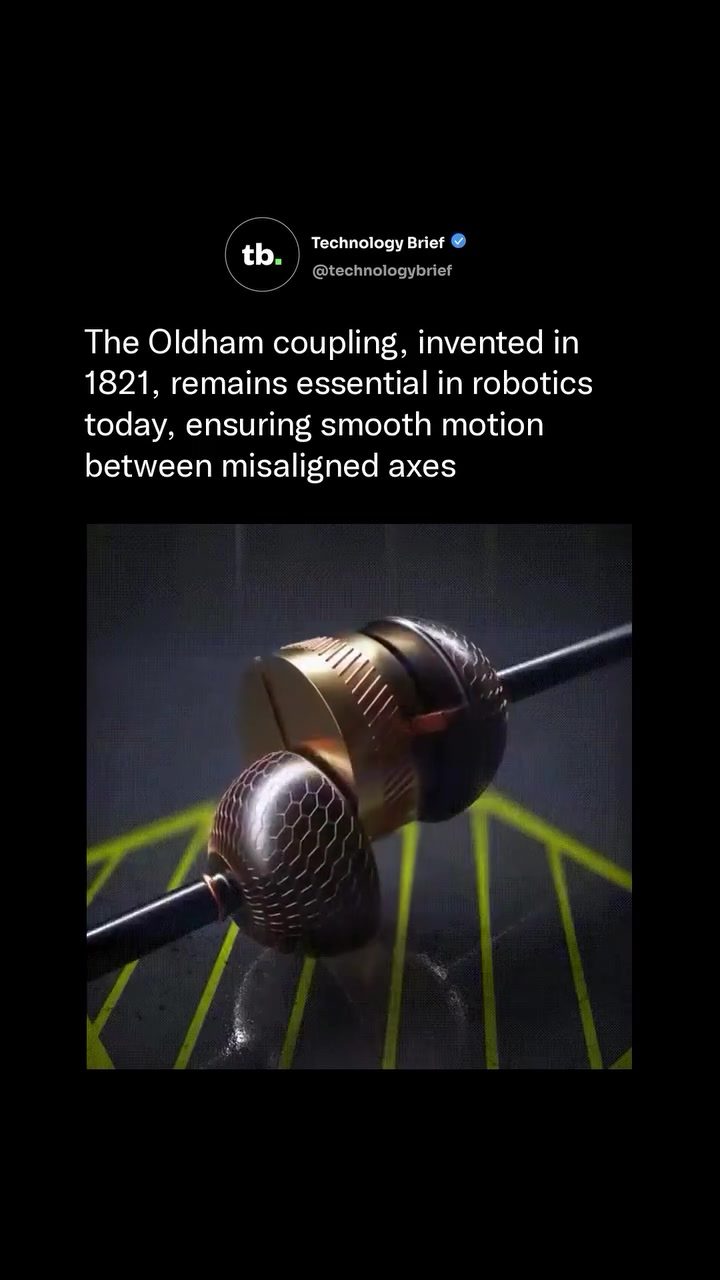
The Oldham Coupling: A Timeless Mechanical Solution
The Oldham coupling is a mechanical device with a rich history and enduring relevance in modern engineering, particularly in robotics. Invented in 1821 by Irish engineer John Oldham, this three-piece mechanical coupling consists of two outer hubs and a sliding center disc. This design allows two parallel shafts to rotate in sync, even when their axes are slightly misaligned. The center disc absorbs the offset, sliding back and forth with every rotation to ensure both shafts turn at the exact same speed without bending or stressing them.
Context / Why this Matters
The Oldham coupling is more than just a historical artifact; it remains a critical component in various industries today. Originally designed for textile machinery, its ability to solve misalignment problems without adding backlash or vibration quickly made it indispensable in other sectors. Today, it is a standard component in CNC machines, medical devices, pumps, and robotics. In these applications, precise and smooth motion between connected shafts is crucial, making the Oldham coupling an essential tool.
Main Discussion
The Inventor and Its Original Design
John Oldham's invention was a breakthrough in mechanical engineering. The coupling's simplicity—comprising just three parts and no fasteners—is one of its greatest strengths. The design effectively handles what rigid couplings cannot, making it a staple in various mechanical systems. The core design has remained essentially unchanged since its patent in 1821, a testament to its effectiveness and reliability.
How It Works
The Oldham coupling operates by allowing the center disc to slide back and forth, absorbing any misalignments between the two shafts. This sliding action ensures that both shafts rotate at the same speed, regardless of their axial offset. The motion is smooth and precise, which is particularly important in applications where vibration or backlash could be detrimental. Unlike rigid couplings, the Oldham coupling does not add any additional stress or wear to the shafts, making it a durable and long-lasting solution.
Applications in Modern Engineering
The Oldham coupling's versatility makes it suitable for a wide range of applications. In CNC machines, it ensures precise and smooth motion, which is crucial for the accuracy of the machining process. In medical devices, it helps in maintaining the precision and reliability of mechanical components, which is essential for patient safety. Pumps and other fluid-handling equipment benefit from the Oldham coupling's ability to handle misalignments, ensuring smooth operation and reducing the risk of mechanical failures.
Practical Tips
When working with Oldham couplings, there are a few practical tips to keep in mind:
-
Alignment: While the Oldham coupling can handle some misalignment, it is still essential to ensure that the shafts are as closely aligned as possible. This will help to extend the life of the coupling and improve its performance.
-
Maintenance: Regular maintenance is crucial to keep the coupling in good working condition. Check for any signs of wear or damage, and lubricate the center disc as needed to ensure smooth operation.
-
Material Selection: Choose the right materials for the coupling based on the specific application. For example, in high-temperature environments, consider using materials that can withstand the heat without degrading.
-
Installation: Proper installation is key to the performance of the coupling. Ensure that the coupling is installed correctly, with the center disc aligned between the two shafts. This will help to ensure smooth and efficient operation.
Important Takeaways
The Oldham coupling, despite being over 200 years old, continues to be an essential component in modern engineering. Its simplicity, reliability, and effectiveness in handling misalignments make it a valuable tool in various industries. From CNC machines to medical devices, the Oldham coupling plays a crucial role in ensuring smooth and precise motion.
Conclusion
The Oldham coupling's enduring relevance is a testament to its design and functionality. Its ability to handle misaligned shafts without adding backlash or vibration makes it an indispensable component in various mechanical systems. By understanding its design, applications, and maintenance requirements, one can effectively use the Oldham coupling to achieve precise and reliable motion in their engineering projects.
Questions readers ask
What are the main components of an Oldham coupling?
An Oldham coupling consists of three main parts: two outer hubs and a central sliding disc. The hubs connect to the shafts, while the disc accommodates any misalignment between them, ensuring smooth and synchronous rotation.
How does an Oldham coupling handle shaft misalignment?
The sliding center disc of an Oldham coupling absorbs any offset between the shafts. This allows the shafts to rotate at the same speed without causing excessive stress or bending, even when they are slightly misaligned.
Who invented the Oldham coupling and when?
The Oldham coupling was invented by John Oldham, an Irish engineer, in 1821. Although originally designed for textile machinery, it has found wide-ranging applications and benefits in modern industries, notably in robotics and precision engineering.
Why is the Oldham coupling important for robotics?
In robotics, the Oldham coupling plays a vital role in ensuring smooth and precise motion. It allows misaligned shafts to rotate synchronously, which is crucial for the accurate and reliable operation of robotic systems, particularly in tasks requiring high precision.
Can an Oldham coupling be used in applications other than robotics?
Yes, while the Oldham coupling is particularly beneficial in robotics, its uses extend to other fields. It is utilized in various industries where precise motion control is required, such as automotive, aerospace, manufacturing, and other precision engineering applications.
How does an Oldham coupling differ from other mechanical couplings?
Unlike some other mechanical couplings, the Oldham coupling is designed to handle parallel misalignment between shafts. Its unique design with a sliding center disc allows it to accommodate this misalignment while ensuring synchronous rotation, making it ideal for applications where shaft alignment is challenging to maintain.
What are the advantages of using an Oldham coupling in precision engineering?
Oldham couplings offer several advantages in precision engineering, including the ability to compensate for shaft misalignment, reduce stress and wear on components, and maintain synchronous rotation. These features contribute to the overall efficiency, accuracy, and lifespan of the mechanical systems.
Recent articles
Fresh deep dives from the latest Reels we unpacked.




Comments
Be the first to comment.